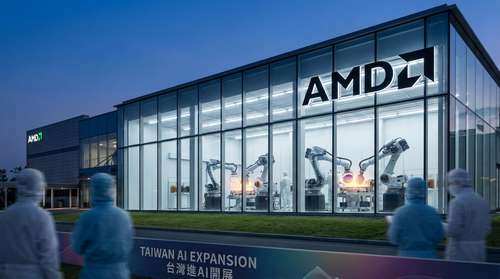
The battle for data center supremacy just entered a new era. In a move that fundamentally reshapes the AI chip market 2026 landscape, Advanced Micro Devices has laid down its most aggressive marker yet. During the highly anticipated Lisa Su Taiwan announcement today, the chief executive revealed a landmark AMD $10 billion investment spread across the island's semiconductor ecosystem. The capital injection is explicitly designed to scale manufacturing and advanced semiconductor packaging for the company's next-generation processors. As artificial intelligence models grow exponentially more complex, the demand for raw compute power is outpacing supply, pushing the ongoing AMD vs Nvidia AI rivalry into overdrive.
Accelerating Advanced Semiconductor Packaging
To meet unprecedented AI infrastructure growth, AMD is deepening its ties with local manufacturing giants rather than building its own semiconductor fabs. A significant portion of this capital will accelerate the development of industry-leading Elevated Fanout Bridge (EFB) 2.5D packaging. By partnering with heavyweights like ASE Technology Holding, Siliconware Precision Industries (SPIL), and PTI, the chipmaker aims to solve one of the biggest bottlenecks in modern computing: power efficiency and interconnect bandwidth.
Traditional monolithic chip designs simply cannot handle the thermal constraints of modern data centers. The shift toward complex chiplet architectures requires flawless integration at microscopic levels. This new EFB architecture allows processors to communicate faster while drawing significantly less power. AMD also confirmed it achieved a major industry milestone with PTI by qualifying the first 2.5D panel-based EFB technology. This critical engineering leap translates into tangible performance-per-watt gains for cloud providers operating under strict thermal and cooling limits.
Enter the AMD EPYC Venice and Helios Platform
At the heart of this massive manufacturing push is the 6th Gen AMD EPYC Venice processor. Built on Taiwan Semiconductor Manufacturing Co.'s (TSMC) bleeding-edge 2-nanometer process technology, Venice marks a historic milestone for both companies. It is the first high-performance computing product in the semiconductor industry to enter volume production on the 2nm node, giving AMD a distinct process advantage over competitors still relying on older architectures.
The Helios Rack-Scale Vision
Processors alone aren't enough to challenge incumbent monopolies. The real endgame for this funding is bringing the AMD Helios rack-scale platform to market in massive volumes. Helios integrates the new Venice CPUs alongside the formidable AMD Instinct MI450X accelerators, creating a unified, liquid-cooled system capable of multi-gigawatt deployments.
Expected to roll out in the second half of 2026, Helios is designed specifically for frontier-scale AI training and inference workflows. The industry is currently experiencing a massive shift toward Agentic AI workflows, where interconnected intelligent agents autonomously drive complex tasks. These advanced deployments require sophisticated orchestration between the GPU and the CPU. The pairing of EPYC Venice and Instinct MI450X ensures that memory bottlenecks are minimized during these intensive multi-agent operations. Furthermore, instead of locking customers into proprietary networks, the system leverages open-standard interconnects like UALink. This provides enterprise customers and hyperscalers a highly scalable, flexible alternative to closed networking architectures.
Redefining the AMD vs Nvidia AI Rivalry
For the past three years, Nvidia has maintained a formidable stranglehold on enterprise AI hardware. However, the dynamics of the AI chip market 2026 are rapidly shifting from individual GPU sales to fully integrated, turnkey rack-scale solutions. AMD's strategy directly attacks this vector. By pouring billions into the broader supply chain—including system builders like Wistron, Wiwynn, Sanmina, and Inventec—AMD guarantees that when Helios ships, the assembly and testing capacity will be fully prepped to meet massive hyperscaler demand.
During today's presentation, Dr. Su emphasized this collaborative approach. 'As AI adoption accelerates, our global customers are rapidly scaling AI infrastructure to meet growing compute demand,' she noted. She stressed that combining the company's high-performance silicon with Taiwan's specialized ecosystem enables faster, more efficient deployment of these massive systems. The AMD Instinct MI450X accelerators specifically target the performance metrics required to go head-to-head with Nvidia's next-generation architectures, ensuring the performance delta continues to shrink.
Securing the Supply Chain for Future AI Infrastructure Growth
While today's capital commitment focuses heavily on Asian partners, it represents a crucial pillar of a broader global diversification strategy. AMD confirmed that while the initial volume production for 2nm Venice processors is ramping up in Hsinchu, future phases will expand manufacturing footprints, including planned production at TSMC's expanding Arizona fabrication plants.
The financial magnitude of this move cannot be overstated. Committing a massive AMD $10 billion investment strictly to ecosystem and infrastructure enhancements—without building a single proprietary fab—demonstrates the sheer scale of the modern AI economy. It guarantees priority access to the highly constrained advanced semiconductor packaging capacity that dictates exactly how many AI accelerators can actually make it to market. By locking down these critical supply chain nodes now, AMD is ensuring it has the sheer volume necessary to satisfy the explosive AI compute demand over the next several years. For enterprise buyers, government computing initiatives, and major cloud providers, this massive expansion signals a healthy, aggressively competitive market where rapid innovation thrives on fierce rivalry.