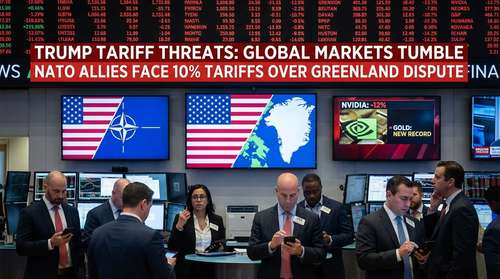
U.S. and international markets faced a sharp downturn on Tuesday, January 20, 2026, as investors reacted to President Trump’s sudden escalation of trade tensions with key European allies. The stock market crash today saw major indices, including the S&P 500 and Nasdaq, plummet by nearly 2% following the President's announcement of a proposed 10% import tax on eight NATO nations. The sell-off was triggered by a deepening standoff over the U.S. administration's renewed efforts to purchase Greenland, a move that has rattled global diplomatic relations and sent shockwaves through the financial world.
Stock Market Crash Today: Wall Street Reacts to Trade War Fears
The trading session opened with significant volatility as traders digested the implications of the new US trade policy shift. By midday, the Dow Jones Industrial Average had shed over 800 points, while the tech-heavy Nasdaq Composite led the decline. The uncertainty surrounding the Trump NATO tariffs 2026 has reignited fears of a trans-Atlantic trade war that could disrupt global supply chains already strained by geopolitical friction.
Tech giants were among the hardest hit, with the Nvidia stock plunge serving as a bellwether for the sector. Shares of the AI chipmaker dropped nearly 6% as analysts warned that the proposed tariffs on European partners—specifically the Netherlands and Germany, key players in the semiconductor equipment supply chain—could hamper production and inflate costs. "The market hates uncertainty, and a multi-front trade dispute with our closest military allies is the definition of uncertainty," noted a senior strategist at Morgan Stanley.
Greenland Trade Dispute: The 8-Nation Tariff List
The catalyst for the market rout was a series of posts on Truth Social where President Trump explicitly linked the tariffs to the ongoing Greenland trade dispute. Frustrated by Denmark's refusal to entertain purchase offers for the semi-autonomous territory, the President threatened to impose a 10% levy starting February 1 on imports from Denmark and seven supporting nations: Norway, Sweden, France, Germany, the United Kingdom, the Netherlands, and Finland. He warned that these tariffs could escalate to 25% by June 1 if a deal for the territory is not reached.
"World Peace is at stake! China and Russia want Greenland, and there is not a thing that Denmark can do about it," the President wrote, framing the acquisition as a critical national security imperative. The inclusion of major economies like the UK and Germany has broadened the conflict from a bilateral dispute into a NATO-wide crisis, raising questions about the future cohesion of the alliance.
Gold Prices Record 2026 Highs as Investors Flee Risk
As equities tumbled, safe-haven assets experienced a massive inflow of capital. Gold prices record 2026 highs were set during early European trading, with the precious metal surging past the $4,700 per ounce mark. Silver also saw significant gains, rising 4% as institutional investors hedged against the possibility of prolonged economic instability.
The flight to safety extends beyond commodities. U.S. Treasury yields compressed as bond prices rallied, signaling that the market is pricing in a potential economic slowdown resulting from the new trade barriers. Analysts predict that if the tariffs are implemented next month, the inflationary pressure could complicate the Federal Reserve's rate path for the remainder of the year.
Davos World Economic Forum News: Tension Grips Switzerland
The timing of the announcement has cast a long shadow over the ongoing Davos World Economic Forum news. With global leaders, including President Trump himself, currently gathered in Switzerland for the annual meeting, the atmosphere is reportedly tense. The forum's theme, "A Spirit of Dialogue," stands in stark contrast to the aggressive trade rhetoric emerging from Washington.
European delegates at Davos were reportedly scrambling to coordinate a unified response. Sources indicate that emergency meetings have been called between the targeted nations to discuss potential countermeasures, which could include reciprocal tariffs on U.S. agricultural and industrial goods. The standoff over Greenland has effectively hijacked the agenda at Davos, shifting focus from climate change and AI safety to the immediate threat of a fractured Western alliance.
What’s Next for Investors?
Market watchers advise caution in the coming days. The volatility is expected to persist until there is clarity on whether the tariffs will be enacted or if they are a negotiating tactic. For now, the combination of the Greenland trade dispute and the broader Trump NATO tariffs 2026 narrative suggests that defensive sectors and commodities may continue to outperform growth stocks in the short term.