
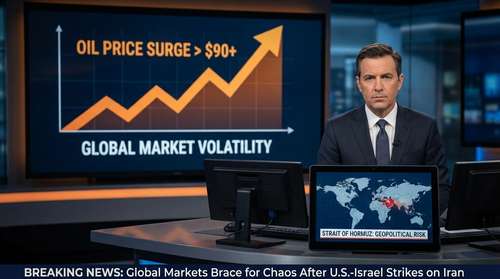
Global energy markets are on high alert this weekend as traders and analysts scramble to assess the fallout from a massive, coordinated military offensive launched by the United States and Israel against Iranian infrastructure early Saturday. With Brent crude news already dominating headlines after closing at a seven-month high of $72.87 on Friday, the unprecedented scale of the airstrikes—dubbed "Operation Epic Fury" by the Pentagon—has ignited fears of a supply shock that could send global oil prices spiraling when Asian markets open on Monday.
Operation Epic Fury: A Geopolitical Earthquake
In what military officials are calling the largest combat sortie in the history of the Israeli Air Force, approximately 200 fighter jets targeted over 500 military and strategic objectives across Iran. The strikes, which began before dawn on February 28, reportedly hit missile launch sites, air defense systems, and nuclear facilities in Tehran, Isfahan, and Qom. The operation, coordinated closely with U.S. forces, was described by Israeli Defense Minister Israel Katz as a "preemptive attack" designed to neutralize immediate threats.
U.S. President Donald Trump addressed the nation shortly after the strikes commenced, urging the Iranian people to "seize control of your destiny" and framing the assault as a necessary measure to dismantle the regime's nuclear ambitions. The sheer magnitude of the attack has fundamentally altered the geopolitical risk business landscape, moving the region from a state of proxy skirmishes to direct, high-intensity conflict.
Strait of Hormuz: The Choke Point Nightmare
The single biggest fear driving energy market volatility is the potential closure of the Strait of Hormuz. This narrow waterway is the jugular vein of the global economy, facilitating the passage of approximately 20% of the world's daily oil consumption. While analysts have long debated the likelihood of Iran attempting to blockade the strait—a move that would technically cut off its own remaining exports to China—the regime's back is now against the wall.
"If tanker traffic is disrupted even for a few days, we aren't talking about a minor fluctuation," warns Clayton Seigle, a prominent energy strategist. "We are looking at a scenario where crude could easily push past $90 per barrel within 48 hours." With Iranian state media already broadcasting footage of missile launches in retaliation, the risk premium priced into barrels is expected to skyrocket.
Oil Price Forecast: What to Expect on Monday
As the new trading week approaches, investment banks and energy consultancies are hastily revising their oil price forecast models. Before Saturday's strikes, the market was already jittery, pushing Brent crude to $72.87—its highest level in seven months. Rystad Energy analysts suggest that fear alone could add a $5 to $10 premium to prices immediately upon market open.
However, the ceiling could be much higher if physical infrastructure damage is confirmed. Reports indicate that the strikes may have targeted port facilities near Asaluyeh, a critical hub for Iran's energy trade. If the Middle East supply chain suffers verifiable ruptures, the psychological barrier of $80 could be shattered in early trading, dragging WTI crude (which closed at $67.02) up with it.
Impact on U.S. Consumers and Global Logistics
The ripple effects are already being felt beyond the futures pits. Global flight disruptions intensified throughout Saturday, with Dubai International Airport—the world's busiest hub for international travel—halting flights indefinitely due to safety concerns. For American consumers, the timing is precarious. U.S. gas prices, which averaged $2.98 per gallon last week, are poised to climb if crude prices sustain a rally.
While the U.S. is energy independent, global oil prices are set on the world stage, meaning a spike in Brent inevitably bleeds into prices at the pump. The White House has hinted at releasing further reserves if necessary, but strategic stockpiles can only dampen, not eliminate, the effects of a prolonged conflict in the Persian Gulf.
China's Dilemma and Market Demand
A wildcard in this escalating crisis is China. As the primary purchaser of Iranian oil (taking in roughly 1.6 million barrels daily despite sanctions), Beijing faces an immediate energy deficit if Iranian exports are severed. This could force Chinese refineries to bid aggressively for non-sanctioned barrels from Saudi Arabia or West Africa, further tightening the global supply-demand balance.
Market watchers will be glued to screens as the Asian trading session begins. The initial reaction will be a litmus test for the world's tolerance of this new geopolitical reality. With volatility indices flashing warnings not seen since the last major regional crisis, the only certainty for the coming week is turbulence.