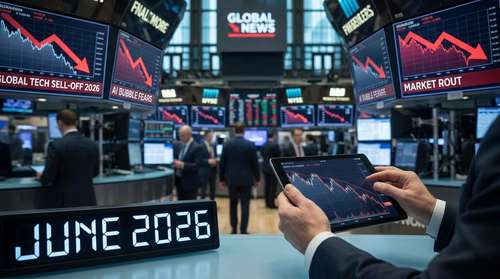
A massive global tech sell off 2026 has violently reshaped Wall Street, wiping hundreds of billions of dollars from the ledgers of major technology companies. Driven by mounting anxieties over a potential AI stock bubble, the aggressive market contraction has left investors scrambling for safer shores. The resulting Nasdaq drop June 2026 saw the tech-heavy index plummet by 2.2%, while the broader S&P 500 index retreated by 1.4%. This sudden, dramatic reversal highlights a growing skepticism surrounding astronomical artificial intelligence valuations versus their actual return on investment.
From Darling to Dust: The Artificial Intelligence Market Rout
The catalyst for this week's artificial intelligence market rout originated overseas before crashing into US markets. In South Korea, memory chip giants SK Hynix and Samsung Electronics both saw their shares crater by more than 12%. The panic was triggered by reports that SK Hynix might deliberately slow its high-bandwidth memory expansion to focus on conventional DRAM production.
This Asian tech bloodbath quickly spilled over into American semiconductor stocks, sparking a brutal Nvidia Micron stock plunge. Micron Technology suffered a devastating 13.3% loss, erasing days of significant gains after its stock had soared roughly 260% since the start of the year. Meanwhile, AI hardware titan Nvidia saw its shares slide by 4%, knocking its market capitalization below the $5 trillion threshold. Market analysts are now deeply questioning whether the colossal capital expenditure required to fund the global AI infrastructure buildout is sustainable.
Is the AI Infrastructure Trade Broken?
The swiftness of the sell-off indicates that the market is clearly rattled, but experts are divided on the long-term implications. While some view the memory chip downturn as a sharp but healthy reset following a parabolic rally, others warn that the memory industry's historic boom-bust cycle is far from obsolete. If demand growth begins to moderate, the simultaneous massive capital expenditure programs from Micron, SK Hynix, and Samsung could potentially flood the market with excess capacity by 2027.
The Historic SpaceX Market Value Loss
Adding unparalleled shock value to the broader market retreat is the unprecedented collapse of Elon Musk's newly public aerospace juggernaut. Following a historic $75 billion initial public offering that briefly catapulted the company to a nearly $3 trillion valuation, the stock has violently reversed course. The staggering SpaceX market value loss erased more than $600 billion in just three trading sessions, sending the stock tumbling 23% from its recent peak.
Wall Street's sudden pivot on SpaceX was accelerated by two major financial moves. First, the company announced a massive $60 billion all-stock acquisition of AI coding startup Cursor, prompting analysts to lower their fair value estimates due to severe shareholder dilution. Second, SpaceX announced plans to sell investment-grade bonds to fund its sweeping artificial intelligence ambitions, stoking immediate fears about the company's escalating debt load. The combination of massive spending plans and low early-trading liquidity left the stock highly vulnerable to this week's aggressive profit-taking.
Interest Rate Hike Fears Compound the Misery
While sector-specific headwinds were the immediate trigger, the overarching macroeconomic environment provided the perfect fuel for a market fire. Deepening interest rate hike fears have dramatically shifted investor sentiment. Earlier in the year, markets were eagerly anticipating rate cuts from the Federal Reserve. Now, confronted by persistent inflation and resilient economic data, traders are actively pricing in the possibility of a rate hike by December under the newly appointed Fed Chair Kevin Warsh.
Higher interest rates inherently damage fast-growing technology stocks, as investors become increasingly unwilling to pay massive premiums today for profits that may not materialize for years. This hawkish shift in monetary policy expectations makes debt-funded AI infrastructure spending much harder to justify at current record-high valuations.
As the dust settles on this intense period of market turbulence, the fundamental question remains: are we witnessing a temporary correction, or the definitive bursting of the modern tech bubble? For now, the era of unquestioned, limitless funding for artificial intelligence ventures appears to have hit a solid brick wall.