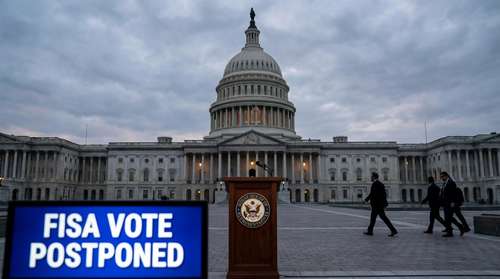
In a dramatic display of a deepening House Republican legislative crisis, GOP leadership abruptly scrapped plans to hold a floor vote today on the FISA Section 702 renewal 2026 measure. The sudden cancellation occurs just days before the federal government's broad warrantless surveillance authority is set to expire. A bloc of conservative privacy hawks threatened to sink the procedural rule, forcing House Speaker Mike Johnson to pull the legislation from the floor while scrambling to negotiate a last-minute compromise.
The collapse leaves U.S. intelligence agencies staring down a potentially catastrophic lapse in their foreign intelligence-gathering capabilities. With the FISA expiration April 20 deadline rapidly approaching, the Trump administration and top national security officials are issuing stark warnings about the severe risks of letting the surveillance program go dark during a period of heightened global instability.
The Fight Over Surveillance Warrant Requirements
At the center of this fierce internal Republican debate is an uncompromising demand by hardline conservatives—often joined by progressive Democrats—for strict surveillance warrant requirements. Section 702 of the Foreign Intelligence Surveillance Act allows the government to collect the digital communications of targeted foreigners located overseas without a warrant. However, the system routinely and incidentally sweeps up the emails, text messages, and phone calls of American citizens who communicate with those foreign targets.
Lawmakers such as Rep. Andy Biggs (R-AZ) and Rep. Anna Paulina Luna (R-FL) have drawn a firm line, refusing to authorize a clean 18-month extension without binding privacy reforms. They argue that the FBI has historically abused the backdoor query system to search through the database for Americans' communications without demonstrating probable cause. While a prior reauthorization in 2024 instituted numerous compliance guardrails, the holdouts assert that those internal policies are fundamentally insufficient without a constitutionally mandated warrant requirement.
The Mike Johnson FISA Vote Strategy
Navigating a razor-thin majority in the 119th Congress, leadership can only afford a maximum of two defections on procedural votes, which traditionally fall strictly along party lines. The highly anticipated Mike Johnson FISA vote had to be delayed when it became mathematically impossible to advance the debate rule out of the House and onto the floor for a final tally.
Speaker Johnson told reporters on Wednesday that negotiations are actively ongoing and remain fruitful, noting that he is exploring the possibility of minor modifications to the bill. Behind the scenes, the pressure campaign is immense. CIA Director John Ratcliffe and President Donald Trump have both made personal pitches to the conservative holdouts. Ironically, despite his own campaign falling victim to FISA abuses in 2016, President Trump is now strongly urging lawmakers to pass a clean reauthorization, recently posting on social media that the tool is vital for doing what is right for our Country.
A History of Controversial Intelligence Community Surveillance
To fully understand the current deadlock, one must look at the fraught history of intelligence community surveillance. Section 702 was originally passed in 2008 as a critical counterterrorism tool. Over the years, however, civil liberties organizations and government oversight boards have documented numerous instances of improper data queries. Most notably, oversight reports revealed that authorities improperly searched for information related to political donors, racial justice protesters in 2020, and individuals involved in the January 6 Capitol riot.
In response to these controversies, the 2024 reauthorization included 56 specific reforms, which House Judiciary Chairman Jim Jordan recently argued have been effective in sharply reducing FBI abuses. Yet, a bipartisan coalition in both the House and the Senate—including figures like Senators Dick Durbin and Mike Lee, who recently championed the SAFE Act—believe that allowing agencies to self-police is a fundamental violation of Fourth Amendment protections.
Impact on National Security News Today
For those closely tracking national security news today, the geopolitical stakes of the current impasse could not be higher. Proponents of the program emphasize that Section 702 provides the essential foundation for a significant portion of the president's daily intelligence briefing. The tool is actively utilized to detect sophisticated cyber threats, track international drug cartels, monitor hostile foreign powers, and disrupt terror plots before they materialize on American soil.
A lapse in the statute would force the administration to rely on a sluggish, piecemeal approach to foreign intelligence, severely degrading the nation's early warning systems. While the Foreign Intelligence Surveillance Court (FISC) reportedly renewed the government's underlying 702 certifications in March—potentially allowing existing surveillance directives to continue temporarily—the legal ambiguity of operating under an expired congressional statute creates massive liabilities. Telecommunication and tech companies may challenge the government's authority to compel data without an active law on the books.
What Happens Next as the Deadline Approaches?
The legislative clock is deeply unforgiving. Congress has until Monday, April 20, 2026, to reauthorize the measure or watch it sunset. If Speaker Johnson fails to broker a viable compromise regarding the warrant amendment over the next 48 hours, lawmakers may be forced to pass a brief stopgap extension to buy more negotiating time. However, even a short-term continuing resolution for FISA faces steep resistance from the most hardline conservative factions.
As the political maneuvering intensifies inside the Capitol, the fundamental tension remains completely unresolved: balancing the critical operational needs of American intelligence agencies with the constitutional privacy rights of American citizens. Whether House leadership can thread that needle before the midnight deadline remains the most pressing and consequential question in Washington.