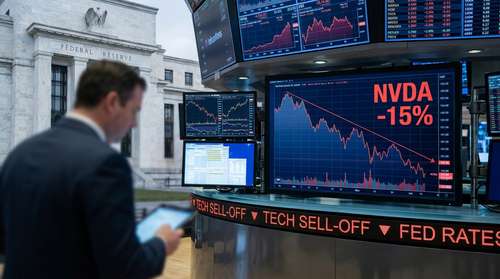
Wall Street is experiencing a sharp reality check this week. In a surprising turn for the artificial intelligence darling, the Nvidia stock drop of 2026 has dominated market chatter after shares tumbled to $215 on Monday. The nearly 7% decline over the last five trading days presents a glaring disconnect for the semiconductor giant, coming mere days after the company reported an astonishing $81.6 billion in record quarterly sales. But exceptional earnings are no longer enough to insulate high-flying equities from macroeconomic headwinds. The swearing-in of Kevin Warsh as Fed Chair last Friday has ushered in a new era of monetary policy, and his hawkish stance on inflation is already fueling a broader tech stock sell-off.
Record $81.6 Billion Revenue Eclipsed by Macro Fears
Just last week, Nvidia posted fiscal first-quarter revenue that decimated Wall Street consensus. The company reported $81.6 billion in total sales for the quarter, representing a massive 85% year-over-year increase. Data center revenue alone accounted for a staggering $75.2 billion of that total, highlighting the ongoing, hyper-aggressive buildout of artificial intelligence factories.
Yet, the NVDA share price reaction was decisively negative. Investors appear to be looking past the rearview mirror of blowout earnings and bracing for a tougher road ahead. Under Nvidia’s newly updated reporting framework—which categorizes revenue into Data Center and Edge Computing—analysts are beginning to question how long the hyper-growth phase can last. The massive capital expenditures from top-tier cloud providers have been the engine of Nvidia's ascent, but Wall Street is increasingly anxious about impending market saturation.
Breaking Down the Data Center Dominance
Nvidia's internal revenue structure shift reveals exactly where the institutional capital is flowing. In its latest quarterly report, the company began splitting its Data Center segment into two distinct markets: Hyperscale and AI Cloud, Industrial, and Enterprise (ACIE). Hyperscale revenue skyrocketed 115% to $37.9 billion, driven almost entirely by the rapid deployment of the GB300 platform and intense Nvidia Blackwell chip demand.
Despite these eye-watering figures, the whisper numbers on Wall Street suggest that hyperscaler spending could plateau by late 2026. Companies like Amazon, Microsoft, and Google are currently absorbing massive infrastructure costs, but they will eventually need to demonstrate significant software revenue returns on these investments to justify further purchases. This underlying anxiety is acting as a heavy anchor on shares, as fund managers attempt to time the peak of the hardware cycle.
Kevin Warsh Takes the Helm at the Federal Reserve
The sudden shift in investor sentiment cannot be separated from Washington. On May 22, 2026, Kevin Warsh officially took the oath of office as the 17th Chairman of the Federal Reserve. Taking over the world's most powerful economic post, Warsh immediately signaled a "reform-oriented" approach to central banking.
For technology investors, a Warsh-led Fed translates to one distinct probability: a deeply hawkish Federal Reserve interest rate outlook. Warsh has historically prioritized hardline inflation control over accommodative policy, leading markets to quickly price in a "higher for longer" rate environment. Growth stocks like Nvidia are highly sensitive to rising yields, as higher interest rates aggressively discount the present value of their future cash flows. This policy pivot is the primary catalyst behind the accelerating tech stock sell-off dragging down the Nasdaq this week.
Is an AI Market Correction Underway?
The collision of record corporate earnings and tightening monetary policy has ignited fears of a broader AI market correction. After years of unrestricted expansion, the narrative is shifting from unbridled optimism to rigid margin scrutiny. While CEO Jensen Huang continues to point toward a robust pipeline for new agentic AI workloads and the upcoming Vera Rubin architecture, institutional investors are actively dialing back risk.
If borrowing costs remain elevated under Chairman Warsh, corporate America may be forced to rationalize its artificial intelligence infrastructure budgets. Nvidia still commands a virtual monopoly in the AI accelerator market, but the drop to the $215 price level indicates that perfection was fully priced in—leaving zero room for error. Until the market receives clearer guidance on both terminal interest rates and enterprise software monetization, Nvidia shares may face sustained pressure in the volatile months to come.