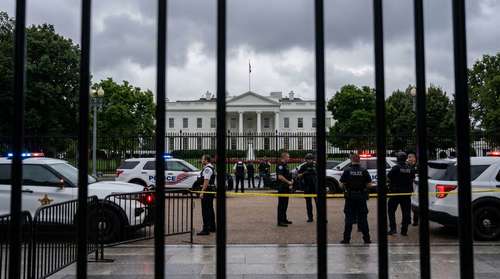
The heart of the nation's capital was thrown into chaos on Saturday evening as a dramatic Secret Service exchange of fire left a suspect dead and a civilian injured just steps from the executive mansion. The harrowing incident prompted an immediate White House lockdown while President Donald Trump was inside the residence. As federal authorities secure the area and piece together the exact timeline of events, this Washington DC breaking news has ignited fresh, urgent discussions surrounding the vulnerability of the nation's most heavily guarded complex.
The sudden eruption of gunfire sent journalists, administration staffers, and tourists scrambling for cover shortly after 6:00 p.m. Eastern Time on May 23. While the immediate tactical threat was neutralized within moments, the reverberations of this President Trump security breach will likely shape law enforcement protocols, threat assessment strategies, and physical barriers for the foreseeable future.
The Checkpoint Confrontation: How the Attack Unfolded
According to preliminary statements from the United States Secret Service, a 21-year-old American man, identified by law enforcement officials as Nasire Best, approached a security checkpoint near the bustling intersection of 17th Street NW and Pennsylvania Avenue NW. Without prior warning or provocation, Best pulled a revolver from a bag he was carrying and began firing directly at posted uniform division officers.
Secret Service personnel immediately returned fire, striking the assailant multiple times. First responders transported Best to a local trauma center in critical condition, where he later succumbed to his injuries. The swift neutralization of the threat ensured the White House gunman killed in the altercation did not breach the inner perimeter of the complex, keeping the violence contained to the outer public boundary.
Civilian Casualties and Emergency Response
Tragically, the chaotic shootout did not spare the public. An unnamed bystander was struck during the intense crossfire that echoed across the plaza. Secret Service communications chief Anthony Guglielmi noted that forensic investigators are currently analyzing ballistics to determine whether the civilian was hit by the suspect's initial volley of bullets or by rounds fired by law enforcement officers returning fire. The bystander remains hospitalized, with officials closely monitoring their medical status.
Immediate Lockdown and the President's Response
As the shots rang out—described by reporters sheltering on the North Lawn as sounding like dozens of gunshots in rapid succession—security details immediately initiated a comprehensive White House lockdown. Journalists recording segments outside were directed by heavily armed tactical units to sprint to the James S. Brady Press Briefing Room. They sheltered in place for hours while emergency response teams cleared the grounds and swept for secondary threats.
President Donald Trump was inside the executive mansion throughout the entirety of the incident. Officials quickly confirmed that the president was secured and that no Secret Service personnel sustained physical injuries.
As the public digested the Secret Service shooting today through morning broadcasts, Trump took to social media to commend the swift and professional action of the law enforcement officers who intercepted the active shooter. The president emphasized the absolute necessity of maintaining the most secure space possible, characterizing the executive complex as requiring unparalleled fortification.
A Troubling History of Security Interactions
As federal detectives comb through the suspect's background, a deeply disturbing pattern of prior incidents has emerged. Court records indicate that Saturday evening was not Best's first confrontation with authorities at the executive complex. In July 2025, he was arrested for unlawful entry after attempting to force his way through an exit turnstile in a highly restricted zone. During that arrest, Best reportedly told intervening officers that he was Jesus Christ and explicitly stated he wanted to be taken into custody.
Following the 2025 incident, a District of Columbia judge issued a Pretrial Stay Away Order, legally barring the young man from the area surrounding the White House. When Best subsequently failed to appear for an August court hearing, a bench warrant was issued for his arrest.
The Challenge of Threat Assessment
Law enforcement sources described the suspect as an emotionally disturbed individual well-known to local and federal authorities. This revelation raises serious, systemic questions about how a suspect with an active bench warrant, documented mental health crises, and a highly specific history of targeting the presidential complex was able to approach the outer perimeter checkpoint heavily armed. The incident exposes the critical gaps between local judicial enforcement and federal protective intelligence.
Urgent Review of White House Perimeter Security
Saturday's deadly confrontation marks the third high-profile security scare involving firearms in the vicinity of the president over the past month. Following recent, separate gun-related incidents at the White House Correspondents' Association dinner in April and another near the Washington Monument earlier in May, congressional and public scrutiny is intensifying over current White House perimeter security measures.
The recurrent nature of these threats is forcing an urgent, top-down review of how federal agencies collaborate to monitor individuals with known fixations on the presidency. While the Secret Service successfully executed their primary objective—preventing the assailant from breaching the fence line and protecting the commander in chief—the injury to a civilian underscores the inherent dangers of armed confrontations in one of the world's most heavily trafficked tourist destinations.
Security analysts expect temporary hard closures of surrounding streets and a significantly bolstered uniform division presence in the coming weeks. For now, the capital remains on high alert, grappling with the sobering reality of the violence that unfolded just steps from the Oval Office.