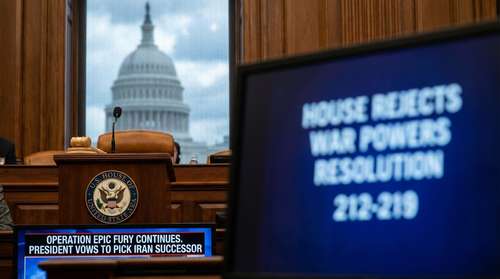
In a decisive and politically charged showdown, the U.S. House of Representatives narrowly rejected a war powers resolution late Thursday, clearing the path for the continuation of the expansive military campaign known as Operation Epic Fury. The measure, which sought to terminate the unauthorized use of U.S. Armed Forces against Iran, failed in a tight 212-219 vote, largely splitting along party lines. The legislative defeat for anti-war lawmakers comes as President Donald Trump escalates his rhetoric, asserting he must personally "hand-pick" the successor to Iran’s late Supreme Leader to ensure a regime friendly to American interests.
House Rejects War Powers Resolution in Razor-Thin Vote
The 212-219 vote marks a significant victory for the Trump administration, effectively greenlighting the ongoing US Iran military escalation that began with shock-and-awe airstrikes on February 28, 2026. Proponents of the resolution argued that the executive branch had bypassed Congress’s constitutional authority to declare war, warning that Operation Epic Fury was spiraling into a prolonged regional conflict without a clear exit strategy. However, the administration’s allies in the House maintained that the President’s actions were necessary defensive measures against imminent nuclear threats.
"This vote was a choice between security and capitulation," stated a senior House Republican following the tally. Conversely, opposition leaders decried the outcome as an abdication of congressional oversight. The Senate had already defeated a similar measure earlier in the week, cementing the legislature’s inability to halt the 2026 Congressional war vote challenge. With the resolution’s failure, the White House has interpreted the result as a mandate to press forward with its campaign to dismantle Iran’s military infrastructure.
Operation Epic Fury Updates: 'Laser-Focused' Strikes Continue
As political battles raged in Washington, the military offensive on the ground intensified. Operation Epic Fury updates provided by the Pentagon confirm that U.S. and allied forces have now entered the sixth day of sustained combat operations. The campaign, described by Defense Secretary Pete Hegseth as "laser-focused," has already achieved widespread destruction of Iran’s command and control centers, ballistic missile arsenals, and naval assets.
According to U.S. Central Command (CENTCOM), the operation has degraded an estimated 80% of Iran’s integrated air defense systems. "We are systematically removing the regime's ability to threaten the region," a CENTCOM spokesperson told reporters. The offensive has not been without cost; the Department of Defense confirmed the deaths of three U.S. service members earlier in the week, further fueling the urgency of the debate surrounding Trump Iran war powers.
Khamenei’s Death and the Power Vacuum
The catalyst for the current chaos—the death of Supreme Leader Ali Khamenei in a targeted airstrike on February 28—has left a power vacuum in Tehran that the U.S. appears eager to exploit. Intelligence reports indicate that an interim leadership council is currently managing state affairs while the Assembly of Experts struggles to convene under the threat of continued US military strikes Tehran 2026.
Trump Sparks Outrage with Supreme Leader Comments
In a move that has stunned diplomatic observers, President Trump explicitly linked the cessation of hostilities to his direct involvement in Iran's political transition. Speaking to reporters and later amplifying his message on social media, Trump declared that the likely successor, Mojtaba Khamenei, was "unacceptable" to the United States.
"Khamenei’s son is a lightweight. I have to be involved in the appointment, like with Venezuela," Trump asserted, referring to previous U.S. interventions. The President insisted that he would only accept a leader capable of bringing "harmony and peace," effectively vetoing the internal selection process of a sovereign nation. These Trump Iran supreme leader comments have drawn sharp rebukes from international allies, who worry that demanding a U.S.-vetted leader will make a diplomatic resolution impossible and entrench the conflict.
What Lies Ahead for US-Iran Relations?
With the House rejects war powers resolution vote behind him, President Trump faces few domestic hurdles to continuing the war. The administration has signaled that "further action" is imminent, potentially targeting Iran's oil infrastructure to exert maximum economic pressure. Meanwhile, the rejection of Mojtaba Khamenei as a successor suggests the U.S. goal has shifted from containment to explicit regime engineering.
As Operation Epic Fury enters its second week, the risk of a broader regional conflagration remains high. Military analysts warn that while the initial phase has been tactically successful, the political objective of installing a hand-picked leader in Tehran may require a prolonged and destabilizing presence—a reality Congress has now implicitly accepted.