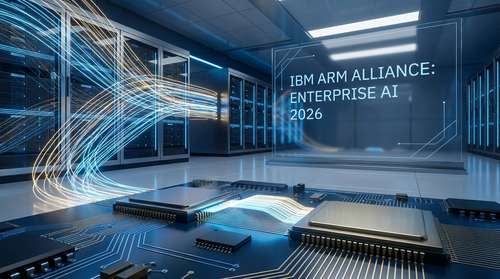
The rapid acceleration of artificial intelligence has placed unprecedented stress on corporate data centers, forcing tech giants to rethink traditional computing models. In a massive shift for the industry, the newly announced IBM Arm partnership 2026 aims to tackle this challenge head-on. The two technology stalwarts have forged a strategic alliance to design and launch specialized dual-architecture chips tailored for heavy-duty, data-intensive workloads. By fusing Arm’s globally recognized power-efficient designs with IBM’s legendary mission-critical enterprise systems, this collaboration is setting a new benchmark for enterprise AI infrastructure worldwide.
Expanding Virtualization Across Platforms
Announced on April 2, the joint initiative targets a multi-architecture landscape that steps beyond traditional boundaries. For corporate technology leaders, this means a clear path toward greater deployment flexibility, enhanced security, and the ability to scale sophisticated AI models seamlessly. One of the most immediate priorities of this collaboration revolves around software portability. IBM and Arm are jointly developing virtualization technologies that allow Arm-based software environments to natively execute within IBM’s highly secure computing platforms, such as its iconic Z-series mainframes.
Historically, navigating disparate software ecosystems required substantial engineering overhead. Now, the companies are constructing shared technology layers designed to unify developer experiences. Enterprise systems will recognize and execute Arm applications natively, ensuring that cloud-native code can operate in mission-critical environments. "As enterprises scale AI and modernize their infrastructure, the breadth of the Arm software ecosystem is enabling these workloads to run across a broader range of environments," noted Mohamed Awad, executive vice president of Arm’s Cloud AI Business Unit.
Merging Next-Gen Silicon Innovation
To understand the hardware implications, you have to look at the specialized silicon both companies bring to the table. IBM is actively rolling out its latest IBM Telum II and Spyre platforms, moving them from proof-of-concept into the heart of the modern data center. Built on Samsung's 5-nanometer process node, the Telum II processor features expanded L2 cache, an integrated AI accelerator, and a coherently attached data processing unit (DPU). The complementary Spyre Accelerator, which is now shipping alongside z17 and LinuxONE 5 systems, connects via a 75-watt PCIe adapter and packs 32 specialized cores to run advanced ensemble models alongside standard transactional workloads.
Arm’s contribution to these dual-architecture systems hinges on its expertise in building power-efficient instruction sets. Arm recently launched its own AGI CPU based on the highly successful Neoverse architecture, landing launch partners like OpenAI and Meta. By bringing these two engineering powerhouses together, the alliance forms a foundational bedrock for next-gen silicon innovation. The resulting enterprise systems will distribute complex machine learning inference tasks across the most optimal processors available, dynamically allocating resources based on the specific demands of the workload.
Redefining Data Center Power Management
Energy consumption is rapidly becoming the most critical bottleneck for corporate artificial intelligence initiatives. Generative models require immense computational power, putting an outsized strain on cooling systems and electricity grids. Analysts project that the energy demands from generative AI will skyrocket 75% annually over the next few years, potentially consuming as much energy in 2026 as entire nations did just a few years ago. This is where energy-efficient AI hardware becomes a non-negotiable asset rather than a simple cost-saving perk.
Arm has built an industry-leading reputation on maximizing instructions per watt. Integrating this efficiency philosophy into the heavy-lifting capabilities of IBM's mainframe computing allows organizations to achieve superior data center power management. The joint architecture will help distributed AI systems orchestrate tasks—from memory management to workload scheduling—without the massive power draw traditionally associated with scaling large language models.
Mission-Critical Security and Sovereignty
Corporate AI requires more than just raw processing speed; it demands absolute reliability. Highly regulated industries, such as global banking and healthcare, cannot afford network downtime or data leaks. This hardware collaboration specifically addresses local data sovereignty and strict security requirements. By processing complex tasks directly on the mainframe hardware using integrated Arm environments, businesses can keep their proprietary data on-premises and tightly guarded from external threats.
The Future of Enterprise Computing
The trajectory of business computing is clearly shifting toward hybrid, multi-chip ecosystems. The IBM and Arm alliance represents a proactive response to how modern organizations actually operate: needing the extreme agility of the cloud software ecosystem combined with the bulletproof reliability of traditional mainframes.
As infrastructure continues to evolve, developers will increasingly rely on these unified environments to power advanced features like real-time fraud detection and automated analytics. This collaboration gives corporate data centers the freedom to choose the best architecture for each specific task without sacrificing compatibility. By establishing shared technology layers, IBM and Arm are ensuring that the upcoming decade of enterprise AI deployment will be faster, highly secure, and profoundly more sustainable.