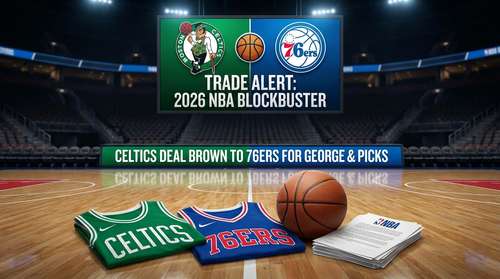
In a stunning twist that has completely reshaped the start of NBA free agency 2026, the Boston Celtics have agreed to a historic blockbuster Jaylen Brown trade. The franchise is sending the 29-year-old star forward, homegrown talent, and former Finals MVP to their fiercest Eastern Conference rival, the Philadelphia 76ers. In return, the Celtics acquire 36-year-old veteran Paul George, alongside two first-round picks and two second-round draft picks.
This unprecedented move officially ends the Tatum and Brown era in Boston. While shipping a player squarely in the middle of his prime to a divisional rival is a staggering decision that has left fans reeling, the harsh financial realities of the current collective bargaining agreement forced Boston's front office into a difficult corner. The trade instantly alters the championship math, proving that in today's landscape, team building is as much about salary cap management as it is about star power.
Why the Celtics Trade Jaylen Brown Now
To understand why the Celtics trade Jaylen Brown instead of riding out his prime, you have to look closely at the team's restrictive cap sheet. Brown signed a massive five-year supermax extension in 2023, which carries a staggering cap hit of $57.1 million for the upcoming 2026-27 season. With Jayson Tatum operating on a similar supermax contract, Boston was staring down the barrel of the dreaded second apron luxury tax penalty.
Under the restrictive new CBA, the projected 2026-27 salary cap is approximately $165 million, with the luxury tax line near $201 million and the second apron set at roughly $222 million. Having two players command around 35 percent of the salary cap each heavily restricts a front office's ability to build a deep, competitive roster. Surpassing the second apron strips teams of their mid-level exceptions, limits trade possibilities, and ultimately freezes future draft assets.
By executing this deal, Boston actually saves about $2.9 million for the upcoming season. More importantly, it provides them a much-needed exit ramp before Brown's salary escalates to a virtually unmanageable $64 million by the 2028-29 season. The front office recognized that relying on two incredibly expensive wings limited their flexibility to fortify the bench and properly match up against the elite depth of Western Conference juggernauts.
The Paul George Celtics Era Begins
Bringing Paul George to the Celtics represents a significant pivot in Boston's competitive strategy. George, now 36 years old, is entering the third year of the four-year, $211.5 million contract he originally signed with the Sixers in July 2024. He will earn $54.1 million this season and holds a $56.6 million player option for the 2027-28 campaign. After that, his money comes off the books, providing Boston with immense future flexibility.
While George has battled injury concerns over the past two seasons, he remains an elite veteran presence. In Boston's system, he can stretch the floor, defend the wing at a high level, and provide valuable secondary scoring behind Tatum without demanding the same offensive volume as Brown. George acts as a high-level, short-term bridge, allowing Boston to stay competitive while they integrate younger rotational pieces on cheaper rookie-scale deals.
Breaking Down the Draft Compensation
Beyond matching salaries, Boston secured essential draft capital to restock its depleted asset pool. The complete trade package includes:
- A 2028 first-round pick (conditional, originating from the Clippers)
- An unprotected 2031 first-round pick from Philadelphia
- Two future second-round picks
These picks offer Boston the ammunition to either draft cheap, young talent—a mandatory strategy under the new CBA—or package them in a future transaction to acquire a different superstar when the cap sheet opens up.
Jaylen Brown 76ers Fit: A New Eastern Juggernaut
On the other side of the transaction, the 76ers trade package signifies an aggressive, all-in push by Daryl Morey. The Jaylen Brown 76ers pairing is a terrifying concept for the rest of the league. Philadelphia successfully offloaded an aging George and immediately upgraded by acquiring a 29-year-old, two-way superstar squarely in his prime. For just $3 million more against the cap this year, the Sixers vastly improved their ceiling.
Brown will slot seamlessly next to former MVP Joel Embiid and dynamic point guard Tyrese Maxey, establishing what is undoubtedly the best starting trio in the NBA. Embiid ($58.1 million) and Maxey ($40.7 million) are already secured on massive contracts through the 2026-27 season. Philadelphia clearly viewed Brown as the ultimate missing piece required to snap their agonizing quarter-century drought of conference finals appearances. Brown's elite transition scoring, relentless perimeter defense, and proven playoff pedigree alleviate the pressure on Maxey and elevate Philadelphia to immediate championship favorites.
The Legacy of the Tatum and Brown Era
For Celtics fans, saying goodbye to Brown is an emotional and bitter pill to swallow. Over nearly a decade, the Tatum and Brown era produced thrilling playoff runs, incredible individual accolades, and the ultimate prize of an NBA Championship. Brown evolved from a raw, athletic prospect into a polished franchise icon and a Finals MVP.
Yet, the modern NBA landscape is deeply unforgiving. Escalating player salaries and restrictive aprons mean that franchise sentimentality often takes a back seat to cold, hard math and long-term roster sustainability. It is incredibly rare to see a team trade a Finals MVP while he is still producing at an elite level, but Boston chose financial flexibility over an increasingly expensive status quo.
As the dust settles on this historic Jaylen Brown trade, the power dynamics of the Eastern Conference have fundamentally shifted. Boston is betting on cap flexibility, draft assets, and a refreshed supporting cast around Jayson Tatum, while Philadelphia is wagering that Jaylen Brown is the ultimate catalyst to finally bring a championship parade back to Broad Street.