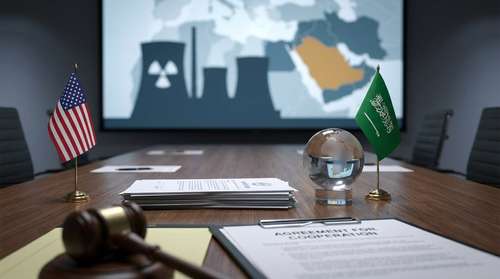
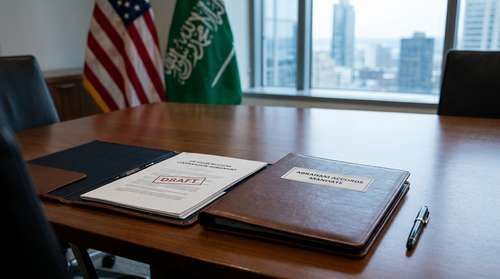
A historic 30-year civilian nuclear pact between the United States and Saudi Arabia has been abruptly plunged into chaos just days after its signing. In a whiplash-inducing pivot, President Donald Trump declared that the multibillion-dollar Trump Saudi nuclear deal is retroactively contingent upon the kingdom joining the Abraham Accords and normalizing diplomatic relations with Israel. The sudden ultimatum has blindsided diplomats and effectively paralyzed one of the most significant energy and security agreements in modern Middle East diplomacy.
A Monumental Pact Suddenly Suspended
Just 24 hours after U.S. Energy Secretary Chris Wright and his Saudi counterpart inked the sweeping commercial framework, celebration turned to confusion. The US Saudi nuclear agreement was designed to grant American companies a leading role in building out Saudi Arabia's civilian nuclear infrastructure, securing a massive win for Washington over rival bidders from Russia and China. It also marked a dramatic shift in US Saudi relations, locking in three decades of technology cooperation.
However, in a surprise Truth Social post on Thursday, President Trump announced that while the deal would theoretically be approved, it is now "totally subject to Saudi Arabia joining the very respected and successful Abraham Accords". White House Press Secretary Karoline Leavitt swiftly confirmed the administration's new stance, telling reporters bluntly that if the Saudis refuse to enter the accords, "the deal is off". The sudden shift threw the international community off guard and cast an immediate shadow over the multi-billion-dollar framework.
The Sticking Point of Israel Saudi Normalization
The linkage of atomic energy to diplomatic recognition represents a bold, high-stakes gamble for Trump foreign policy. The Abraham Accords, a crowning achievement of Trump's first term, successfully normalized relations between Israel and several Arab nations, including the UAE, Bahrain, and Morocco. However, bringing Riyadh into the fold has remained a far more elusive prize.
For months, Saudi Arabia has maintained that Israel Saudi normalization requires a clear, irrevocable pathway to Palestinian statehood—a precondition that Israeli Prime Minister Benjamin Netanyahu’s government has repeatedly dismissed. By chaining the nuclear agreement directly to the Abraham Accords, the White House is essentially forcing Riyadh’s hand. This complex geopolitical maneuvering sets a dramatic stage for Prime Minister Netanyahu's highly anticipated upcoming visit to Washington, where the fate of this tripartite dynamic will undoubtedly dominate discussions.
Uranium Enrichment and the Nonproliferation Debate
Before this abrupt diplomatic mandate, the US Saudi nuclear agreement was already generating fierce bipartisan backlash on Capitol Hill and among nonproliferation experts. Initially, reports indicated that the sweeping framework—officially a "123 Agreement," named after Section 123 of the U.S. Atomic Energy Act—omitted the nonproliferation "Gold Standard". This strict standard prohibits domestic uranium enrichment and the reprocessing of spent fuel, provisions that were rigidly enforced in the 2009 U.S.-UAE agreement.
Critics warned that giving Riyadh a pathway to enrich uranium could spark a regional nuclear arms race. However, in his Truth Social post announcing the new normalization condition, Trump pushed back against these fears, explicitly claiming, "There will be no enrichment of material!". He emphasized that the framework pertains exclusively to non-military, civilian use similar to other regional programs. Despite this presidential assurance, nonproliferation experts remain deeply skeptical, noting that establishing bespoke arrangements without airtight legal prohibitions leaves the door to domestic enrichment dangerously ajar.
The Strategic Ripple Effects on US Saudi Relations
By suddenly tying the agreement to Saudi Arabia Abraham Accords participation, the administration may be attempting to appease domestic critics and Israeli security officials who strongly opposed handing advanced nuclear capabilities to an Arab state without concrete diplomatic guarantees. However, the ultimatum carries immense geopolitical risk.
Crown Prince Mohammed bin Salman has long viewed domestic nuclear energy as a central pillar of his economic diversification strategy. If the United States effectively torpedoes its own agreement over the normalization impasse, Saudi Arabia has made it abundantly clear that it possesses other options. The kingdom could swiftly pivot eastward, inviting Chinese or Russian state-owned nuclear firms to construct its commercial reactors. This scenario would effectively strip the United States of any nonproliferation oversight and severely fracture the bilateral relationship.
Netanyahu's Visit and the Path Forward
Israeli officials have quietly harbored severe anxieties about a Saudi nuclear program, yet they are simultaneously desperate for a formal peace treaty with the Arab world's wealthiest powerhouse.
As diplomats scramble to salvage the framework, the fate of the Trump Saudi nuclear deal rests on a razor's edge. It remains entirely unclear whether this eleventh-hour mandate will successfully strong-arm a historic peace treaty or permanently shatter a 30-year energy partnership. What is undeniably certain, however, is that this sudden executive pivot has completely rewritten the immediate future of international nuclear diplomacy.