
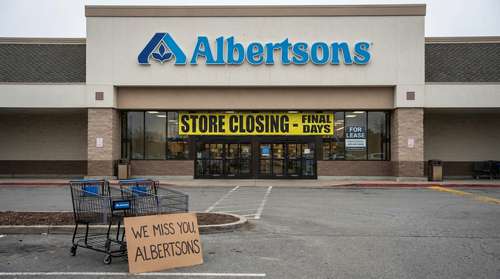
The highly anticipated $24.6 billion merger between Kroger and Albertsons was definitively halted by federal regulators, leaving the grocery giants to carve out separate paths forward. Now, the dramatic Kroger Albertsons merger fallout continues to reshape communities as Albertsons aggressively pivots to cost-cutting to stabilize operations. With roughly $1.5 billion burned collectively on failed deal costs and mounting margin pressures, the Boise-based grocer is drastically shrinking its physical footprint. The newly announced Albertsons store closures 2026 wave signals a tough reality for the company, triggering widespread grocery industry layoffs and leaving consumers with fewer local supermarket options.
Expanding Albertsons Store Closures 2026: A Shrinking Footprint
Operating independently in a fiercely competitive environment requires tough decisions, and Albertsons is rapidly downsizing its retail presence. Following the closure of approximately 20 stores in 2025, the company has ramped up its efforts to shutter underperforming locations. Recent Worker Adjustment and Retraining Notification (WARN) filings reveal a systematic reduction of retail footprints spanning from the West Coast to the nation's capital.
These retail restructuring news updates confirm that multiple banners are affected. In Southern California, Vons locations in Escondido and Redlands are shutting down this spring. Over in Texas, two Albertsons-branded supermarkets in Fort Worth and Euless will close their doors by late April. Even the East Coast footprint is shrinking, with a Washington, D.C. Safeway location on Maryland Avenue permanently ceasing operations by mid-May. Analysts emphasize that cutting physical overhead is the most immediate way for the grocery giant to conserve capital following the scuttled acquisition.
Impacted Regions and Albertsons Job Cuts
These strategic closures carry a heavy human cost. The latest round of shutdowns has resulted in hundreds of localized Albertsons job cuts nationwide. The North Texas closures alone will impact 138 workers across two stores, while the Southern California Vons shutdowns eliminate roughly 135 positions. In Washington, D.C., 87 store employees are facing layoffs following the closure of their Safeway branch.
While Albertsons has indicated it intends to place as many affected store-level associates as possible into nearby locations, the sheer volume of grocery industry layoffs highlights the brutal reality of market consolidation. The grocer has also reduced general and administrative expenses, laying off corporate and division support staff to streamline operations and trim a targeted $1.5 billion in spending over the next three years.
Navigating the Kroger Albertsons Merger Fallout
The collapse of the landmark grocery tie-up continues to dictate the overarching strategy for both companies. Regulators blocked the deal over concerns that reduced competition would inflate grocery prices for everyday Americans, culminating in a federal judge halting the acquisition. However, defending the merger in court drained immense resources from both supermarket chains.
As a standalone entity, Albertsons is forced to radically adjust its operational structure. The Kroger Albertsons merger fallout prompted a massive corporate reorganization designed to unlock new sources of productivity. The company recently consolidated its regional operations, merging its Intermountain Division—which covers Idaho, Montana, and Wyoming—with its Denver Division to form the newly streamlined Mountain West Division. This maneuver is intended to leverage regional scale and improve local operational excellence without the added bulk of an oversized corporate hierarchy.
Supermarket Competition Trends and US Grocery Market Analysis
Any comprehensive US grocery market analysis reveals that Albertsons is fighting a multi-front war. Rivals like Walmart, H-E-B, and Whole Foods have aggressively expanded their reach, utilizing deep pockets to capture market share. At the same time, regional operators are fiercely defending their local territories, expanding their footprint while Albertsons was tied up by years of merger litigation.
These evolving supermarket competition trends force traditional grocers to rethink their entire value proposition. The rising costs of goods, persistent inflation, and shifting consumer preferences have made legacy lease rates financially untenable for older, underperforming locations. To survive, companies are pulling out of saturated and highly competitive markets, such as the North Texas region, where formidable competitors have been rapidly opening new, state-of-the-art facilities.
The Pivot to Automation and Digital Growth
Instead of relying solely on physical retail expansion, Albertsons is aggressively shifting its capital into retail technology. The company recently reported a massive 23 percent surge in digital sales, underscoring a rapid change in how modern Americans shop for their groceries. To capitalize on this consumer shift, the grocer is heavily investing in artificial intelligence, e-commerce platforms, and supply chain automation.
Digital grocery growth often requires fewer traditional in-store workers, allowing the company to offset the sting of rising labor and real estate costs. While the physical Albertsons store closures 2026 narrative dominates local headlines, the underlying long-term strategy is a comprehensive digital transition designed to future-proof the 87-year-old business against encroaching low-cost competitors.