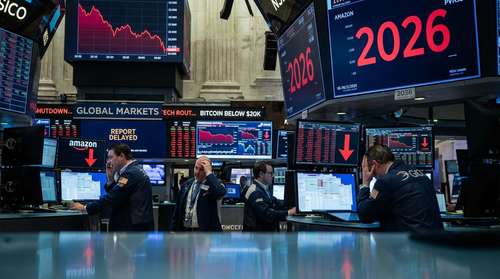
Wall Street is reeling this Friday morning as a perfect storm of economic uncertainty triggers a massive stock market selloff 2026. The convergence of a federal government shutdown, a resulting blackout of critical economic data, and a shockwave from Amazon’s headquarters has sent indices plummeting. With the highly anticipated January jobs report delay leaving investors flying blind, and tech giants signaling unprecedented spending on artificial intelligence, fear has gripped the markets. The Dow Jones and Nasdaq are both trading significantly lower as the volatility index (VIX) spikes to levels not seen since late 2025.
The Data Blackout: January Jobs Report Delay
The Bureau of Labor Statistics (BLS) confirmed earlier this week what traders feared most: the release of the January Employment Situation report, originally scheduled for this morning, has been indefinitely postponed. This marks the first major casualty of the partial government shutdown that began on January 31, 2026. Without this crucial gauge of labor market health, the Federal Reserve—and the broader market—is effectively operating in the dark.
"We are flying a plane through a storm with no instruments," said a senior analyst at Morgan Stanley. The delay effectively freezes critical data on payrolls and unemployment, exacerbating government shutdown economy news. This outage is particularly painful given the recent memory of the record-breaking 43-day shutdown last autumn, which cost the economy an estimated $11 billion. Investors are terrified that this new political impasse could drag on, further obscuring the economic reality just as the Fed weighs its next interest rate move.
Blind Spots in Economic Policy
The blackout isn't limited to the headline jobs number. The December JOLTS report (Job Openings and Labor Turnover Survey) has also been shelved. This leaves economists unable to verify if the labor market is cooling as intended or cracking under pressure. The uncertainty is fueling the selloff, as algorithms and institutional investors pull liquidity from the market rather than bet on unknown economic conditions.
Amazon AI Spending Crash Leads Tech Rout
While the silence from Washington is unsettling, the noise from Seattle has been deafening. The tech stock market rout deepened today after Amazon (AMZN) shares cratered more than 10% in pre-market trading. Despite beating revenue expectations for Q4 2025, the e-commerce giant stunned Wall Street with a forecast that includes a staggering $200 billion in capital expenditures for 2026—mostly earmarked for AI infrastructure.
CEO Andy Jassy’s announcement of the Amazon AI spending crash—a term traders are using to describe the stock's reaction to the expenditure—has ignited fears that Big Tech’s AI obsession is spiraling out of control. The $200 billion figure shattered analyst consensus, which had hovered around $146 billion. Investors are now questioning the return on investment (ROI) for these massive outlays, fearing that profit margins will be crushed for years to come as companies engage in an existential arms race for compute power.
AI Job Loss Predictions Fuel Anxiety
The selloff is not just about balance sheets; it is also about a growing existential dread regarding the workforce. The massive capital injection into autonomous systems has brought AI job loss predictions back to the forefront of the national conversation. With Amazon and peers pouring hundreds of billions into technology explicitly designed to automate complex tasks, the narrative has shifted from "AI assistance" to "human displacement."
Market sentiment has been soured by resurfacing reports, such as the Goldman Sachs analysis warning that widespread AI adoption could displace 6-7% of the U.S. workforce over the next decade. The delay in the jobs report makes this anxiety worse; without hard data to prove that humans are still being hired, the market is left with only the bearish signal of massive corporate spending on automation. The fear is that the "jobless recovery" predicted by pessimists is beginning now, hidden behind the veil of the government shutdown.
Bitcoin Price Drop 2026: No Safe Haven
In a sign of broad liquidity stress, even digital assets are failing to act as a hedge. The Bitcoin price drop 2026 narrative is playing out in real-time, with the cryptocurrency struggling to hold key support levels. After peaking near $126,000 late last year, Bitcoin has faced a "death cross" technical setup, pushing prices down toward the $70,000 range. The "Extreme Fear" reading on the crypto sentiment index reflects the broader panic.
The shutdown is also stalling the regulatory clarity many crypto bulls had banked on, specifically delaying the implementation of the so-called "Clarity Act." With risk assets correlating tightly to the tech sector's downturn, the flight to safety is currently bypassing crypto in favor of cash and gold. As the market closes out a tumultuous week, all eyes remain on Washington to reopen the government—and on Big Tech to prove that their multi-trillion-dollar AI gamble won't break the economy before it builds the future.