The Federal Reserve left its benchmark interest rate unchanged on Wednesday, opting for a "hawkish hold" as an escalating war in the Middle East severely complicates the central bank's inflation fight. Concluding the highly anticipated Federal Reserve meeting March 2026, policymakers cited a sudden, aggressive surge in global energy prices as the primary factor keeping borrowing costs locked in their current 3.5% to 3.75% range.
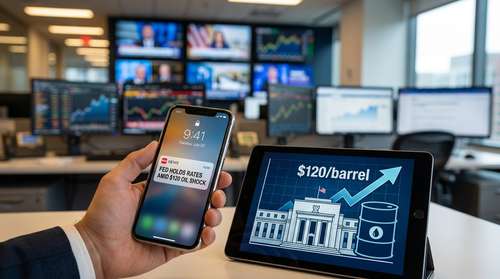
The Fed interest rate decision today dashes Wall Street's lingering hopes for a near-term rate cut. Instead, Chairman Jerome Powell and his colleagues are facing a dual-mandate nightmare: a softening labor market colliding head-on with an inflation shock. With the Strait of Hormuz effectively choked off by the ongoing conflict, international benchmark crude briefly spiked to nearly $120 earlier this week. This massive supply disruption has thrust stagflation risks US economy analysts previously dismissed firmly back into the spotlight.
The Iran War Economic Impact and the $120 Oil Shock
The most immediate and visible consequence of the geopolitical crisis is at the pump. Following weeks of military escalation, the Iran war economic impact has rapidly materialized across global energy markets. With millions of barrels of daily oil shipments halted or rerouted, Brent crude has surged dramatically, with oil prices 120 per barrel becoming a near-term reality after touching $119.50 earlier this week. The domestic fallout has been swift, driving the national average for a gallon of regular gasoline up 88 cents in just a month to hit $3.79 on Tuesday.
While the Federal Reserve traditionally strips out volatile food and energy costs to measure underlying core inflation, a sustained energy shock cannot be ignored. Prolonged energy spikes inevitably bleed into broader consumer prices. Transportation costs for manufactured goods, agricultural expenses driven by natural gas-dependent fertilizers, and airline fares are all facing intense upward pressure. Economists warn that if energy markets remain this strained, it will be impossible to shield the broader economy from the downstream effects.
Labor Market Weakness Meets the 2026 Inflation Forecast
What makes Wednesday's decision particularly fraught is the contradictory nature of recent economic data. Normally, soaring prices demand higher interest rates, while a slowing job market requires rate cuts to stimulate growth. Right now, the Fed is wrestling with both.
The Labor Department's February jobs report served as a stark warning sign for economic growth, revealing an unexpected loss of 92,000 payrolls. Consequently, the national unemployment rate crept up to 4.4%. Under ordinary circumstances, a labor market contracting for the first time in months would prompt swift monetary easing. However, the revised 2026 inflation forecast prevents the Fed from tossing a lifeline to struggling businesses and consumers.
FOMC Economic Projections 2026
Alongside the rate decision, officials released the updated Summary of Economic Projections (SEP). The newly published FOMC economic projections 2026 paint a sobering picture for the months ahead. Policymakers now widely expect inflation to remain stubbornly anchored near 3% through the end of the year, a significant upward revision from the 2.6% projected back in December.
As a result, the "dot plot" of expected rate moves has undergone a drastic transformation. Forecasters who had previously penciled in at least one rate cut by the summer are now adjusting their models to reflect zero reductions this year. The geopolitical tax imposed by the conflict has effectively pushed any timeline for monetary normalization deep into 2027.
Stagflation Risks US Economy Needs to Navigate
This toxic blend of stagnant economic growth and sticky inflation is exactly what evokes comparisons to the brutal economic climate of the 1970s. While the US economy is significantly more energy-independent today than it was half a century ago, the sheer velocity of the current oil shock is exposing undeniable structural vulnerabilities across multiple sectors.
The classic definition of stagflation involves a simultaneous rise in unemployment and consumer prices—a scenario that strips central bankers of their traditional policy tools. Raising rates further could crush an already fragile labor market, but cutting rates risks pouring gasoline on the inflationary fire. Current market dynamics reflect this anxiety, with the US Dollar Index (DXY) rallying and equities facing a volatile "risk triangle" driven by elevated Treasury yields and geopolitical uncertainty.
- Corporate Margin Squeeze: Higher fuel and logistics costs are eating into profit margins, which could force companies to accelerate layoffs to protect their bottom lines.
- Consumer Spending Retreat: With more household income diverted to basic utility and transportation needs, discretionary retail spending is poised to plummet, threatening the service sector.
- Borrowing Pressures: Mortgage and credit card rates will remain painfully elevated as the Fed stands pat to defend its long-term 2% inflation target.
For investors, businesses, and everyday consumers alike, the era of predictable, synchronized rate cuts is officially on hold. Chairman Powell's final year leading the central bank may prove to be his most intensely scrutinized and challenging yet. Policymakers must now embrace a complex wait-and-see approach, hoping they can steer the domestic economy through a narrow, treacherous path without triggering a deep recession or allowing inflation expectations to become completely unmoored.