
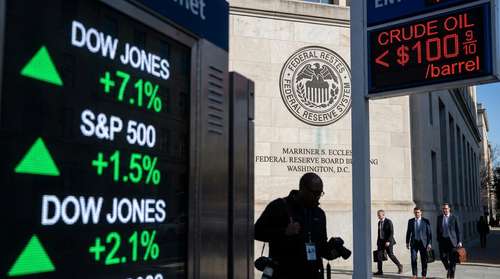
The highly anticipated Federal Reserve meeting March 2026 has officially kicked off against an unprecedented backdrop of global economic turbulence and geopolitical strife. As central bank policymakers convene in Washington today, Wall Street is breathing a collective sigh of relief. Major U.S. indexes are mounting an aggressive rebound, largely driven by a sudden retreat in energy costs. With global markets previously paralyzed by fears of an escalating Middle East conflict, the sudden dip in oil offers a vital, if temporary, lifeline for investors attempting to navigate one of the most unpredictable trading environments in recent history.
Wall Street Rebounds: The Stock Market Rally March 17
Bargain hunters and institutional investors alike swooped into the market early this week, sparking a massive broad-based recovery. The momentum behind the stock market rally March 17 pushed the S&P 500 up 1.0% to a comfortable 6,699. Tech shares followed suit, with the Nasdaq Composite surging 1.2% to 22,374, while the Dow Jones Industrial Average added nearly 0.8% to reach 46,946.
A resurgence in artificial intelligence-related equities initially catalyzed the upswing, heavily supported by Nvidia's massive GTC 2026 conference. However, tech is not the only sector driving the charge. Improved sentiment surrounding travel, consumer discretionary, and manufacturing stocks pushed all 11 sectors of the S&P 500 into positive territory. Investors are clearly interpreting the slight easing in global supply chain fears as an opportunity to secure discounted positions before the central bank finalizes its impending policy moves.
Geopolitical Tensions and Crude Oil Prices Today
The market's newfound optimism is intrinsically tied to shifting energy dynamics. Following a chaotic weekend of drone strikes near major Middle Eastern transit hubs and escalating regional conflicts, the global energy supply faced severe threats. Yet, efforts to coordinate safe shipping passages through the critical Strait of Hormuz have rapidly cooled the panic. Looking at crude oil prices today, front-month West Texas Intermediate (WTI) futures dropped sharply to settle at $93.50 per barrel, while the international Brent benchmark hovered precariously near $100.21.
This massive $6.71 spread between the two benchmarks highlights localized supply constraints and regional anxieties. For everyday consumers and market analysts following the latest inflation and energy crisis news, this slight drop from peak highs offers a glimmer of hope. Even so, energy prices remain a massive wild card. A sustained energy shock could aggressively transmit into broader consumer prices within two to six months, adding approximately 0.1 to 0.2 percentage points to headline inflation for every $10 increase, severely complicating the central bank's mandate for price stability.
High Stakes for the FOMC Interest Rate Decision
The core focus for global markets remains firmly fixed on the outcome of the ongoing policy summit. Traders and economists universally expect the upcoming FOMC interest rate decision to leave the benchmark federal funds rate unchanged at the 3.5% to 3.75% range for the second consecutive meeting. Just a few weeks ago, Wall Street overwhelmingly bet on a June rate cut. Those expectations have virtually evaporated.
According to the latest CME Group FedWatch data, futures markets are now pricing in a near-zero probability of immediate cuts, with expectations for the first easing cycle pushed all the way back to September. Policymakers face a classic economic trilemma: how to support employment and financial stability while battling supply-side price hikes that traditional monetary tools cannot easily fix.
What to Expect from the Jerome Powell Press Conference
When the policy gathering concludes, every word spoken during the Jerome Powell press conference will be meticulously dissected by automated trading algorithms and human analysts alike. Powell is expected to present a newly updated dot plot containing growth and inflation projections through late 2026. Given that this is one of the final pivotal meetings of his term, Powell's commentary on the distinction between transient supply shocks and entrenched core inflation will dictate the trajectory of the U.S. dollar and bond yields for the remainder of the quarter.
Adjusting the S&P 500 Forecast 2026
Looking ahead, financial institutions are rushing to recalibrate their models. Any realistic S&P 500 forecast 2026 must now account for prolonged exposure to elevated borrowing costs and the persistent threat of a renewed energy spike. If crude manages to break significantly above $100 and hold that level, analysts warn of a potential domino effect that could shave crucial percentage points off corporate earnings growth and trigger consumer spending pullbacks.
For now, equities are riding the wave of technological innovation and temporary energy relief. As the trading day continues, the ultimate direction of the economy rests heavily on how the Federal Reserve balances geopolitical realities against its domestic inflation fight.