
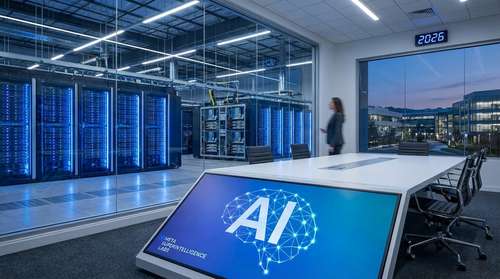
In a defining moment for the global technology sector, Meta Platforms has announced a staggering capital expenditure plan of up to $135 billion for 2026, signaling a 73% increase over the previous year. The announcement, made alongside a blockbuster fourth-quarter earnings report, confirms CEO Mark Zuckerberg's aggressive pivot toward dominating the Big Tech AI race. The historic investment is specifically earmarked to fuel the newly formed Meta Superintelligence Labs, a dedicated division tasked with achieving Artificial General Intelligence (AGI) and delivering "personal superintelligence" to billions of users.
The $135 Billion Gamble: Fueling Superintelligence Labs
The updated guidance, which projects Meta AI spending 2026 to land between $115 billion and $135 billion, represents one of the largest single-year infrastructure investments in corporate history. This massive capital injection is designed to support the computational hunger of Meta Superintelligence Labs (MSL), the company's elite new research entity.
Industry insiders report that MSL, led by recently recruited AI visionary Alexandr Wang, is moving beyond the company's legacy Llama models. The labs are reportedly focusing on next-generation architectures capable of reasoning and autonomy far surpassing current standards. "This isn't just about better chatbots," Zuckerberg stated during the earnings call. "We are building the infrastructure for the future of human-machine collaboration." The spending spree will largely flow into the semiconductor market 2026, securing vast quantities of next-gen GPUs and custom silicon to power massive new data centers.
Beyond Llama: 'Avocado' and the Strategic Pivot
While Meta's open-source Llama series became the industry standard for developers in 2024 and 2025, 2026 marks a strategic evolution. Sources close to the company suggest that MSL is developing a proprietary model codenamed "Avocado," designed to compete directly with closed systems from Google and OpenAI. This potential shift from a purely open-source philosophy to a hybrid approach underscores the immense value—and cost—of the AI infrastructure investment required to train frontier models.
The transition hasn't been without reorganization. Reports indicate that Meta is streamlining its legacy AI research teams to consolidate talent within the Superintelligence Labs. This "load-bearing" restructuring aims to accelerate the deployment of agentic AI models that can perform complex tasks on behalf of users, a core component of Mark Zuckerberg's AI strategy.
Infrastructure as the New Moat
The scale of Meta's buildout suggests that compute power is becoming the ultimate competitive moat. By securing a $135 billion war chest, Meta is effectively trying to price competitors out of the market. The sheer volume of energy and silicon required to run MSL's projected workloads indicates that Meta is preparing for an era where AI compute demand outstrips supply by an order of magnitude.
Wall Street Reacts: Revenue Surge vs. Capex Jitters
The massive spending forecast arrived on the heels of a stellar financial performance. Meta reported a fourth-quarter revenue surge of 24%, reaching nearly $60 billion, driven by AI-enhanced advertising tools that have dramatically improved return on ad spend (ROAS). This revenue beat provided the necessary cover for Zuckerberg to announce the eye-watering capex figures.
However, the Meta stock forecast remains a topic of heated debate. While shares initially surged on the revenue beat, the reality of a $135 billion spending bill has introduced volatility. Analysts are split: some view the expenditure as a necessary stake in the future, while others worry about the pressure on operating margins. "Meta is betting the farm on AGI," noted one senior tech analyst. "If Superintelligence Labs delivers, they win the decade. If not, the depreciation costs alone will be heavy."
The Global AI Arms Race
Meta is not acting in a vacuum. The announcement escalates the Big Tech AI race to unprecedented levels. With Alphabet and Amazon also projecting capital expenditures in the $175 billion and $200 billion range respectively, the industry is witnessing a collective trillion-dollar infrastructure buildout. However, Meta's focused bet on consumer-facing "personal superintelligence" differentiates its strategy from the cloud-centric approaches of its rivals.
As 2026 unfolds, the success of this gamble will depend on execution. Can Meta Superintelligence Labs translate $135 billion of silicon and steel into products that fundamentally change how humans interact with technology? For now, Zuckerberg has made his move, and the chips—quite literally—are all in.