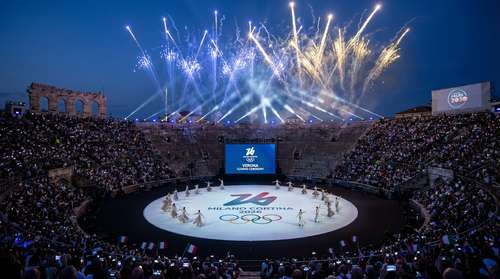
The curtain has officially fallen on the XXV Olympic Winter Games, as the world bid arrivederci to Milano Cortina 2026 in a spectacular closing ceremony held at the ancient Verona Arena. Under the starry skies of the Veneto region, the historic Roman amphitheater transformed into a stage of "Beauty in Action," marking the first time a UNESCO World Heritage site has hosted an Olympic finale. As the Olympic flame was extinguished, the event celebrated 16 days of thrilling competition and formally passed the baton to the 2030 Winter Olympics host, the French Alps.
Verona Arena Olympics Finale: "Beauty in Action"
Unlike the grandiose opening at San Siro in Milan, the Milano Cortina Closing Ceremony offered a more intimate, emotive experience for the 12,000 spectators and roughly 1,500 athletes in attendance. The show, titled "Beauty in Action," was directed by Alfredo Accatino and designed to weave together Italy’s rich tapestry of art, sport, and nature.
The ancient stone walls of the arena vibrated with energy as ballet superstar Roberto Bolle delivered a mesmerizing performance, embodying the harmony between athletic discipline and artistic expression. He was joined by the enigmatic singer-performer Achille Lauro and actress Benedetta Porcaroli, who guided the audience through a narrative celebrating Italian creativity. The absence of fireworks—a decision made to protect local wildlife—was replaced by a breathtaking light show that painted the amphitheater in Olympic colors, symbolizing a sustainable Italy Olympic finale.
Handover to French Alps 2030
One of the most anticipated moments was the ceremonial handover of the Olympic flag. In a historic transition, the mayors of Milan and Cortina d'Ampezzo returned the flag to IOC President Kirsty Coventry, who then entrusted it to the representatives of the French Alps, the confirmed 2030 Winter Olympics host.
The French delegation presented a glimpse of their vision with a segment titled "Le Grand Retour" (The Great Return). Led by Edgar Grospiron, president of the French Alps 2030 committee, the presentation utilized a minimalist theme of "Light" (Lumière) to symbolize the return of the Winter Games to their ancestral home in the Alps. The segment promised a return to the roots of winter sport, contrasting the urban-mountain dual hosting of 2026 with a pure alpine focus for 2030.
Winter Games Highlights 2026: Records and New Stars
As the celebrations concluded, fans and analysts turned their attention to the final Olympic medal count 2026. The games provided no shortage of historic moments. Germany’s dominance on the ice track continued, with Laura Nolte securing a decisive gold in the bobsled, cementing her legacy as one of the sport's greats.
Meanwhile, the bobsled track also saw history from Kaillie Humphries Armbruster, who clinched her sixth Olympic medal, adding another chapter to her storied career. In figure skating, the exhibition gala featured the dazzling talents of Ilia Malinin and Alysa Liu, whose performances earlier in the week were among the top Winter Games highlights 2026.
For the host nation, the debut of Ski Mountaineering (Skimo) was a particular point of pride, with Italian athletes performing strongly on the slopes of Bormio. The addition of this high-endurance sport connected the modern Olympics with the ancient traditions of alpine travel, fitting perfectly with the "Beauty in Action" theme.
Team Canada and International Standouts
The closing parade saw jubilant scenes as athletes marched into the arena. Canada’s flag bearers, short track speed skater Valérie Maltais and fellow skater Steven Dubois, led a spirited delegation after a successful campaign. France also celebrated a banner year, with the team on track to match their record medal haul from Sochi and PyeongChang, setting a high bar as they prepare to host the world in four years.
A Legacy of Two Cities
The 2026 Winter Olympics will be remembered as the most widespread games in history, spanning over 22,000 square kilometers across Lombardy and Veneto. From the ice rinks of Milan to the jagged peaks of the Dolomites, the dual-city concept proved that regional cooperation could deliver a sustainable, world-class event.
As the final notes rang out in the Verona Arena Olympics ceremony, the sentiment was clear: Italy had successfully bridged tradition and innovation. The flame may be out, but the legacy of Milano Cortina 2026—and the anticipation for the French Alps 2030—burns brighter than ever.