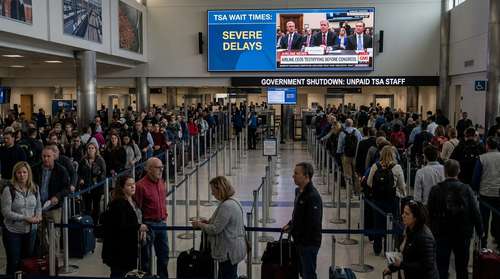
Millions of Americans heading to the airport are checking TSA wait times today with growing panic. A 29-day partial government shutdown has left roughly 50,000 airport security screeners working without pay, creating a perfect storm for the peak vacation season. What began as a partisan standoff over Department of Homeland Security funding and immigration enforcement reforms has morphed into a full-blown travel crisis. The Senate remains deadlocked, with Democrats refusing to fund the administration's demands without operational reforms, while Republicans accuse them of obstruction.
US Government Shutdown Travel Impact Hits Peak Season
With wait times stretching past three hours at major hubs like Houston's William P. Hobby Airport, the US government shutdown travel impact is severely disrupting planned vacations. Passengers across the country are facing massive bottlenecks, missed connections, and overwhelmed terminals. Industry leaders are now stepping in, demanding an immediate resolution before the aviation system buckles entirely under the weight of record-breaking passenger volumes.
Airline CEO Letter to Congress Demands Immediate Action
Frustration reached a boiling point on Sunday when executives from the nation's largest carriers issued a blistering airline CEO letter to Congress. The chiefs of American Airlines, United, Delta, Southwest, JetBlue, and Alaska Airlines demanded lawmakers end the funding lapse that started on February 13.
"Too many travelers are having to wait in extraordinarily long—and painfully slow—lines at checkpoints," the executives wrote, explicitly calling out the absurdity of making air travel a "political football" during legislative battles. The consortium, which also includes cargo giants FedEx and UPS, warned that continuous political gridlock is causing severe collateral damage to the American economy.
The timing of this unified industry pressure is critical. Airlines are bracing for 171 million passengers over the next two months—a 4 percent jump from the same period last year. As Spring Break 2026 travel delays cascade through the system, aviation leaders are demanding legislation to guarantee critical personnel are paid during future funding gaps.
Unpaid TSA Officers Spring Break Crisis Triggers Resignations
The human toll of the standoff became painfully clear last Friday when security personnel missed their first full paycheck. This acute financial strain is directly fueling the massive airport security lines shutdown travelers are navigating right now. The burden placed on unpaid TSA officers spring break schedules is resulting in skyrocketing absences and dangerous vulnerabilities at checkpoints nationwide.
More than 300 transportation security agents have officially resigned since the funding lapse began. Unscheduled absences have tripled from a historical average of two percent to over six percent nationally. The localized statistics paint a grim picture: Houston saw a staggering 53 percent call-out rate earlier this month, while New York's JFK International hit a 77 percent absence rate during a recent winter storm.
You cannot simply replace these highly trained security professionals overnight. Federal screening agents require up to six months of specialized instruction before they can operate a checkpoint independently. Union representatives have warned that officers calling out sick without a doctor's note could face disciplinary action. The American Federation of Government Employees continues to fiercely oppose any moves toward privatizing airport screening—a model used at San Francisco International Airport—arguing it would weaken aviation security.
Navigating Flight Cancellations March 2026 and Security Delays
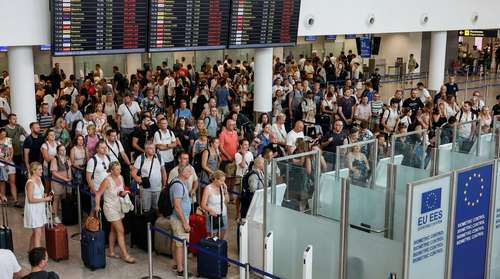
If you are flying this week, the reality is stark. Hubs in Austin, Atlanta, and New Orleans are regularly reporting queues snaking through baggage claim and out the terminal doors. While widespread flight cancellations March 2026 haven't yet reached the catastrophic levels of the 43-day shutdown in 2025—which forced a 10 percent flight cut—the threat remains imminent if walkouts accelerate.
Airlines and local airport authorities are urging passengers to fundamentally change their departure strategies. To survive the current chaos, consider these proven tactics:
- Arrive drastically early: Officials recommend showing up at least three hours prior to domestic departures and four hours for international flights.
- Leverage trusted traveler programs: PreCheck remains fully operational and is largely insulated from the worst delays, with most users clearing security in under 15 minutes. Furthermore, Global Entry processing resumed last Wednesday, helping ease congestion for arriving international passengers.
- Know your passenger rights: Travel legal experts note that if staffing shortages force airlines to ax your itinerary, federal regulations dictate you are entitled to a full cash refund if you choose not to accept the rebooked schedule.
- Pack light and prepare for luggage issues: With staffing strained across all airport operations, keeping essentials in your carry-on is vital. Remember that for baggage issues on domestic flights, airlines must reimburse reasonable expenses up to $3,800 per passenger under federal rules.
With no immediate breakthrough visible on Capitol Hill, the standoff continues to hold the traveling public hostage. Until lawmakers secure funding for the Department of Homeland Security, travelers must prepare for unprecedented friction at the terminal.