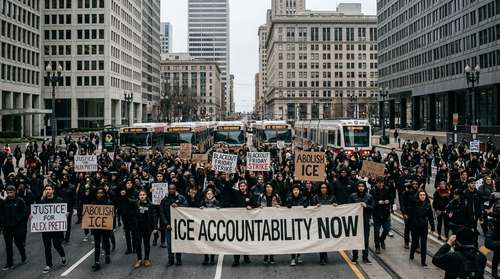
MINNEAPOLIS — Major American cities fell eerily quiet this morning as a nationwide "Blackout" strike took hold, shuttering businesses, emptying schools, and halting transit in a massive show of resistance against the Trump administration's aggressive immigration enforcement. The general strike, organized under the slogan "No Work, No School, No Shopping," comes as public outrage boils over following the fatal shooting of 37-year-old ICU nurse Alex Pretti by federal agents in Minneapolis last Saturday.
'Blackout Friday' Grips the Nation
From the shuttered storefronts of San Francisco's Mission District to the empty classrooms of Chicago, the impact of the "Blackout Friday" strike is visible across the country. Organizers from the grassroots coalition 50501 and local activist groups declared today a "Day of Truth & Freedom," urging Americans to freeze the economy to demand the immediate withdrawal of Immigration and Customs Enforcement (ICE) and Customs and Border Protection (CBP) agents from urban centers.
"This isn't just a protest; it's an economic intervention," said Elena Rodriguez, a strike organizer in Minneapolis, where the movement began. "They can ignore our chants, but they cannot ignore a paralyzed economy. We are shutting it down until there is justice for Alex Pretti, Renee Good, and every neighbor terrorized by Operation Metro Surge."
In Minneapolis, the epicenter of the unrest, downtown streets were largely deserted by 9:00 AM. Major employers reported significant absentee rates, and local businesses, including popular spots like the Book Club restaurant and Barbette, remained closed in solidarity. The strike has spread rapidly to the coasts, with over 50 institutions in San Francisco alone—including the Roxie Theater and Al Pastor Papi—announcing closures.
The Spark: The Killing of Alex Pretti
The strike was catalyzed by the release of harrowing bystander video footage showing the final moments of Alex Pretti on January 24. Pretti, a registered nurse at a VA hospital, was shot multiple times by CBP agents near Nicollet Avenue while filming an arrest. The footage, verified by multiple news outlets, contradicts initial official reports that claimed Pretti was "brandishing a weapon."
The video shows Pretti, phone in hand, attempting to verbally intervene as agents pushed a woman to the ground. Moments later, as agents surrounded him, shots rang out. "He was holding a phone, not a gun. He was a nurse trying to help," said Steve Schleicher, an attorney representing the Pretti family. "Alex was executed for exercising his First Amendment rights."
Pretti's death marks the second fatal shooting by federal agents in Minneapolis this month, following the January 7 killing of poet Renee Good. The twin tragedies have turned the city into a flashpoint for resistance against the "Operation Metro Surge" initiative launched by the second Trump administration earlier this year.
Federal Response and 'Operation Metro Surge'
The White House has staunchly defended the crackdown, citing the need to "restore order" and enforce immigration laws under the newly passed One Big Beautiful Bill Act, which nearly tripled ICE's budget for the 2025-2026 fiscal year. The legislation funded the deployment of thousands of additional federal agents to "sanctuary" jurisdictions, a move that critics argue has militarized American streets.
Department of Homeland Security officials stated that the agents involved in the Pretti shooting have been placed on administrative leave pending an investigation. However, the administration has shown no sign of scaling back operations. "We will not be deterred by anarchists shutting down coffee shops," a White House spokesperson posted on X (formerly Twitter) this morning. "The enforcement of our laws continues."
A Weekend of Unrest Ahead
Today's strike is merely the opening salvo of a weekend of planned demonstrations. Massive rallies are scheduled for Saturday in Washington D.C., Los Angeles, and New York City. In Minneapolis, protesters plan to converge on the federal courthouse at noon, defying local curfews.
The "Blackout" has also garnered support from unexpected corners. Several labor unions, usually hesitant to endorse wildcat strikes, have issued statements of support, citing the safety of their immigrant members. "Our members are afraid to go to work, not just because of the strike, but because they fear being snatched off the street," read a statement from a local service workers' union.
As the sun sets on a quieted nation, the tension is palpable. With the Trump administration digging in its heels and the protest movement gaining unprecedented momentum, the standoff over immigration enforcement has pushed the country into uncharted territory.