
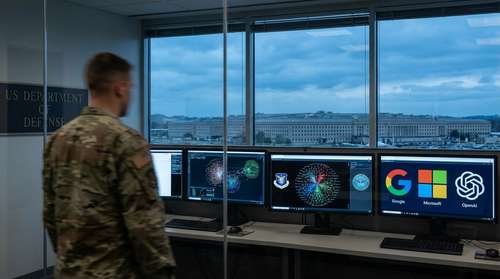
In a monumental shift for national security and modern warfare, the U.S. government has officially finalized the highly anticipated Pentagon AI contracts 2026, cementing landmark partnerships with eight of the world's most powerful technology firms. On Friday, May 1, the Department of Defense announced that industry titans—including Microsoft, OpenAI, Google, and Nvidia—will integrate their cutting-edge artificial intelligence models directly into highly secure military environments. This initiative is explicitly designed to transition the United States into a fully AI-first military force, accelerating battlefield logistics, intelligence synthesis, and rapid decision-making against emerging global threats.
Forging an AI-First Military Force on Classified Networks
To achieve decision superiority across all warfare domains, defense officials confirmed that these frontier commercial models will operate directly on classified military AI networks known as Impact Level 6 (IL6) and Impact Level 7 (IL7). IL6 handles secret national security data, while IL7 governs the Defense Department's most tightly guarded and sensitive computing environments.
The Pentagon intentionally diversified its vendor pool to avoid technological lock-in, integrating both proprietary systems and open-source models. The confirmed roster of tech partners includes:
- Microsoft and Amazon Web Services (AWS): Providing foundational cloud infrastructure and frontier AI models.
- Google: Deploying its Gemini architecture for classified defense workloads.
- OpenAI: Supplying advanced generative systems for complex operational environments.
- Nvidia: Utilizing its "Nemotron" models to build task-oriented AI agents rather than solely supplying hardware chips.
- SpaceX: Bringing its xAI and Grok capabilities to the modern battlefield.
- Reflection AI: A rapidly growing startup backed by Nvidia and 1789 Capital, positioned as an open-source counterweight to foreign developers.
- Oracle: Added to the initiative late Friday, causing a significant surge in its corporate stock price.
These systems all funnel through the Pentagon's central artificial intelligence platform, GenAI.mil. According to the agency, the platform has already been utilized by more than 1.3 million military and defense personnel over the past five months. Users have generated tens of millions of prompts and deployed hundreds of thousands of localized agents to compress critical analytical tasks that once took months into mere days.
Navigating the OpenAI Military Deal
The OpenAI military deal represents a massive paradigm shift in how commercial artificial intelligence intersects with the defense sector. Early in the generative AI boom, OpenAI's terms of service strictly prohibited any military applications. However, their updated agreements permit the operational deployment of ChatGPT-like technologies inside classified spaces, provided they align with "lawful operational use". A source familiar with the rollout indicated the arrangement includes explicit language demanding human oversight for any missions where systems act semi-autonomously, alongside strict mandates protecting civil liberties and constitutional rights.
Facing the Google Pentagon AI Protest
Not every corporate integration has been seamless, and the sweeping military initiative has reignited fierce ethical debates within Silicon Valley. Just days before the contracts were officially publicized, a massive Google Pentagon AI protest materialized internally. More than 600 employees, including high-level engineering directors and vice presidents, formally petitioned Google CEO Sundar Pichai to immediately cancel the defense deployment.
The protesting workers voiced intense concerns that classified workloads might quietly leverage Google's models for lethal autonomous targeting or mass surveillance without the developers' knowledge. Because the defense networks are strictly classified, public transparency is virtually non-existent. Despite the intense resistance, Google formally pushed forward with the agreement, recently rolling out its Gemini 3.1 Pro model on the GenAI.mil platform.
The Fallout: The Anthropic Pentagon Feud
Noticeably absent from Friday's historic announcement was Anthropic, the multi-billion-dollar developer of the widely used Claude chatbot. Their exclusion stems from a dramatic and highly public Anthropic Pentagon feud that peaked earlier this year.
Anthropic explicitly rejected the Defense Department's broad "lawful use" standard, demanding stricter contractual prohibitions against mass domestic surveillance and fully autonomous lethality. In response to the firm's refusal, Defense Secretary Pete Hegseth labeled Anthropic a "supply chain risk," while the Trump administration directed all federal agencies to actively offload Anthropic's technologies. Emil Michael, the Pentagon's newly appointed technology chief, emphasized that AI developers must align with the military's mandate and restrictions. This bitter legal and political battle cleared the path for competitors to secure exclusive footholds within the nation's defense apparatus, fundamentally reshaping the competitive landscape for federal tech funding.
Autonomous Defense and Future Investments
The Department of Defense's aggressive push for technological dominance requires an equally aggressive financial commitment. A prime example is the massive Department of Defense autonomous weapons budget, which recently requested a staggering $54 billion strictly for the development of autonomous warfare capabilities.
This unprecedented influx of capital highlights how heavily the military is leaning into algorithmic superiority. From coordinating sprawling drone swarms to accelerating target acquisition times and predicting supply chain bottlenecks, artificial intelligence is no longer a peripheral experiment; it is the core engine of the modern war machine.
As global superpowers continue to race toward digital supremacy, the Pentagon's decision to lock in eight heavyweights ensures the American military operates with the most advanced, resilient technology stack available. The integration of commercial artificial intelligence into the battlefield is a complete recalibration of how future conflicts will be analyzed, managed, and fought.