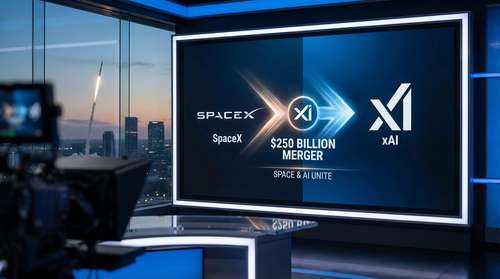
In a move that fundamentally reshapes the global technology landscape, Elon Musk has officially merged his aerospace giant SpaceX with his artificial intelligence startup, xAI. The blockbuster SpaceX xAI merger, finalized on February 2, 2026, values the AI venture at a staggering $250 billion, creating a combined entity worth an estimated $1.25 trillion. This strategic consolidation not only aims to dominate the future of orbital computing but has also propelled Musk’s personal fortune to an unprecedented milestone, with the Elon Musk net worth 800 billion mark now reportedly breached. By integrating advanced generative AI directly into the Starship and Starlink ecosystems, Musk is betting on a future where artificial intelligence is powered not by earthbound grids, but by space-based infrastructure.
The Strategic Vision: Why a $250 Billion Acquisition?
The 250 billion dollar acquisition of xAI by SpaceX is more than just a financial maneuver; it is a critical pivot in Musk's roadmap for humanity. Industry analysts suggest that the primary driver behind this deal is the physical limitation of terrestrial power grids. As AI models grow exponentially in size and complexity, their energy demands are outpacing what Earth's current infrastructure can reliably provide. Musk’s solution is bold: "orbital data centers."
By leveraging the massive payload capacity of the Starship rocket, SpaceX plans to launch dedicated AI-compute satellites powered by unfiltered solar energy. This AI space exploration technology will allow xAI’s Grok models to train and run without the cooling and power constraints faced by traditional data centers. This vertical integration secures xAI's future while giving SpaceX a lucrative new revenue stream beyond launch services and satellite internet.
Unlocking the Power of Starlink Artificial Intelligence
A key component of this merger is the deployment of Starlink artificial intelligence capabilities. The next generation of Starlink satellites won't just relay internet signals; they will serve as edge computing nodes. This means data processing can happen in orbit, reducing latency for critical applications like autonomous Tesla driving systems and real-time global defense monitoring. This synergy transforms Starlink from a communications network into a planetary-scale supercomputer.
SpaceX Valuation 2026: A Trillion-Dollar Titan
Following the merger, the SpaceX valuation 2026 projections have been revised upward aggressively. Prior to the deal, SpaceX was already the world's most valuable private company, but the addition of xAI's intellectual property and talent pool has pushed the combined valuation past $1.25 trillion. Investors are now clamoring for details on a potential initial public offering (IPO), which insiders rumor could happen as early as late 2026.
This valuation isn't just speculative hype. It reflects the company's dominance in launch capability—handling over 90% of global payload mass to orbit—and the rapid maturation of xAI's generative models. By consolidating these assets, Musk has created a "deep tech" conglomerate that has no direct competitor. Neither traditional aerospace contractors nor Silicon Valley AI labs possess this combination of launch hardware and neural network software.
Elon Musk Business News: Net Worth Hits $800 Billion
The financial ripples of this deal are personal as well as corporate. Breaking Elon Musk business news confirms that the revaluation of his holdings in both companies has catapulted his wealth into uncharted territory. With the Elon Musk net worth 800 billion threshold crossed, he is now worth more than the GDP of many mid-sized nations. This liquidity and asset value provide him with unparalleled resources to fund his ultimate ambition: the colonization of Mars.
Critics, however, point to the risks of such concentrated power. Regulatory bodies in the US and EU are expected to scrutinize the merger closely, concerned about the monopolistic potential of controlling both the physical access to space and the most advanced AI systems. Yet, with the deal already closed, unwinding this integration would be complex. For now, Musk stands alone at the apex of the new space age, with xAI as the digital brain guiding SpaceX's physical brawn.