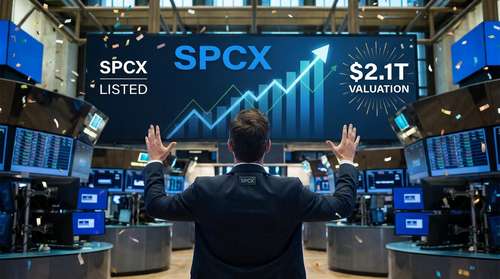
Aerospace juggernaut SpaceX just fundamentally rewrote Wall Street's record books. In a highly anticipated financial event, the SpaceX IPO officially executed on Friday, catapulting the space exploration company to a breathtaking $2.1 trillion market capitalization by the closing bell. Shares surged 19% during their inaugural trading session, transforming CEO Elon Musk into the world's first individual to amass a thirteen-figure fortune. With index funds now scrambling to position themselves ahead of the new trading week, financial analysts are closely monitoring how the newly minted public entity will navigate its astronomical valuation and unprecedented market influence.
The Largest IPO in History: Inside the SPCX Nasdaq Debut
SpaceX's long-awaited transition to public markets did not disappoint the pent-up institutional demand. Pricing initially at $135 per share, the offering raised a staggering $75 billion. This comfortably surpassed the previous global benchmark set by Saudi Aramco's $29 billion listing, officially making it the largest IPO in history. When shares finally began changing hands during the historic SPCX Nasdaq debut on June 12, 2026, retail and institutional demand immediately overpowered the available float.
The stock climbed rapidly throughout Friday's session, ultimately closing at $160.95. This opening day performance cemented a SpaceX valuation 2 trillion milestone, closing out the week at an eye-watering $2.1 trillion. Wall Street has rarely witnessed a market capitalization of this magnitude materialize practically overnight. While the broader technology sector has watched giants like Microsoft, Apple, and Amazon grow over decades, SpaceX bypassed the traditional gradual market ramp-up phase entirely.
From Private Unicorn to Public Titan
Just months prior in late 2025, internal share sales valued the rocket manufacturer at roughly $800 billion. The sheer velocity of this valuation markup highlights the immense premium public market investors are willing to pay for access to the rapidly expanding space economy.
The World's First Trillionaire: A Historic Wealth Milestone
The immense scale of this aerospace offering sent immediate shockwaves through global wealth indices. By the time markets closed on Friday, the astronomical equity spike had officially crowned Elon Musk a trillionaire. According to real-time financial tracking, his personal fortune now sits at an estimated $1.1 trillion, effectively shattering every modern record for individual wealth and redefining the ceiling of personal prosperity.
To put Elon Musk net worth 2026 into perspective, his fortune is now nearly four times the size of Google co-founder Larry Page's, who currently sits a distant second on the billionaire list at roughly $292.7 billion. The combined fortunes of Page, Sergey Brin ($270 billion), and Jeff Bezos ($251.5 billion) do not equal Musk's current standing. Retaining an estimated 42% ownership of the rocket and satellite internet manufacturer, Musk saw his personal balance sheet swell by hundreds of billions in a matter of hours. The combination of his massive equity stake in Tesla and the newly public SpaceX leaves his financial standing larger than the total gross domestic product of several developed nations.
What Fueled the $2.1 Trillion SpaceX Valuation?
Achieving a multi-trillion-dollar market cap on day one requires exceptional investor confidence in future growth. SpaceX generated a robust $18.7 billion in total revenue during 2025, representing a 33% year-over-year jump from 2024. This aggressive growth trajectory is heavily fueled by the rapid expansion of the Starlink broadband constellation, which achieved early profitability milestones, and highly lucrative government defense contracts.
Navigating Cash Burn and Capital Expenditures
However, the company's balance sheet tells a more complex story than top-line revenue suggests. Despite reporting $6.6 billion in adjusted EBITDA profit last year, SpaceX actually posted a net loss of nearly $5 billion. This deficit is driven primarily by aggressive capital expenditures, including massive artificial intelligence infrastructure investments and depreciation tied to launching thousands of low-Earth orbit satellites. Investors are clearly looking past these current cash burns, choosing instead to place a massive premium on the company's near-monopoly in orbital launch capabilities and its disruptive global telecommunications operations.
SPCX Stock Price Outlook and the Looming Passive Buying Surge
As traders and institutional portfolio managers digest the weekend's historic news, a secondary financial phenomenon is already taking shape behind the scenes. Major index-tracking funds are legally obligated to mirror broader market weightings. Because the company debuted with such an immense market capitalization, these passive funds must now accumulate massive blocks of shares to accurately reflect the heavily tracked indexes.
This impending wave of mandatory institutional purchasing will likely create intense upward pressure on the SPCX stock price in the coming weeks. Market strategists predict a volatile but aggressively bullish trading environment as active managers attempt to front-run the institutional block orders slated to hit the tape on Monday morning. Whether the aerospace giant can sustain this momentum long-term against potential regulatory hurdles and technical challenges remains a fierce debate among analysts. Regardless of short-term price action, this initial public offering has undeniably secured its place in financial history, completely reshaping the landscape of modern capital markets.