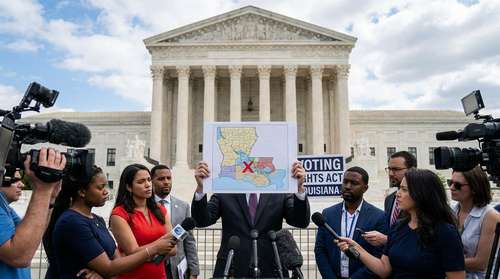
In a momentous 6-3 decision handed down on April 29, 2026, the nation's highest court overhauled the landscape of American elections. By ruling that a recently implemented congressional map is an unconstitutional gerrymander, the justices have fundamentally shifted the balance of political power. With the Louisiana majority-Black district struck down, civil rights advocates are warning of the severe 2026 midterm election impact as similar maps across the South face imminent threats of dissolution.
This pivotal Supreme Court redistricting 2026 ruling, formally known as Louisiana v. Callais, overturned a map adopted in 2024 that had temporarily afforded Black voters a second district in which they could elect a candidate of their choice. The case serves as the catalyst for what voting rights experts are calling a functional Voting Rights Act Section 2 gutting, drastically raising the legal threshold civil rights groups must meet to successfully prove vote dilution in federal court.
The Core of the Racial Gerrymandering SCOTUS Decision
Writing for the conservative majority, Justice Samuel Alito asserted that the state's revised congressional map placed undue emphasis on race over traditional redistricting criteria, thereby violating the 14th Amendment's Equal Protection Clause. Alito concluded that the landmark voting law did not mandate Louisiana to carve out an additional majority-minority district, meaning there was no compelling state interest to justify the boundaries of the revised map, known as Senate Bill 8.
The controversial map featured a district spanning diagonally across the state, linking disparate communities from the Shreveport area down through Alexandria, Lafayette, and Baton Rouge. During oral arguments, Chief Justice John Roberts characterized the district's shape as a "snake" stretching over 200 miles. This racial gerrymandering SCOTUS decision dictates that efforts to remedy historical discrimination cannot rely primarily on racial demographics when drawing district lines. Alito noted that plaintiffs challenging maps under Section 2 must now meet an updated standard, proving that a state intentionally drew lines to afford minority voters less opportunity strictly because of their race.
Dissenters Warn of Far-Reaching Consequences
The court's three liberal justices expressed sharp and vocal disagreement with the majority's legal framework. Justice Elena Kagan underscored the gravity of the moment by reading a searing 48-page dissent directly from the bench. She cautioned that the new precedent effectively renders Section 2 "all but a dead letter," eliminating the primary enforcement mechanism used to combat racially discriminatory election practices. Justice Sonia Sotomayor similarly condemned the ruling, arguing that the decision actively greenlights maps explicitly designed to disable minority communities.
Impact on Minority Representation in Congress
For Black Louisianans, the ruling erases a rare and hard-fought victory for political equity. Despite Black residents comprising approximately one-third of Louisiana's overall population, the state is now poised to revert to a congressional map featuring only a single majority-Black district out of six available seats. This judicial reversal directly threatens the seat currently held by Representative Cleo Fields, a Democrat who won the newly created second district during the 2024 elections.
The broader implications for minority representation in Congress are profound. Organizations like the ACLU and the NAACP argue that representation for voters of color will now depend almost entirely on the partisan goodwill of state legislatures rather than enforceable federal mandates. Following the 2013 Shelby County v. Holder decision which eliminated the preclearance system, Section 2 stood as the last nationwide safeguard against discriminatory voting systems. There is now immense concern surrounding future Congressional Black Caucus redistricting efforts, as lawmakers fear that long-standing diverse districts across the Sun Belt could be dismantled piece by piece under this newly established precedent.
Republican Cheers and the 2026 Midterm Election Impact
Conservative strategists and Republican officials have widely celebrated the ruling as a restoration of constitutional order and a victory for colorblind governance. Louisiana Attorney General Liz Murrill labeled the decision a "seismic" victory, asserting that it ends a prolonged nightmare of federal courts coercing the state into drawing racially focused maps. Similarly, the White House released a statement through spokesperson Abigail Jackson, calling the decision a complete triumph for voters and arguing that an individual's skin color should never dictate their congressional representation.
The legislative ripple effects have already begun to surface. In the hours following the Supreme Court's announcement, leaders in neighboring states initiated aggressive moves to capitalize on the court's reasoning. Mississippi Governor Tate Reeves signaled his intention to call a special legislative session focused on redistricting, while Republican lawmakers in Alabama began urging Governor Kay Ivey to follow suit.
As states move swiftly to redraw their congressional lines, the national political battleground is shifting dramatically just months ahead of key elections. By unwinding majority-minority districts that have traditionally favored Democratic candidates, the ruling is widely expected to bolster the Republican Party's chances of maintaining or expanding its narrow majority in the House of Representatives. By effectively dismantling one of the most successful civil rights frameworks in American history, the Supreme Court has set the stage for an extraordinarily contentious electoral cycle, permanently altering how communities of color participate in the democratic process.