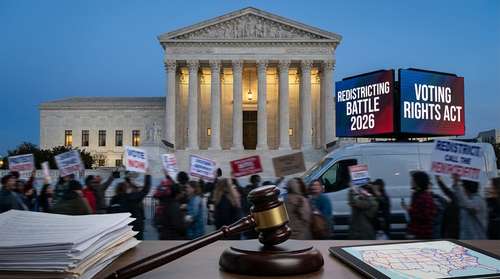
A landmark Supreme Court Voting Rights ruling handed down this week has sent shockwaves through the American political landscape, throwing the 2026 Midterm Primaries into immediate chaos. In a 6-3 decision on April 29, 2026, the conservative majority effectively neutralized Voting Rights Act Section 2 in the highly anticipated Louisiana v Callais decision. By ruling that Louisiana's congressional map containing two majority-minority districts constitutes "unconstitutional racial gerrymandering," the Court has sparked an aggressive redistricting battle 2026. Within hours of the decision, states began halting their election cycles, leading to suspended primaries and a frantic rush to redraw congressional lines ahead of November. For readers following Newsvot political news, this development fundamentally reshapes the battle for control of the U.S. House.
Understanding the Louisiana v Callais Decision
The core of the controversy stems from the unprecedented scope of the Louisiana v Callais decision. Originally tasked with evaluating whether Louisiana's revised congressional maps complied with the Voting Rights Act, the Supreme Court took the opportunity to overhaul decades of legal precedent. The conservative majority ruled that compliance with the Voting Rights Act does not justify the intentional use of race in drawing legislative districts, effectively removing federal mandates for states to create majority-minority voting blocs.
Justice Elena Kagan, writing for the three dissenting liberal justices, issued a scathing rebuke, characterizing the Supreme Court Voting Rights ruling as a "demolition" of civil rights protections that threatens a half-century of gains in voting equality. By ruling that prioritizing racial demographics to empower minority voters equates to unconstitutional gerrymandering, the Court has stripped away the primary legal mechanism used to prevent the dilution of minority voting power. This interpretation essentially guts Voting Rights Act Section 2, forcing plaintiffs to prove intentional racial discrimination rather than simply showing discriminatory electoral effects.
Louisiana Suspends 2026 Midterm Primaries
The immediate fallout from this Supreme Court Voting Rights ruling materialized first in Louisiana. Seizing on the judicial green light, Republican Governor Jeff Landry quickly declared a state of emergency and suspended the state's upcoming congressional primaries. This unprecedented delay gives the Republican-controlled legislature a critical window to scrap the existing map—which featured two majority-Black districts—and draft a new one that strongly favors their party.
Civil rights organizations and voter advocacy groups have already retaliated. Lawsuits were filed almost immediately challenging the suspension of the 2026 Midterm Primaries, arguing that state officials are unlawfully exploiting the ruling to secure additional safe seats for the GOP before voters head to the polls. However, with the highest court in the land having just provided the legal framework for these actions, lower courts find their hands tied, leaving election administrators scrambling to adjust voting schedules and ballot printing deadlines.
A Nationwide Redistricting Battle 2026 Begins
What started in Louisiana has rapidly metastasized into a nationwide redistricting battle 2026. Recognizing a rare opportunity to solidify their congressional majorities, Republican governors across the South are not waiting for the dust to settle. In states like Alabama, Florida, and Tennessee, executives are calling emergency legislative sessions to aggressively redraw their maps before the fast-approaching midterms.
Lawmakers in these states are utilizing the Louisiana v Callais decision as a legal shield. They are openly dismantling previously established majority-minority districts, arguing that such boundaries are now unconstitutional under the Fourteenth Amendment's Equal Protection Clause. Because the ruling dismantled the traditional enforcement of Voting Rights Act Section 2, state legislatures are operating with virtually no federal oversight regarding how racial demographics factor into their district lines. This unprecedented wave of mid-cycle map revisions creates a chaotic environment for incumbents and challengers alike. Legal experts warn that because the burden of proof has shifted entirely to plaintiffs to prove explicit racial intent—a notoriously difficult legal hurdle—these newly drawn maps are highly likely to survive any challenges brought before November.
The Impact on Election Map Changes 2026
As the clock ticks down toward the general election, these sweeping election map changes 2026 are drastically altering the competitive landscape. Political analysts suggest that the hasty redrawing of boundaries could shift multiple House seats nationwide, potentially insulating the Republican majority against what historical trends suggested might be a challenging midterm cycle.
Voters are now facing a period of intense uncertainty. The immediate consequences include:
- Shifted Timelines: Expect primary elections originally scheduled for May and June to be pushed into late summer to accommodate the complex map-drawing process.
- Candidate Confusion: Politicians who have spent months campaigning in specific districts may suddenly find themselves drawn out of their intended constituency.
- Voter Disenfranchisement Risks: Rapid changes to polling locations and district lines often lead to decreased voter turnout and severe administrative bottlenecks.
What Voters Can Expect Next
The coming weeks will feature a barrage of emergency litigation, special legislative sessions, and rapidly shifting primary dates. As the definitive source for Newsvot political news, we will continue to monitor how these election map changes 2026 unfold. One reality remains crystal clear: the Supreme Court has fundamentally transformed the mechanics of American elections, and the consequences of the Louisiana v Callais decision will resonate far beyond the 2026 Midterm Primaries. If you are preparing to cast your ballot this year, staying intimately informed on these local boundary shifts is more critical than ever.