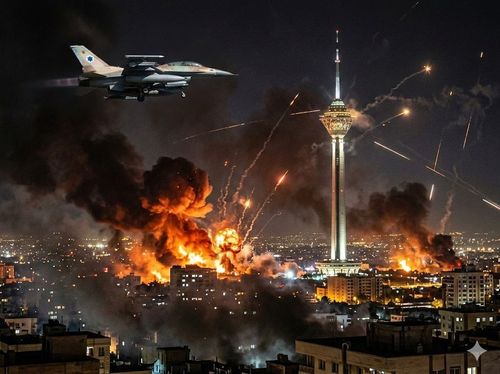
The Middle East has erupted into direct, open conflict. Early Saturday morning, Israel launched a massive preemptive attack on Iran, prompting Tehran to retaliate swiftly by firing waves of missiles toward Israeli territory.
Defense Minister Israel Katz initially confirmed the Israeli operation, stating it was necessary to "remove immediate threats to the State of Israel." Shortly after, Prime Minister Benjamin Netanyahu addressed the nation: "Today, we chose not to wait for the sword to fall. We have crippled the Iranian regime's ability to execute their planned assault. The message to our enemies is clear: there is nowhere in the Middle East the long arm of Israel cannot reach."
Immediately following the initial strikes in Tehran, the reality of a two-front war materialized. Sirens sounded across Tel Aviv and throughout Israel as the IDF issued nationwide emergency alerts directly to civilian cellular devices, instructing the public to remain near protected spaces as air defense systems engaged incoming Iranian projectiles.
Digital Darkness: Cyber Warfare Targets Iran's Grid
As the kinetic aerial battle unfolds, a parallel war is being waged in the digital domain. Concurrently with the airstrikes, Iran is experiencing a near-total disconnection from the global internet. Global cybersecurity monitors, including NetBlocks, report an unprecedented collapse of connectivity across the country.
Unlike previous internet shutdowns initiated by the Iranian regime to suppress domestic protests, current assessments indicate that Israel has intentionally crippled Iran's internet infrastructure via a complex cyberattack. The strategic objective is to paralyze the communication and command-and-control networks of the Islamic Revolutionary Guard Corps (IRGC), inducing chaos among decision-makers in Tehran during the critical hours of the conflict.
The American Posture
While the United States did not directly participate in the offensive strikes, defense and political analysts assess that an operation of this magnitude would not have proceeded without explicit American approval.
President Donald Trump released a statement from Washington addressing the escalation: "Israel is doing exactly what it has to do. We fully support their right to preempt a massive terror attack. The Iranian regime is playing a very dangerous game, and if they escalate further, the consequences will be like nothing they've ever seen. America stands strong with Israel, but we are taking every precaution to keep our people safe."
Following the President's remarks, the Pentagon placed U.S. Central Command (CENTCOM) forces on maximum alert and deployed additional THAAD and Patriot missile defense batteries across the region to intercept ongoing and future retaliations. Concurrently, the U.S. State Department escalated its travel advisories, mandating the immediate evacuation of all non-essential embassy staff and American citizens from Israel.
Regional Lockdown and A Prolonged Campaign
The exchange of fire has triggered a domino effect across the region. As of Saturday morning, the airspaces over Iran, Israel, Jordan, and Iraq have been completely shut down to civilian aviation.
Officials warn that this operation marks the beginning of a multi-day campaign rather than an isolated strike. As the situation remains highly volatile, with rapid developments and further escalations expected at any moment, the IDF has emphasized that citizens must strictly follow Home Front Command guidelines while the region braces for further volleys.