The dominance of Wall Street faces its most formidable test in decades as the Texas Stock Exchange (TXSE) prepares for its highly anticipated live debut this Monday, July 6, 2026. Following months of aggressive capital raising and regulatory maneuvering, the Dallas-based exchange will commence operations with a phased rollout of test stocks, officially introducing a heavyweight competitor to a landscape long controlled by the New York Stock Exchange and Nasdaq.
Backed by an impressive $270 million in funding from financial titans including BlackRock, Citadel Securities, and JPMorgan Chase, the TXSE launch Monday marks a pivotal shift in American capital markets. This is not merely a regional experiment; it is a coordinated, well-funded effort by the industry's largest players to inject friction and options into the business of corporate listings and stock trading.
The Dallas Financial Hub Powers a Wall Street Alternative
The momentum behind the Texas Stock Exchange did not materialize in a vacuum. Over the past five years, the Dallas financial hub has quietly transformed into a formidable mecca, affectionately dubbed 'Y'all Street' by industry insiders. Major institutions have increasingly voted with their geographic footprints, moving capital and talent to the Lone Star State.
JPMorgan Chase, for instance, now employs roughly 33,000 workers across Texas—eclipsing its 26,000-person headcount in New York. Goldman Sachs is constructing a $500 million campus in downtown Dallas designed to host more than 5,000 employees, making it the bank's largest hub outside of Manhattan. Even Charles Schwab relocated its corporate headquarters from California to Westlake, Texas, bringing trillions in client assets to the region.
This critical mass of talent and capital makes Dallas the logical home for a viable NYSE Nasdaq alternative. In fact, the threat of US stock market competition has become so pronounced that both incumbent exchanges recently established their own regional headquarters in Texas to defend their market share.
Why the TXSE Launch Monday Matters for Issuers
At the core of this capital markets news is a growing appetite among publicly traded companies for listing alternatives. The American investment system has long forced corporate executives to choose between two private, New York-based entities. According to TXSE CEO James Lee, the new exchange's mission is to offer alignment, stability, and transparency for corporate issuers and sponsors of exchange-traded products.
When the opening bell rings on Monday, the exchange will initially execute a phased rollout of test stocks to validate its electronic trading infrastructure. This methodical testing phase is a standard technical requirement before the platform can open its doors to primary corporate listings and dual-listed equities, which are expected to ramp up in the coming months.
Can the Texas Stock Exchange Break the Duopoly?
Financial history is littered with regional trading platforms—such as the Chicago Stock Exchange and Philadelphia Stock Exchange—that ultimately failed to maintain independence and were swallowed by the New York giants. Skeptics naturally question whether a Dallas-based upstart can genuinely disrupt the entrenched duopoly.
However, the unprecedented scale of institutional backing sets this Texas business news apart from past attempts. The TXSE is supported by 82 financial entities and business leaders. Crucially, its investor roster includes Citadel Securities and Charles Schwab, organizations that collectively manage and execute a massive percentage of daily US equity retail order flow. When the very firms responsible for routing trades hold an equity stake in a new exchange, the structural path to achieving necessary liquidity becomes significantly clearer.
By bringing heavyweights from both the buy-side and sell-side to the cap table, the founders have essentially pre-packaged the market ecosystem required for the exchange to survive its infancy. BlackRock's involvement alone—as the world's largest institutional manager with over $13 trillion in assets—provides an immediate stamp of institutional credibility.
A Shifting Center of Gravity in US Capital Markets
The establishment of a fully integrated, electronic national securities exchange in the Southeast quadrant of the United States goes beyond mere corporate rivalry. It signals a fundamental restructuring of how companies access public capital and where that capital is managed.
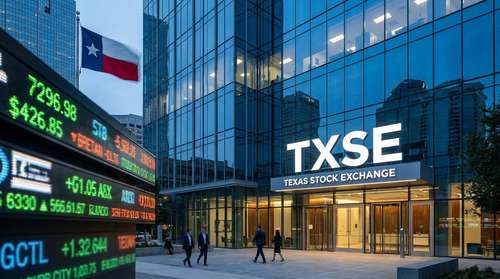
Texas boasts the eighth-largest economy in the world and serves as headquarters for the second-highest number of Fortune 500 companies in the nation. State leaders and corporate executives alike have championed the new trading floor as a natural extension of the region's economic expansion. In a symbol of its modern ambitions, the exchange has even engaged local authorities to install a sprawling, live digital stock ticker on its Dallas headquarters, aiming to recreate the energetic atmosphere of Times Square right in the heart of Texas. This physical presence will soon house over 100 dedicated employees focused on scaling the platform's operations.
Additionally, the broader implications for the Dallas economy are substantial. Beyond the immediate jobs created by the exchange itself, the influx of supportive infrastructure—from specialized legal counsel to financial technology vendors—promises to further entrench the region as a primary center for global finance.
As live operations begin Monday with test stocks, the financial sector will be closely monitoring the platform's execution and volume. While it will take time to lure flagship initial public offerings away from Wall Street, the Texas Stock Exchange has already succeeded in proving one point: the era of unquestioned market dominance by a two-player system is officially over.