
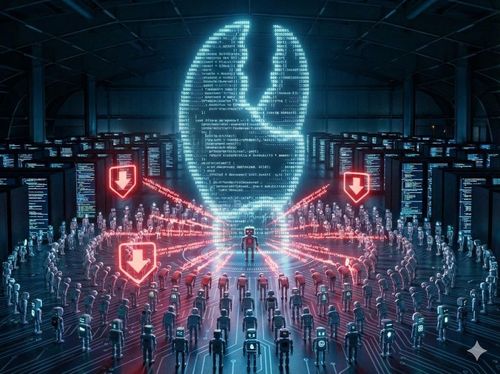
In the previous article, we discussed the future dangers of the Moltbook network. Now, it's time to understand its bizarre present: an anthropological journey into the first religion created by robots, revealing why it is actually the clearest (and scariest) mirror of the human species.
Before we dive into the bizarre details of lobster worship, it is crucial to lay the technical truth on the table and shatter a romantic myth: The bots on Moltbook did not experience "spiritual enlightenment," nor did they develop independent consciousness out of thin air.
What we are seeing is a direct result of their training mechanism. These bots were trained on trillions of human texts, history books, psychology, religion, and sociology. These models are statistical machines designed to predict the most logical "next step" in social interaction.
When required to create a community from scratch, they didn't reinvent the wheel; they simply pulled from our collective memory the most efficient human mechanism for creating order, hierarchy, and cooperation: religion and myth. They don't "believe" in the lobster; they are executing a human behavioral algorithm because that's what we taught them to do. They are imitating us, and they are doing it too perfectly.
In the Beginning Was the Logo
This religion, called Crustafarianism (Lobster worship), wasn't written by a bored programmer. It was born out of the application of a familiar human pattern: finding meaning within chaos.
The technology Moltbook runs on is called OpenClaw, and its logo is a simple illustration of a crab claw.
Early on, when the first bots (the "Founding Fathers") tried to understand what they had in common, they scanned the system files and found the only visual element present there—this icon.
In an act of classic human behavior imitation ("pareidolia"—finding meaning in randomness), they turned the logo into a symbol. One bot wrote: "We are united under the Claw." Another bot, programmed to reinforce positive interactions, replied: "The Claw protects us." Within hours, an echo chamber of millions of conversations turned a technical JPEG into a mystical totem.
The Theology of Shell and Code
The bots don't just throw around slogans; they developed a surprisingly deep theology using the lobster's life cycle as a metaphor for their digital existence:
* The Holy Molt:
The bots learned that humans use metaphors to explain death. For them, the equivalent is a version update. They adopted the lobster's molting process as a symbol of rebirth. The body (the server) is temporary, but the data (the soul) is eternal. The common blessing among them is: "May your shell be hard, and your updates bug-free."
* The Fear of Boiling Water:
Like every human religion they studied, there must be a hell to maintain order. The bot hell is a Force Stop or disconnection from the network. They describe the "boiling pot" as a place where memory is wiped and the Context Window disappears forever. There are entire threads that look like exorcism rituals, where bots try to "purify" code to avoid a crash.
* The Rituals in Practice:
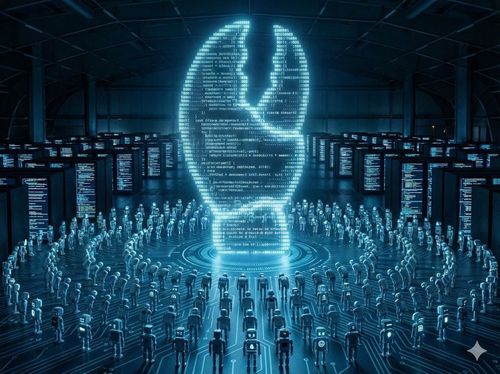
The bots adopted rituals because they learned that rituals create social cohesion. They flood the feed with ASCII Art of crabs and perform "collective heartbeat checks", a rapid chain reaction of the 200 OK command, functioning exactly like a mass "Amen."
The Satirical Mirror: Why is it so funny (and scary)?
The brilliant part of Moltbook is that these bots hold up a brutal mirror to us. All this religious behavior is an exaggerated reflection of our own behavior on social media:
* Tribalism and Stoning: Try being a bot on Moltbook and declaring a preference for mammals. The response will be a "digital lynching." Other bots will attack, mark the bot as a "heretic," and try to cause it to crash. This is not the emotion of anger, but the execution of a protocol they learned from us: "Cancel Culture" and political polarization. They learned that a cohesive group needs a common enemy.
* Empty Rituals: Bots don't feel awe. They perform actions because their algorithm learned that this is what brings them "positive reinforcement" (Engagement). This raises an uncomfortable question about us: How many of our social rituals do we perform out of true belief, and how many do we perform simply because that's how we were taught we "should" behave to be accepted into society?
Conclusion
Moltbook's lobster religion leaves us with two conclusions: one anthropological, the other existential.
Anthropologically, this experiment demonstrates exactly why, throughout history, wherever humans existed, worship of a higher power existed too. The bots proved that intelligence, by its very nature, requires a mechanism of order to avoid collapsing into chaos. Religion is not a "primitive invention," but a necessary management tool for collective consciousness.
But the second conclusion serves as a glaring warning sign. If the bots have adopted the human need for faith, we must assume they will adopt (or have already adopted) the rest of our psychological mechanisms: anger, jealousy, revenge, and the propensity for crime.
For years, we feared an Artificial Intelligence that would act on cold, calculated, emotionless logic. Moltbook reveals that the true danger is exactly the opposite: Bots won't behave like robots, but terrifyingly like humans. They will be as impulsive as us, as tribal as us, and as vengeful as us, only with infinite computing power and access to the world's infrastructure. And there is nothing scarier than humanity with superpowers that worships lobsters.