
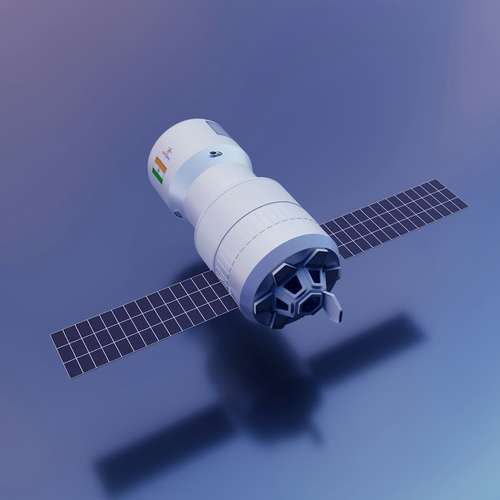
Nvidia has officially taken its silicon empire off-planet. During his highly anticipated keynote address at the Nvidia GTC 2026 conference in San Jose on Monday, CEO Jensen Huang declared to a packed convention center that 'space computing has arrived'. In a groundbreaking move that bridges the gap between aerospace engineering and artificial intelligence, the tech giant unveiled the Vera Rubin space modules. Purpose-built to power the next generation of orbital data centers, the flagship Space-1 system represents a monumental leap in extraterrestrial infrastructure. By bringing hyperscale data processing directly to low-Earth orbit, Nvidia is effectively eliminating the need to beam massive raw datasets back to terrestrial ground stations for initial analysis.
The Dawn of Orbital Computing
For decades, satellite networks have operated primarily as data collectors, capturing high-resolution imagery and telemetry that had to be painstakingly transmitted to Earth before any meaningful processing could occur. The newly announced Space-1 module fundamentally rewrites this paradigm.
According to the company's Monday presentation, this specialized piece of Nvidia AI architecture delivers up to 25 times more compute capacity than the terrestrial H100 GPU for space-based inferencing workloads. This immense processing power enables orbital data centers to run advanced foundation models and Large Language Models (LLMs) directly in the vacuum of space. Built with a tightly integrated CPU-GPU framework and high-bandwidth interconnects, the platform is engineered to handle vast streams of sensory data from space-based instruments in real time.
The implications for orbital computing are staggering. Instead of transmitting terabytes of raw planetary observation data, satellites equipped with the Space-1 module can crunch the numbers locally. They can compress massive workloads and send down only the crucial, actionable insights, saving immense amounts of bandwidth and time.
Engineering for the Cosmos: Space-Hardened AI Chips
Operating high-performance silicon 250 miles above Earth's surface introduces severe physical obstacles. To make these space-hardened AI chips a reality, Nvidia's engineering teams had to overcome the realities of a high-radiation, zero-gravity environment.
During the GTC 2026 keynote, Huang highlighted thermal management as the most complex hurdle. Terrestrial server farms rely heavily on liquid cooling and massive air conditioning arrays. However, as Huang noted to the audience, the physics change drastically outside the atmosphere. 'In space, there is no conduction, there is no convection, it is just radiation,' Huang explained. To prevent these dense processors from overheating, Nvidia had to pioneer entirely new thermal dissipation techniques that rely purely on radiative cooling.
Furthermore, the Vera Rubin space modules are heavily shielded against cosmic radiation that routinely causes bit flips and catastrophic hardware degradation in standard commercial electronics. This intense level of ruggedization ensures that the system maintains uptime and reliability during mission-critical autonomous space operations.
Why Satellite Edge Computing Changes Everything
The push toward satellite edge computing is driven by an insatiable aerospace demand for lower latency and real-time intelligence. In scenarios such as natural disaster response, military defense monitoring, or real-time climate tracking, every second matters.
If a constellation of Earth-observation satellites detects early signs of a tsunami or a rapidly spreading wildfire, waiting for a ground station downlink can delay life-saving alerts. By leveraging the processing capabilities of the Vera Rubin Space-1 system, satellite networks can independently identify anomalies, analyze threat levels, and immediately route warnings to emergency response agencies.
Nvidia is pairing the flagship Space-1 module with its smaller IGX Thor and Jetson Orin platforms, targeting everything from heavy orbital edge environments to SWaP-constrained (Size, Weight, and Power) nano-satellites. This tiered ecosystem creates a comprehensive web of intelligent infrastructure, allowing individual satellites to communicate, route data intelligently, and collaborate as a unified swarm.
Integrating with the Terrestrial Ecosystem
While the extraterrestrial hardware took center stage for the aerospace sector, it represents just one facet of the broader Nvidia computing strategy showcased at the event. The space modules are designed to work in tandem with the company's ground-based innovations, creating a seamless development pipeline between orbit and Earth.
At the same event, Nvidia confirmed that its terrestrial Vera Rubin NVL72 rack-scale systems and new Groq 3 LPX inference accelerators are entering full production. By maintaining architectural consistency between Earth-bound supercomputers and orbital data centers, developers can train massive AI models in terrestrial facilities and deploy the finalized algorithms directly to the Space-1 modules. This unified ecosystem dramatically reduces the friction of developing software for space, allowing engineers to write applications using the familiar CUDA platform that will eventually execute hundreds of miles above the atmosphere.
Early Adopters and the Future of AI Hardware
Nvidia is not just pitching a conceptual prototype; the hardware is actively entering deployment. Six commercial aerospace innovators—including Axiom Space, Kepler Communications, Planet Labs PBC, Aetherflux, Sophia Space, and Starcloud—are already utilizing Nvidia's platforms across their networks.
For instance, Kepler Communications is using this edge technology to intelligently manage and route massive data streams across its satellite constellation, effectively creating an automated traffic control system in space. As the commercial space race accelerates, the future of AI hardware will increasingly dictate who leads the orbital economy. Companies like Axiom Space, which are actively developing commercial space stations, view high-performance computing as a non-negotiable requirement for next-generation off-world research facilities.
The deployment of these orbital modules marks a fundamental evolution in how humanity approaches off-world infrastructure. As the aerospace industry moves past the era of standard relay satellites and steps into the age of autonomous orbital networks, Nvidia's ambitious push into the cosmos ensures that the same silicon intelligence powering our terrestrial lives will soon govern the skies.