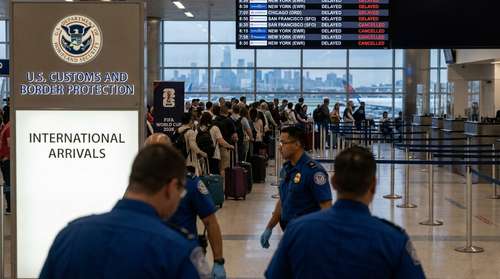
The travel and aviation industries are bracing for a catastrophic standoff this week following an unprecedented DHS airport customs threat. Department of Homeland Security Secretary Markwayne Mullin, who replaced Kristi Noem in March, recently confirmed that his agency is drawing up plans to halt airlines international flight processing by pulling Customs and Border Protection (CBP) officers from major airports in sanctuary cities. Triggered by intense immigration protests in New Jersey, this political maneuver threatens to paralyze global air traffic and devastate international tourism.
The Catalyst Behind the Sanctuary City Flight Ban
The sudden escalation stems from Memorial Day weekend protests outside Delaney Hall, an immigration detention facility in Newark. When local law enforcement allegedly refused to assist federal agents during the demonstrations, Mullin took to Fox News to voice his frustration. He suggested that if local officials refuse to cooperate with federal immigration laws, the federal government should not facilitate lucrative international travel into their jurisdictions.
'We are currently drawing up plans,' Mullin stated, adding that in sanctuary cities where local Democrats refuse to enforce federal laws, the agency should not be processing international flights either. The proposed sanctuary city flight ban would force the withdrawal of CBP personnel from key international gateways, severely limiting or entirely halting international arrivals in Democratic-led hubs like New York, Los Angeles, Chicago, Denver, and San Francisco.
Widespread Newark Airport Travel Chaos and Industry Backlash
If executed, the sheer logistical complexity of having CBP officers pulled from airports would instantly trigger widespread Newark airport travel chaos and beyond. Millions of passengers funnel through these hubs annually, with more than 50 million international travelers utilizing the three major New York-area airports last year alone. Diverting these flights is not as simple as drawing a new route on a map.
Airlines for America and the U.S. Travel Association have sounded the alarm. Industry watchers note that non-sanctuary hubs—such as Dallas-Fort Worth, Charlotte, and Miami—simply lack the gate capacity, staffing, and infrastructure to absorb a massive influx of diverted international flights. Rerouting flights requires renegotiating gate access, relocating ground staff, and entirely upending passenger itineraries, leaving airlines to foot an insurmountable bill.
The disruption would not stop at passenger travel. A significant portion of international cargo travels in the bellies of passenger aircraft. Halting these flights would sever critical supply chains, delaying essential goods and manufacturing components from reaching American businesses. Airlines would be forced into an impossible corner, having to somehow coordinate international arrivals at secondary domestic airports that simply lack the sprawling customs facilities required for high-volume processing.
Unprecedented Cabinet Pushback
The aggressive nature of the Markwayne Mullin airport crackdown has even sparked internal friction within the administration. Transportation Secretary Sean Duffy openly criticized the feasibility of the plan, noting during a congressional hearing that people around the world need to be able to fly into all different kinds of places, regardless of local politics. FAA Administrator Bryan Bedford echoed these concerns, warning that there are very limited opportunities to physically move international flights from one airport to another.
Looming 2026 World Cup Flight Disruptions
Perhaps the most immediate economic casualty of this brewing policy battle is the impending influx of global tourists. With matches scheduled across the United States in a matter of weeks—including highly anticipated games at MetLife Stadium in New Jersey—the threat of 2026 World Cup flight disruptions is sending shockwaves through the hospitality and tourism sectors.
Industry analysts argue that yanking customs operations from New York and Newark right before the world's largest sporting event is an economic non-starter. Foreign visitors rely heavily on these specific gateways to access the Northeast corridor. Throwing their travel plans into limbo would not only tarnish the country's reputation as a reliable host but also jeopardize billions of dollars in projected revenue for local businesses, hotels, and restaurants.
With international fans already holding non-refundable tickets and hotel reservations, a sudden logistical pivot would invite widespread chaos and international embarrassment. Mayors and local officials in targeted cities are already preparing legal challenges, arguing that the federal government cannot weaponize domestic commerce to punish local jurisdictions over unrelated political disputes. While the White House has yet to officially sign off on Mullin's proposal, the mere suggestion of weaponizing customs enforcement has airlines scrambling. Whether this remains a tough-talking political tactic or materializes into official policy, the ongoing uncertainty has already put the global travel sector on high alert.