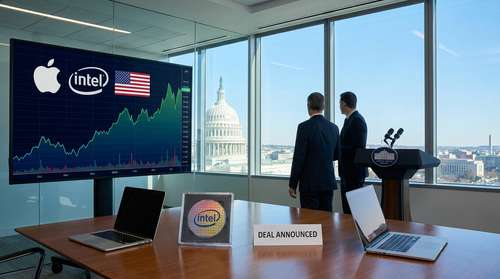
In a move that promises to dramatically reshape the global technology supply chain, U.S. President Donald Trump announced late Thursday that Apple has agreed to partner with Intel for domestic semiconductor manufacturing. The revelation of this massive Intel Apple chip deal immediately sent markets into a frenzy, triggering an Intel stock surge in 2026 that pushed the chipmaker's valuation near $600 billion. The agreement marks a critical milestone for U.S. semiconductor manufacturing and signals a profound shift in how Silicon Valley's most valuable company sources its silicon.
The Catalyst: Trump, Apple, and Intel
The news broke in a late-night post on Truth Social, where President Trump revealed that the iPhone manufacturer had committed to designing and fabricating processors within the United States. While rumors of an alliance had circulated since May, the Trump Apple Intel announcement provided the first concrete validation of the partnership.
"Apple has agreed to work with Intel to design and build its Chips in America," Trump wrote, further claiming that the administration's intervention helped secure the arrangement. He also noted that the U.S. government holds a 10% equity stake in Intel—an impactful arrangement orchestrated last year to rapidly scale the nation's foundry infrastructure.
Under the leadership of CEO Lip-Bu Tan, Intel has aggressively courted top-tier clients to revitalize its manufacturing division. Securing a commitment from Apple serves as the ultimate endorsement of Tan's turnaround strategy, proving that the company can attract the industry's most demanding hardware designers.
Driving Factors Behind Apple's TSMC Diversification
For years, Apple has relied almost exclusively on Taiwan Semiconductor Manufacturing Company (TSMC) to produce its cutting-edge M-series and A-series processors. However, the current landscape has made Apple TSMC diversification a strategic necessity rather than a mere geopolitical preference.
TSMC is currently operating under immense capacity strain, largely driven by the explosive demand for AI accelerators from companies like Nvidia and AMD. By moving a portion of its production to Intel, Apple is mitigating supply chain risks and ensuring it isn't completely reliant on a single supplier geographically concentrated in Taiwan.
Industry analysts at Wedbush note that this multi-year deal will likely begin with older or lower-end processors rather than the flagship silicon destined for the upcoming iPhone 18 Pro Max. Intel is expected to handle the fabrication of standard M-series chips for devices like the MacBook Air and iPad Pro, effectively freeing up TSMC's limited 2-nanometer capacity for Apple's most advanced requirements.
Advancing Domestic Chip Production and Intel Foundry 18A
At the technological heart of this agreement is Intel's ambitious manufacturing roadmap. The validation of the Intel foundry 18A (and the newly detailed 18A-P process) is a monumental victory for domestic chip production.
Intel has recently entered risk production for its advanced 18A node, positioning the company to rival TSMC's industry-leading technology. While full-scale manufacturing for Apple is not expected to reach maximum volume until mid-2027 at the earliest, the commitment provides the reliable revenue stream and operational scale Intel needs to perfect its fabrication lines.
This contract represents more than just a corporate victory; it is a tangible realization of broader efforts to onshore advanced technology. By localizing the production of processors that power tens of millions of consumer devices, the United States is rapidly decreasing its exposure to trans-Pacific logistical shocks and geopolitical tensions.
Intel Stock Surge 2026: Analyzing the Financial Impact
The financial markets reacted to the Truth Social post with immediate aggression. Pre-market trading saw Intel's shares leap by over 10%, opening at a staggering $133.82 and touching a record high of $135.13 in New York. To put this financial event into perspective, the company was trading near $19 just one year ago.
This meteoric rise reflects a broader market rotation toward companies actively building tangible infrastructure for the next generation of computing. While Apple shares also saw a modest uptick of roughly 1.5%, the overwhelming beneficiary is Intel. Market analysts point out that landing Apple fundamentally de-risks Intel's foundry business model, making it highly attractive to other fabless chipmakers who have been waiting to see if the American giant could truly compete with Asian foundries.
As the details of the agreement finalize over the coming months, the technology sector will be closely monitoring production timelines and capacity allocation. What remains clear today is that the era of complete reliance on overseas foundries is fracturing, and a new chapter of localized hardware manufacturing has definitively begun.