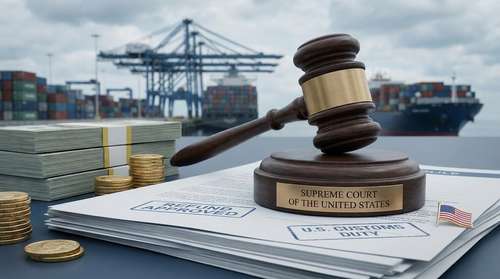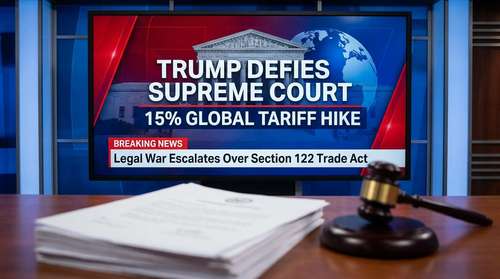
President Donald Trump has escalated his trade war to unprecedented heights, announcing a new 15 percent global tariff on imports just 24 hours after the U.S. Supreme Court declared his previous trade measures unconstitutional. In a move that legal experts are calling a direct challenge to the judiciary, the President is utilizing Section 122 of the Trade Act to bypass the high court's ruling, setting the stage for a historic constitutional crisis ahead of the 2026 midterm election news cycle.
Supreme Court Strikes Down Previous Levies in 6-3 Ruling
On Friday, February 20, 2026, the Supreme Court delivered a stunning rebuke to the administration, ruling 6-3 that the President had exceeded his authority by using the International Emergency Economic Powers Act (IEEPA) to impose sweeping tariffs. The justices argued that while the executive branch has broad powers during national emergencies, the power to levy US import taxes belongs primarily to Congress.
Chief Justice John Roberts, writing for the majority, stated that the IEEPA "does not authorize the president to impose tariffs" merely by declaring a national emergency. The decision was initially hailed by free-trade advocates and importers as a restoration of congressional authority. However, the victory appears to have been short-lived. President Trump blasted the decision on Truth Social as "ridiculous" and "poorly written," vowing an immediate counterattack that materialized less than a day later.
Trump Pivots to Section 122 of the Trade Act
In a rapid strategic pivot, the White House has invoked a seldom-used provision of the Trade Act of 1974 to implement the new duties. Section 122 of the Trade Act allows the President to impose temporary import surcharges of up to 15% for 150 days to address "large and serious" balance-of-payments deficits. Unlike the IEEPA, this section specifically mentions surcharges, providing a narrower but legally distinct pathway for the administration.
Initially proposing a 10% rate on Friday evening, President Trump raised the stakes on Saturday morning, February 21, hiking the levy to the maximum allowable 15 percent global tariff. "Please let this statement serve to represent that I... will be, effective immediately, raising the 10% Worldwide Tariff... to the fully allowed, and legally tested, 15% level," Trump posted. This maneuver effectively nullifies the immediate economic relief many businesses expected following the Supreme Court tariff ruling.
The 150-Day Clock is Ticking
Crucially, the authority granted under Section 122 is temporary. The tariffs can only remain in place for 150 days unless Congress votes to extend them. With the 2026 midterm election news cycle heating up, it is highly unlikely that a divided Congress will grant such an extension. This timeline creates a window of extreme economic uncertainty for businesses, who now face higher costs without knowing if the policy will persist beyond mid-summer.
Trump vs Supreme Court: A Constitutional Showdown
The swift reimposition of tariffs has triggered what many analysts are describing as a full-blown Trump vs Supreme Court showdown. By technically complying with the letter of the ruling (abandoning IEEPA) while defying its spirit (immediately reimposing taxes under a different statute), the President is testing the limits of executive power. Legal scholars warn that this back-and-forth could erode institutional stability.
"This is no longer just about trade policy; it is about who holds the ultimate power to tax the American people," said a senior constitutional law professor. The administration's aggressive posture suggests that Donald Trump tariffs 2026 will remain a central theme of his second term, regardless of judicial pushback. Democrats have already condemned the move, accusing the President of "pickpocketing the American people" to fund his agenda.
Economic Impact and Global Reaction
The economic fallout was immediate. Markets that had rallied on Friday's court news tumbled on Monday as the reality of a 15 percent global tariff set in. International partners, including key allies who thought they had secured exemptions, are scrambling to understand if the new "balance-of-payments" justification applies to them. While the White House has hinted that CUSMA-compliant goods from Canada and Mexico might remain exempt, the broad language of the announcement has left global supply chains in disarray.
For American consumers, the new levies mean that the price relief promised by the court's decision will not materialize. Retailers are warning that the costs of the US import taxes will be passed directly to shoppers, potentially reigniting inflation fears just as the economy was stabilizing. As the 150-day deadline approaches, the pressure on Congress to intervene—or on the courts to step in again—will reach a fever pitch.