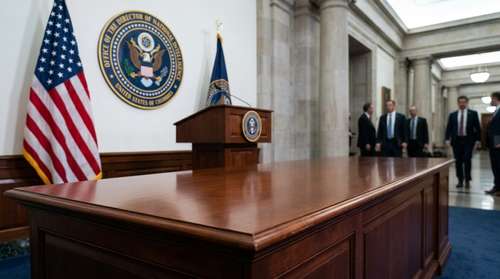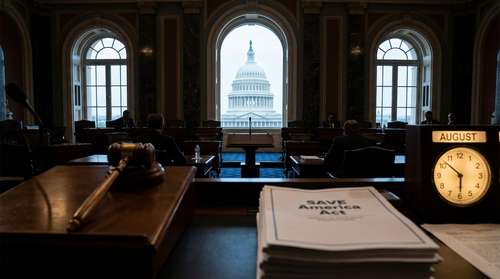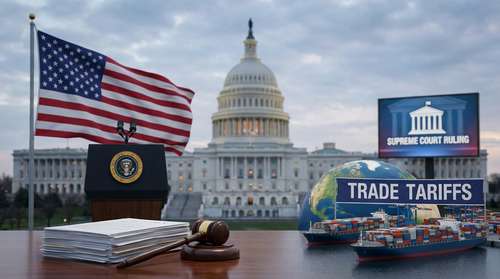
President Donald Trump has thrown Washington into a state of unprecedented paralysis, declaring a complete legislative boycott until Congress delivers a national Trump Voter ID Act to his desk. The commander-in-chief's refusal to sign any new legislation into law arrives at a perilous moment for the global economy. As the escalating conflict in the Middle East throttles shipping routes, the severe US Iran war impact has officially sent oil prices 100 dollars a barrel and beyond, igniting a fierce partisan brawl over emergency energy measures.
The Trump Legislative Freeze: A High-Stakes Ultimatum
In a bold maneuver designed to force the hands of Senate Democrats, President Trump announced that no federal funding extensions, infrastructure packages, or routine administrative bills will receive his signature without stringent new federal voting requirements attached. The proposed mandate would require strict proof of citizenship and government-issued photo identification for all federal elections, effectively overriding looser state-level voting regulations.
This Trump legislative freeze represents a massive gamble as the nation barrels toward the highly contested 2026 midterm elections. White House allies argue the hardline stance is an absolute necessity to secure election integrity, a cornerstone of the administration's platform. However, critics warn that holding the legislative process hostage during a period of international instability could have catastrophic consequences for the American public, particularly as economic pressures mount.
With crucial federal funding deadlines approaching, the boycott guarantees a dramatic showdown. Routine governance has ground to a halt, leaving emergency appropriations and defense authorizations caught in the crossfire of domestic partisan warfare.
Global Crisis Hits Home: Oil Markets Panic
The domestic political gridlock is unfolding against a backdrop of severe geopolitical turmoil. Over the weekend, the international benchmark Brent crude surged 13 percent to nearly $102 per barrel, while West Texas Intermediate (WTI) jumped nearly 19 percent to eclipse $108. The financial shockwaves mark the first time crude has traded in the triple digits since the 2022 supply shocks.
Market analysts attribute the dramatic spike directly to the expanding U.S.-Israeli military engagements with Tehran. The threat of Iranian missile and drone strikes has effectively paralyzed commercial transit through the Strait of Hormuz. With roughly 15 to 20 million barrels of crude—representing about 20 percent of the world's daily oil supply—unable to safely navigate the corridor, energy markets are bracing for a prolonged structural deficit.
The ripple effects are already crippling regional infrastructure. Neighboring producers like Iraq, Kuwait, and the United Arab Emirates have been forced to cut their oil production as storage facilities reach maximum capacity due to the halt in maritime exports. Barclays warns that if the strait remains impassable, Brent crude could swiftly approach $120 per barrel, triggering massive global inflation.
The Battle Over a Strategic Petroleum Reserve Release
As the overseas conflict deepens, the fallout at the domestic pump has been swift and punishing. Forecasts for gas prices March 2026 are increasingly grim, with the national average already spiking 50 cents to $3.45 per gallon over the last week. Petroleum analysts project prices could easily breach the $4 mark nationwide within days if supply chain disruptions persist.
The skyrocketing costs have triggered a bitter debate on Capitol Hill regarding a potential Strategic Petroleum Reserve release. Senate Democrats are demanding the White House immediately tap the national emergency stockpile to shield consumers from wartime price shocks. They argue that the SPR exists precisely for acute geopolitical emergencies like the current Middle Eastern blockade.
Yet, the administration and conservative lawmakers remain deeply resistant. Republican leadership argues that depleting the reserve now leaves the nation vulnerable if the Middle East crisis broadens, noting that the stockpile should be preserved for genuine catastrophic supply collapses rather than short-term price stabilization. Furthermore, the ongoing legislative blockade means any congressional action to mandate energy subsidies or direct reserve allocations is effectively dead on arrival.
Collision Course: The 2026 Midterm Elections
The convergence of a global energy crisis and a domestic government shutdown creates a highly volatile and unpredictable environment for the 2026 midterm elections. Incumbents on both sides of the aisle are facing furious constituents who are grappling with rapid inflation, soaring fuel bills, and congressional gridlock.
For the White House, the political calculus is clear: leverage the urgency of routine governance to fulfill a major campaign promise. By forcing opposition leaders to choose between passing the voter identification mandate or shouldering the blame for a paralyzed government, the administration hopes to secure a massive political victory.
Conversely, Democratic leaders are betting that voters will ultimately punish the president's party for playing procedural games while working families bear the brunt of a massive global energy crisis. Whether the legislative blockade breaks before the economic damage becomes irreversible remains to be seen. What is certain, however, is that Washington's standoff has turned a turbulent international conflict into a defining domestic crisis.