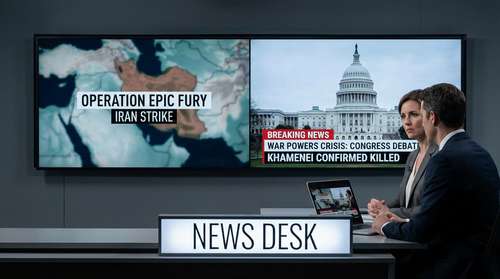
Washington, D.C. — In a seismic escalation of Middle East tensions, President Donald Trump has authorized "Operation Epic Fury," a massive joint military offensive with Israel that has reportedly decapitated the Iranian leadership, including Supreme Leader Ayatollah Ali Khamenei. The unilateral strikes, launched in the early hours of February 28, have plunged Washington into a fierce constitutional battle, with lawmakers from both parties scrambling to challenge the President's authority to wage what they are calling an illegal war of regime change.
Decapitation Strike: Khamenei Reported Dead
The operation, coordinated closely with Israeli forces—who dubbed their component "Operation Roaring Lion"—targeted hundreds of strategic sites across Iran. Precision strikes hit nuclear facilities, missile production complexes, and command centers in Tehran, Isfahan, and Qom. But the most consequential target was the fortified compound of Supreme Leader Ali Khamenei in central Tehran.
President Trump, breaking the news on Truth Social, declared that Khamenei, "one of the most evil people in History," had been eliminated. "He was unable to avoid our Intelligence and Highly Sophisticated Tracking Systems," Trump wrote, framing the death as "justice for the people of Iran." Israeli Prime Minister Benjamin Netanyahu corroborated the reports, stating there were "many signs" that the 86-year-old cleric was "no longer with us."
Intelligence sources indicate that the strike also claimed the lives of other top regime figures, including Supreme National Security Council secretary Ali Shamkhani and several high-ranking IRGC commanders. The sudden vacuum at the top of the Islamic Republic has created an unprecedented scenario, with reports of chaos within Iran's security apparatus and the IRGC scrambling to maintain order.
Congress Rebels: The War Powers Crisis
While the White House is victory-lapping the operation as a decisive blow against terror, the mood on Capitol Hill is explosive. Lawmakers were reportedly given no prior notice of the offensive, with notification provided to the "Gang of Eight" only minutes before the first Tomahawk missiles made impact. This lack of consultation has triggered a swift and furious response from Congress, igniting a constitutional showdown over war powers.
Senators Tim Kaine (D-VA), Chuck Schumer (D-NY), and Adam Schiff (D-CA) have announced the immediate introduction of a privileged War Powers Resolution intended to force a vote on the President's military actions. "The President has boxed us in and put us on the hook for a war of regime change that we never authorized," said Senator Kaine. "This is not just about defense; this is an unconstitutional, open-ended war."
Bipartisan Alarm
The unease is not limited to the opposition. Several key Republicans have expressed private concerns about the scale of the operation and the lack of a clear endgame. The administration's stated goal of "securing freedom" for the Iranian people suggests a commitment to nation-building or prolonged occupation—prospects that few in Congress are eager to fund. The War Powers Resolution aims to restrain the administration from further escalation without explicit congressional approval, though overriding a likely presidential veto remains a steep numerical challenge.
Regional Fallout and Retaliation
The reaction from Tehran was immediate and violent. Despite the reported loss of their Supreme Leader, surviving elements of the regime launched waves of ballistic missiles targeting Israel and U.S. bases in the Persian Gulf. Explosions have been reported in Tel Aviv and near U.S. assets in Bahrain and the UAE, though U.S. Central Command (CENTCOM) claims that air defense systems intercepted the vast majority of threats.
President Trump has appealed directly to the Iranian public, releasing a video message urging them to "take back your country" and asserting that "the hour of your freedom is at hand." This rhetoric marks a sharp pivot from the limited strikes of "Operation Midnight Hammer" in June 2025, which focused solely on nuclear containment. The shift to an explicit strategy of regime collapse carries immense risks, potentially fracturing Iran into civil war or empowering hardline factions to fight to the bitter end.
A New Era of Uncertainty
As smoke rises over Tehran and political firestorms consume Washington, the United States finds itself at the center of a conflict with undefined boundaries. The death of Khamenei ends a 37-year era of Iranian leadership but opens a Pandora's box of instability. With the War Powers Resolution gaining momentum, the coming days will test not only the resilience of the Iranian regime but the very limits of American presidential power in the 21st century.