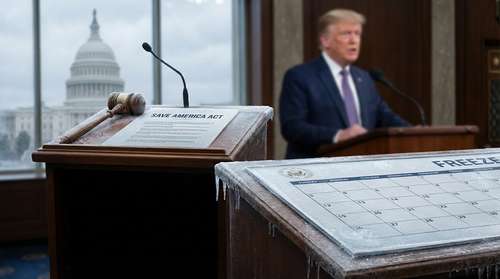
Washington is bracing for unprecedented gridlock as President Donald Trump's SAVE America Act standoff reaches a boiling point. The President has officially threatened a full Trump legislative freeze, vowing to withhold his signature from all congressional bills until his sweeping election integrity reform reaches his desk. This high-stakes ultimatum places the nation's legislative agenda in jeopardy, leaving crucial government funding and everyday operations in limbo as the 2026 midterm elections draw nearer.
Inside the SAVE America Act: Citizenship and ID Mandates
In a series of recent addresses in mid-March, Trump directed lawmakers to "go for the gold," explicitly demanding they pass the Safeguard American Voter Eligibility (SAVE) America Act. The legislation, which cleared the House on a tight 218-213 party-line vote in February, faces a massive roadblock in the upper chamber. With a unified Democratic blockade holding strong, the Senate filibuster 2026 showdown is testing the limits of Republican leadership and threatening a broader government shutdown.
At the heart of the current crisis is a fundamental dispute over how federal elections are conducted. The proposed legislation would mandate strict documentary voter citizenship proof—such as a passport or a physical birth certificate—for anyone attempting to register to vote. Furthermore, it would require valid photo identification for all in-person balloting across all fifty states.
Trump's demands extend even beyond the original text of the bill. The White House is now pushing for severe restrictions on mail-in voting, insisting that absentee ballots be banned entirely except for active military personnel, the disabled, or those traveling due to illness. A recent Harvard Harris poll indicated that 81% of Americans support standard photo ID requirements at the polls, but the logistical hurdles of forcing voters to provide birth certificates have sparked fierce partisan debate.
How Voter Registration Laws Could Shift
Critics and voting rights advocates warn that these stringent voter registration laws could disenfranchise millions of eligible citizens. Finding or replacing a birth certificate is often a costly and time-consuming process. Senate Minority Leader Chuck Schumer recently slammed the bill, arguing that the requirements could strip legitimate Americans of their voting rights simply because they lack immediate access to specific government paperwork. For married women who have legally changed their names, or naturalized citizens facing bureaucratic delays, the barriers to the ballot box would become significantly higher.
John Thune Senate Rules and the Procedural Nightmare
While the House managed to pass the bill, the Senate presents a formidable mathematical challenge for the GOP. Republicans currently hold 53 seats, falling well short of the 60 votes required to invoke cloture and break the Democratic blockade. This reality has thrust Senate Majority Leader John Thune into the crosshairs of his own party.
Conservative activists and the President himself have heavily pressured Thune to bypass standard John Thune Senate rules. Many on the right are demanding a "talking filibuster"—a grueling procedural maneuver that would force opposing Democrats to physically hold the Senate floor for days or weeks to sustain their obstruction. However, Thune has publicly poured cold water on the idea.
Addressing reporters on Capitol Hill, Thune stood firm against the pressure campaign. "The votes aren't there to nuke the filibuster, and the votes aren't there for a talking filibuster," the South Dakota Republican stated bluntly. Instead of altering the chamber's fundamental mechanics, leadership has opted for an extended debate period, fully aware that the math simply does not support a final floor vote without bipartisan compromise.
The Real-World Impact of a Legislative Blockade
The immediate consequences of this standoff are already rippling across the country. By executing a Trump legislative freeze, the White House has effectively tied unrelated government operations to the fate of the voting bill. Because the President refuses to sign alternative legislation, funding for critical agencies like the Department of Homeland Security remains stalled.
The effects are highly visible at major transit hubs. With federal workers facing delayed paychecks, airports from New Orleans to Los Angeles are reporting massive TSA agent shortages. Travelers are currently being urged to arrive up to four to five hours early for domestic flights as security lines stretch into parking garages. The blockade guarantees that no stopgap funding bills will see the Oval Office until the voting mandate is resolved.
What Comes Next for Election Integrity Reform?
As the standoff drags into late March, neither side appears willing to blink. Democrats view the defeat of the legislation as an existential necessity, arguing that capitulating would upend decades of voting access norms. Conversely, the White House sees the SAVE America Act as a non-negotiable cornerstone of their midterm strategy.
Unless a sudden, unlikely compromise emerges from the Senate floor, the United States is staring down months of systemic legislative paralysis. Whether the pressure of long airport lines and stalled federal funding will force a fracture in the Democratic coalition—or prompt the President to abandon his hardline stance—remains the defining question in Washington.