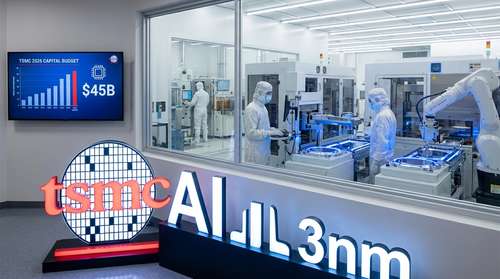
In a decisive move that underscores the semiconductor industry's explosive growth, TSMC has officially greenlit a massive $44.96 billion capital budget for 2026. The approval, finalized during Tuesday's board of directors meeting, marks a historic high for the world's leading chipmaker as it races to meet insatiable demand for AI chip production and next-generation silicon. With major clients like Nvidia and Apple clamoring for more capacity, this investment signals a new era of aggressive expansion for the Taiwanese giant.
TSMC 2026 Budget: A $45 Billion Bet on AI Dominance
The board's approval of approximately US$44.96 billion (NT$1.4 trillion) in capital appropriations is a direct response to the global AI hardware shortage. Unlike previous years where conservative estimates ruled, TSMC is now pivoting to an offensive strategy to maintain its technological lead. This war chest is specifically allocated for the installation and upgrade of advanced technology capacity, including the coveted 3nm chip technology and 2nm processes scheduled for mass production.
Industry analysts note that this appropriation differs from total capital expenditure (CapEx), effectively giving management the "checkbook" to execute projects rapidly. "This is not just about building more fabs; it's about building smarter, faster, and more advanced facilities to handle the complexity of generative AI workloads," noted a Taipei-based semiconductor analyst. The funds will also cover essential facility systems and the construction of new fabrication plants in Taiwan and abroad.
Accelerating 3nm Chip Technology and Advanced Packaging
A significant portion of the newly approved budget is earmarked for advanced chip packaging, specifically TSMC's CoWoS (Chip-on-Wafer-on-Substrate) technology. This packaging is the bottleneck in the supply chain for high-performance AI accelerators, such as Nvidia's Blackwell series. By expanding this capacity, TSMC aims to alleviate the supply constraints that have capped the growth of the broader AI sector.
Global Expansion: Spotlight on Kumamoto
The aggressive spending plan also touches TSMC's international footprint. CEO C.C. Wei recently confirmed plans to upgrade the company's second facility in Kumamoto, Japan, to produce 3nm chip technology. Originally slated for less advanced nodes, the pivot to 3nm in Japan highlights the ubiquity of demand for cutting-edge logic chips. This strategic shift ensures that semiconductor industry news continues to revolve around TSMC's ability to serve global markets from diversified locations.
Record Revenue and Employee Bonuses
The budget approval comes on the heels of a stellar financial performance. TSMC reported a staggering 37% year-over-year revenue jump for January 2026, totaling NT$401.3 billion. This financial windfall is trickling down to the workforce; the board approved a record-breaking employee bonus package totaling NT$206.15 billion (US$6.54 billion). The average payout per employee is expected to exceed NT$2.64 million, reflecting the company's robust health and the critical role its engineers play in the TSMC capital expenditure strategy.
Impact on the Global AI Hardware Shortage
For tech giants and data centers, TSMC's spending spree is the best news of 2026. The AI hardware shortage has been a persistent thorn in the side of innovation, with lead times for top-tier GPUs stretching for months. This $45 billion injection is expected to compress those timelines significantly by late 2026 and early 2027.
While competitors like Samsung and Intel grapple with yield issues and strategic pivots, TSMC's ability to deploy such massive capital effectively solidifies its monopoly on the high-end foundry market. As the TSMC 2026 budget begins to materialize into physical equipment and factories, the gap between supply and demand for AI processors is finally poised to narrow.