WASHINGTON, D.C. — The United States aviation system is bracing for a potential "catastrophic failure" as the clock ticks past the midnight January 30 government funding deadline. While Senate negotiators and the White House have reportedly struck a last-minute deal in principle to temporarily fund the Department of Homeland Security (DHS), a technical lapse appears all but inevitable with the House of Representatives out of session until Monday. For millions of travelers, this legislative gridlock threatens to collide with the lingering devastation of Winter Storm Fern, creating a perfect storm of disruption for the nation's airports.
Shutdown Deadline: A "Technical" Lapse with Real-World Consequences
As of Friday morning, the threat of a partial government shutdown remains critically high, with prediction markets pegging the likelihood of a funding lapse at nearly 69%. Although Senate Democrats and the Trump administration have reportedly agreed to a two-week stopgap measure for DHS to allow for continued negotiations, the logistics of passing this legislation are messy. With House Speaker Mike Johnson and the lower chamber not scheduled to return until Monday, a short-term "technical shutdown" over the weekend is now a distinct possibility.
This gap leaves over 50,000 Transportation Security Administration (TSA) officers and 14,000 air traffic controllers in a precarious position: working as "essential" employees without the guarantee of a timely paycheck. "Every hour of delay increases the likelihood that America's aviation system experiences a catastrophic failure due to underpaid, overstressed essential workers," warned a spokesperson for the National Air Traffic Controllers Association (NATCA). The fear is not just a legislative pause, but a morale collapse that could trigger a wave of sick-outs similar to those that crippled LaGuardia Airport in 2019.
The "Double Whammy": Political Gridlock Meets Winter Storm Fern
The timing could not be worse. The U.S. aviation network is already reeling from the impact of Winter Storm Fern, which forced over 10,000 flight cancellations earlier this week. Major hubs like Dallas-Fort Worth (DFW) and Charlotte (CLT) are still processing a backlog of displaced passengers and crews. Airlines are warning that the system has zero slack to handle a fresh crisis.
"We are seeing cascading delays nationwide as planes and crews are stuck in the wrong cities," noted an operational update from American Airlines. If TSA screening lines slow down due to staffing shortages this weekend, the fragile recovery from the storm could shatter, leading to a new round of ground stops and missed connections. The FAA has already issued warnings for potential wind-related delays in Boston and New York today, adding another layer of complexity for controllers who may soon be working for IOUs.
Why This Shutdown is Different: The Alex Pretti Factor
Unlike previous budget squabbles, this standoff is driven by a specific, volatile incident. Negotiations stalled over demands for reform within Immigration and Customs Enforcement (ICE) following the fatal shooting of Alex Pretti in Minnesota by federal agents earlier this month. Senate Democrats, led by Chuck Schumer, have refused to sign off on long-term DHS funding without new accountability measures, including mandatory body cameras and de-escalation training.
This specific sticking point has made the usual bipartisan rubber-stamping of security budgets impossible. "We cannot write a blank check while families in Minnesota are grieving without answers," one Senate aide told reporters. The compromise—a two-week extension—kicks the can down the road but keeps the immediate threat of a full DHS shutdown alive, leaving aviation workers as pawns in a heated debate over policing and immigration reform.
TSA and ATC: The Human Cost of Political Brinkmanship
For the rank-and-file workers keeping the skies safe, the uncertainty is taking a toll. The American Federation of Government Employees (AFGE), which represents TSA officers, reports that members are already facing extreme financial hardship. "Some of them have already quit, and many are considering quitting the federal workforce because of this shutdown threat," said Hydrick Thomas, AFGE TSA Council president.
Travelers flying this weekend should prepare for:
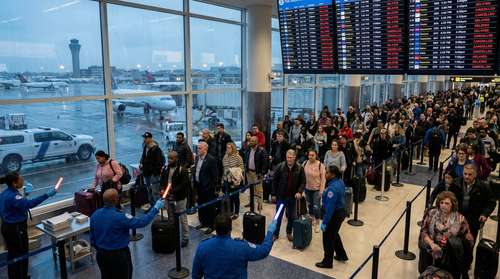
- Longer Security Lines: Even a small increase in TSA officer absenteeism can cause wait times to balloon by 30-60 minutes at major airports.
- Ground Stops: If air traffic control centers fall below minimum staffing levels due to "sick-outs," the FAA will mandate ground stops to maintain safety, as seen recently at Detroit Metro (DTW) during a mechanical emergency.
- Flight Delay Alerts: Download your airline's app and monitor flight status closely. Delays from staffing shortages often appear as "air traffic control" holds rather than airline-specific issues.
Spring Break 2026 at Risk?
The immediate crisis is the weekend, but the longer-term worry is the upcoming Spring Break travel season, which kicks off in late February. If the two-week temporary fix is the only solution Congress can muster, the aviation industry faces a rolling series of deadlines that destroy certainty for travelers. Airlines for America CEO Nicholas Calio warned that uncertainty "will devastate bookings and cost our industry billions," potentially mirroring the $6.1 billion loss from the 2025 shutdown.
For now, the message to travelers is clear: arrive early, pack patience, and keep a close eye on Washington. The government might technically be "open" on paper thanks to a last-minute deal, but for the workers on the front lines, the crisis is far from over.