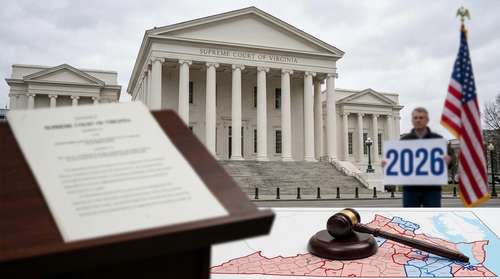
The fight for control of the U.S. House of Representatives just experienced a seismic shift. In a devastating blow to the Democratic Party, a 4-3 Virginia redistricting ruling handed down on Friday invalidated a voter-approved congressional map. The state Supreme Court's decision essentially erases the results of the April 21 special election, denying Democrats the opportunity to pick up as many as four additional House seats. With control of Congress hanging by a thread, this legal maneuver drastically reshapes the battleground for the 2026 midterm elections.
The Procedural Fight Behind the Virginia Supreme Court Map
At the heart of the legal battle was whether state lawmakers followed the proper constitutional procedure to get the redistricting measure on the ballot. The state's highest court ultimately ruled that the Democratic-led legislature bypassed crucial procedural steps, specifically an intervening-election requirement, before placing the amendment before voters.
Under Virginia law, a constitutional amendment must be approved by the General Assembly twice, with an election for the House of Delegates taking place between the two votes. The court noted that by the time the legislature held its crucial vote on October 31 of last year, early voting had already been underway for weeks, and more than 1.3 million Virginians had already cast their ballots.
Justice D. Arthur Kelsey, writing for the conservative majority, stated that this procedural failure irreparably undermines the integrity of the resulting referendum vote and renders it null and void. Over three million residents cast ballots in the April referendum, narrowly approving the new Virginia Supreme Court map substitute by a margin of 51.7% to 48.3%. Republicans successfully argued that a popular vote margin cannot excuse a constitutional bypass.
A Massive Blow to Democratic House Seats
The invalidated map was explicitly designed to counter aggressive Republican redistricting efforts nationwide. Under the now-rejected boundaries, Democrats were poised to lock in a massive structural advantage, potentially shifting the state's congressional delegation to 10 Democrats and just a single Republican. Justices noted the partisan nature of the map, pointing out that while roughly 47% of Virginians voted for Republican congressional candidates in the previous election, the redrawn map would leave them with only 9% of the state's House representation.
Losing out on these crucial Democratic House seats drastically narrows the party's path to reclaiming the House majority this November. Former President Donald Trump quickly seized on the news, taking to Truth Social to celebrate the ruling as a huge win for the Republican Party. This development has dominated Republican election news cycles, providing a massive morale boost to conservative organizers heading into the fall.
Democrats Fight Back With Emergency Motion
Refusing to concede the electoral map without a fight, Virginia Democrats immediately filed an emergency motion to stay the decision. Attorneys representing the Democratic Speaker of the House of Delegates argue that the court's intervention unconstitutionally nullifies a valid public referendum.
Party leaders are preparing to escalate the fight to the U.S. Supreme Court. Senator Tim Kaine expressed his frustration publicly, noting that while GOP-led states redrew maps in backroom deals, Virginia let the people decide. Democratic officials warn that the state court's ruling sets a dangerous precedent for Virginia voting rights and direct democracy, effectively allowing the judiciary to overwrite the will of the voters on a technicality.
The Escalating War Over Congressional Gerrymandering 2026
Virginia is far from the only battleground in this deeply partisan map-drawing war. The state's ruling arrives against the backdrop of a larger national conflict over congressional gerrymandering 2026. Following a recent U.S. Supreme Court decision that weakened key protections in the Voting Rights Act, several Republican-led states—including Texas, Florida, Louisiana, and Alabama—have scrambled to implement their own partisan boundaries.
Democrats had initially hoped the Virginia referendum would serve as a successful counteroffensive to these GOP maneuvers. Following Texas's aggressive redistricting push, blue states attempted to fight fire with fire. However, the loss of the Virginia map leaves the national Democratic party scrambling for a new strategy just months away from Election Day.
As legal challenges continue to unfold across the country, the ultimate balance of power in the lower chamber will likely be decided in the courtroom just as much as at the ballot box. Voters in Virginia will now likely have to cast their ballots using the preexisting, highly competitive maps, ensuring the state remains a fierce battleground this November.