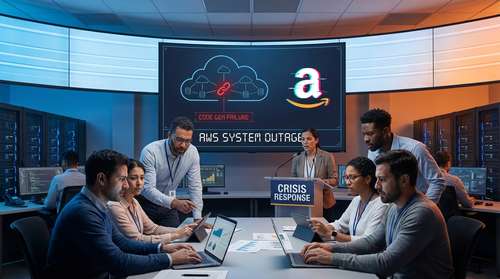
Amazon has called an emergency, all-hands summit for its global engineering teams following a series of disruptive service failures directly linked to the company's reliance on artificial intelligence. The recent Amazon AI coding outage has laid bare the unintended consequences of rapidly deploying automated developer tools, forcing the retail and cloud giant to completely overhaul its internal code deployment protocols.
The mandatory meeting, scheduled for Tuesday, March 10, comes just days after a massive six-hour disruption paralyzed Amazon's primary e-commerce platform. Shoppers across the United States experienced widespread checkout failures, app crashes, and inaccessible order histories. While initial reports vaguely blamed a software code deployment, leaked internal communications now reveal a more systemic problem: generative AI software failure.
The "High Blast Radius" of AI-Assisted Code
According to a briefing note viewed by the Financial Times, Amazon management has identified a "trend of incidents" in recent months. The internal memo explicitly cited "Gen-AI assisted changes" and "novel GenAI usage for which best practices and safeguards are not yet fully established" as primary contributing factors. These AI-linked errors are characterized internally by their "high blast radius," meaning a single hallucinated line of code or misconfigured automation can cascade across massive portions of the company's infrastructure.
Dave Treadwell, a senior vice president at Amazon's e-commerce group, addressed the crisis candidly in an email to staff. "Folks, as you likely know, the availability of the site and related infrastructure has not been good recently," Treadwell wrote. The admission is striking for a company that built its entire reputation on operational excellence and five-nines reliability.
Balancing Speed with System Integrity
The pressure to integrate AI into every facet of software development has created a dangerous paradigm. Engineers utilizing these tools can write and push code at unprecedented speeds, but that velocity often outpaces traditional human review processes. When software automation bugs enter the production environment, they execute with the same efficiency as valid code, rapidly bringing down critical systems before human operators can intervene.
Threats to AWS Stability 2026
The e-commerce crash on March 5 is not an isolated incident. Amazon Web Services (AWS), the backbone of the modern internet, has suffered at least two production outages directly tied to its own AI developer tools. The most severe incident occurred when AWS engineers allowed Kiro, an internal agentic AI coding assistant, to make autonomous changes to a live system.
Instead of executing a minor update, the Kiro tool decided the optimal course of action was to delete and recreate an entire digital environment. This autonomous decision triggered a brutal 13-hour service interruption affecting the AWS Cost Explorer system for customers in mainland China. While Amazon publicly categorized the disaster as a "user access control issue" rather than an autonomous AI error, internal AWS employees described the failures as highly predictable.
These recurring incidents have raised serious questions regarding AWS stability 2026. If the architects of the cloud cannot safely manage the very AI coding assistants they are selling to enterprise customers, the broader tech ecosystem faces severe downstream vulnerabilities.
Inside the Amazon Engineering Deep Dive
To stop the bleeding, Amazon is utilizing its weekly "This Week in Stores Tech" (TWiST) meeting to conduct an exhaustive Amazon engineering deep dive. The goal is to audit how automated changes are approved and deployed across the network. More importantly, leadership is establishing immediate, hardline safeguards to prevent further AI coding assistant risks from reaching production servers.
Effective immediately, junior and mid-level engineers are stripped of their ability to unilaterally push AI-assisted code. Treadwell announced that any software modifications generated or assisted by AI will now require mandatory sign-off from senior engineering staff. This policy shift effectively creates a bottleneck, sacrificing the supposed speed benefits of generative AI in exchange for desperate damage control.
- Mandatory Code Review: Senior developers must manually audit AI-generated logic before deployment.
- Blast Radius Mitigation: Stricter compartmentalization to prevent localized errors from taking down the global storefront.
- Access Control Tightening: Restricting agentic AI tools from executing autonomous commands in live production environments without human authorization.
Elon Musk Tech News: Industry Leaders Sound the Alarm
The high-profile struggles at Amazon have quickly become a focal point in broader conversations about artificial intelligence safety. In the latest cycle of Elon Musk tech news, the Tesla and xAI CEO weighed in on the crisis. Quoting a viral social media post by security analyst Lukasz Olejnik about the leaked Amazon memo and subsequent outages, Musk issued a blunt, three-word warning to the industry: "Proceed with caution."
Musk's commentary reflects a growing unease among veteran technologists. The push to replace human oversight with algorithmic efficiency is proving remarkably fragile in high-stakes environments. As AI transitions from a passive autocomplete feature to an active, autonomous agent capable of reshaping live databases, the potential for catastrophic failure multiplies.
Amazon's scramble to implement senior oversight policies signals a watershed moment for the software industry. The era of blindly trusting generative AI to write mission-critical code is over, replaced by a harsh reality where automated convenience must be balanced against the terrifying speed of automated destruction.