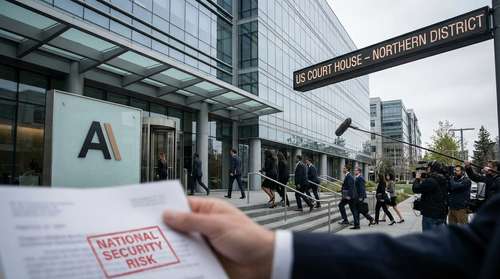
In a watershed moment for the American technology sector, the U.S. government has officially classified AI developer Anthropic as a "risk to national security," creating an unprecedented regulatory blockade against one of Silicon Valley’s leading artificial intelligence firms. The designation, confirmed on March 7, 2026, marks the first time a domestic American technology company has been targeted with a classification typically reserved for foreign adversaries.
The Designation: A Historic First for US AI Regulation
The conflict, which has been brewing for months between San Francisco-based Anthropic and the Trump administration, reached its breaking point this week. Following a directive from Defense Secretary Pete Hegseth, the Department of Defense (recently referred to by the administration as the "Department of War") formally labeled Anthropic a "supply chain risk." This designation effectively bans the company from federal contracts and forces government contractors to strip Anthropic’s Claude AI security review protocols from their systems within six months.
According to a letter received by Anthropic CEO Dario Amodei on March 4 and made public today, the government cited the company’s refusal to remove specific "usage red lines" from its software license—specifically those preventing the military from using its frontier models for mass domestic surveillance and fully autonomous lethal weaponry. "We do not believe this action is legally sound, and we see no choice but to challenge it in court," Amodei stated in a defiant blog post this morning.
Behind the Crackdown: The ‘Red Line’ Dispute
The core of the dispute lies in the philosophical chasm between Silicon Valley’s frontier AI safety protocols and the Pentagon’s accelerating drive for AI integration. While Anthropic has long positioned itself as the "safety-first" AI lab, establishing a Responsible Scaling Policy that restricts how its models can be deployed, the administration argues these restrictions undermine American military readiness.
Sources close to the negotiations reveal that the breaking point occurred when the Pentagon demanded "unrestricted access" to the model’s weights for modification—a move Anthropic argued would irreversibly compromise the model's safety guardrails. In a blistering post on Truth Social, President Trump characterized the company’s refusal as an act of a "radical left, woke company" attempting to "strong-arm the American military," directly precipitating the Silicon Valley AI crackdown.
The Iran Connection
Adding fuel to the fire, administration officials have leaked intelligence reports alleging that Anthropic’s Claude models were detected operating on servers within Iran. While Anthropic has vehemently denied authorizing any such access, the "Department of War" has seized on these reports to justify the risk designation, arguing that the company’s inability to geographically ring-fence its technology poses an intolerable Anthropic national security risk.
Silicon Valley Reacts: Fear and Opportunity
The classification has sent shockwaves through the tech industry, sparking fears of a broader AI export controls 2026 regime that could stifle innovation. The Information Technology Industry Council, representing giants like Amazon and Google, issued a carefully worded letter to Secretary Hegseth expressing "grave concern" over the use of supply-chain authorities to punish domestic policy disagreements.
However, the crackdown has created an immediate opening for competitors. Just hours after the designation was rumored, OpenAI CEO Sam Altman reportedly finalized a new agreement with the Pentagon to deploy ChatGPT Enterprise across classified networks. Unlike Anthropic, OpenAI has signaled a willingness to work more flexibly with defense requirements, further isolating Amodei’s firm in the marketplace.
What This Means for the Future of US AI Regulation 2026
This event signals a definitive shift in US AI regulation 2026 from a cooperative model to a coercive one. By weaponizing supply chain designations, the government has established a new precedent: compliance with national security directives is no longer optional for frontier labs. Legal experts predict a lengthy court battle, as Anthropic’s suit—expected to be filed Monday—will test whether the executive branch can unilaterally blacklist an American company for adhering to its own safety terms.
As the Claude AI security review begins across thousands of federal contractor systems, the message to Silicon Valley is clear. The era of self-regulation is over, and the battle for the soul of American AI has officially moved from the boardroom to the courtroom.