
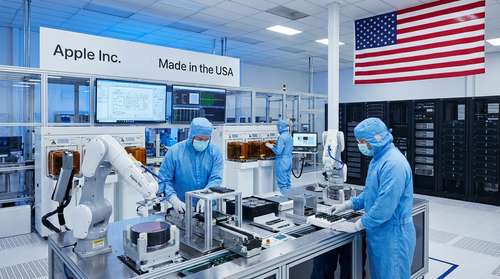
In a major move to secure its domestic supply chain, Apple announced a $400 million expansion of its Apple American Manufacturing Program on March 26, 2026. The tech giant is partnering with four major component suppliers—Bosch, Cirrus Logic, TDK, and Qnity Electronics—to bring the production of critical hardware directly to United States soil through 2030. This latest capital injection aims to accelerate U.S. semiconductor manufacturing and fortify the company's hardware ecosystem against global supply chain volatility.
"At Apple, we believe in the power of American innovation and manufacturing," CEO Tim Cook stated in a press release accompanying the announcement. The strategic move has quickly dominated Tim Cook tech news cycles, highlighting the company's aggressive strategy to localize the creation of advanced materials needed for everything from iPhone cameras to cutting-edge artificial intelligence systems.
Reshoring the Supply Chain: A $600 Billion Vision
The $400 million pledge is not an isolated initiative. It serves as the latest pillar in Apple's broader, four-year commitment to inject $600 billion into the American economy. By welcoming Bosch, Cirrus Logic, TDK, and Qnity Electronics into the fold, the company is proving that Apple supply chain reshoring is transitioning from a conceptual goal into a tangible reality.
For decades, the global electronics industry has relied heavily on overseas production facilities. However, rising geopolitical tensions and the need for semiconductor independence have prompted a massive strategic shift. The addition of these four strategic partners means that components previously imported from across the Pacific will now be manufactured in facilities spanning from Washington state to New York, securing thousands of U.S. high-tech jobs in the process.
Expanding Mac Mini Production
Adding to the momentum of localized manufacturing, Apple also revealed plans to begin producing a portion of its Mac mini supply in the United States later this year. The Mac mini will join the Mac Pro in being assembled domestically, marking another milestone in the company's ongoing effort to reduce its reliance on international assembly lines. Apple has absorbed over $3.3 billion in costs since the implementation of recent tariff policies. Shifting the assembly of the Mac mini to the U.S. acts as a crucial buffer against these escalating expenses. This realignment not only protects consumer pricing but also strengthens the brand's resilience against unforeseen global trade disputes.
Powering Face ID Technology and Critical Sensors
A closer look at the new partnerships reveals exactly how the $400 million will be allocated to enhance the everyday features of iPhones and iPads. By bringing production to American soil, Apple is drastically shortening the pipeline between component fabrication and final device assembly.
- Cirrus Logic and GlobalFoundries: Operating out of Malta, New York, these companies are establishing new semiconductor process technologies. The resulting components will power Apple's highly secure Face ID technology, bringing the production of these mixed-signal integrated circuits to America for the first time.
- TDK: As a long-time supplier for three decades, TDK will manufacture tunnel magnetoresistance (TMR) sensors at its U.S. facility. These specific sensors are the invisible force behind crucial hardware features, including advanced camera stabilization for the latest iPhones.
- Bosch and TSMC: On the West Coast, Bosch is teaming up with TSMC at a facility in Camas, Washington. Together, they will produce integrated circuits tailored for specialized sensing hardware. These chips are vital for life-saving features like the Apple Watch and iPhone Crash Detection and activity tracking systems.
Advancing Apple AI Chip Production and Materials
Hardware is only part of the equation; the underlying materials are equally vital. To maintain its competitive edge in artificial intelligence, Apple is bringing Qnity Electronics and HD MicroSystems into the program. These companies are tasked with developing and supplying the cutting-edge materials and technologies essential for advanced electronics and semiconductor manufacturing.
This partnership is a strategic cornerstone for Apple AI chip production. As the tech industry races to build more sophisticated machine learning models, the demand for high-performance computing components has skyrocketed. By securing the raw materials required for semiconductor fabrication on domestic soil, Apple is future-proofing its AI infrastructure. It ensures that the silicon architecture powering the next generation of Siri, computational photography, and generative AI tools is built with American materials. The intersection of artificial intelligence and hardware requires an unprecedented level of precision. Qnity Electronics and HD MicroSystems will provide the exact high-performance computing materials needed to push the boundaries of neural engines. As competitors scramble to source AI-capable processors globally, Apple's localized approach guarantees a steady, uninterrupted supply of the critical materials necessary for next-generation intelligence features.
The Future of U.S. Semiconductor Manufacturing
The expansion of the Apple American Manufacturing Program sends a clear signal to the rest of the industry: domestic production is necessary for long-term stability. The collaboration between Apple and established silicon giants like TSMC and GlobalFoundries accelerates the overall growth of U.S. semiconductor manufacturing, creating a ripple effect that benefits other domestic tech enterprises.
Furthermore, these investments translate into tangible economic benefits. Apple currently supports over 450,000 jobs across the United States and has outlined plans to add 20,000 more employees in sectors like research, chip design, software development, and AI. By funneling resources into local facilities, the company is directly contributing to the growth of a highly skilled workforce, ensuring that U.S. high-tech jobs remain globally competitive.
Ultimately, this $400 million commitment is more than a capital expenditure. It represents a fundamental realignment of how the world's most valuable technology company builds its flagship products. Through strategic partnerships with Bosch, Cirrus Logic, TDK, and Qnity Electronics, Apple is not just designing its future in California—it is manufacturing it across the United States. The commitment from CEO Tim Cook and his leadership team reflects a deep understanding of modern geopolitical realities. Relying on a single geographical region for electronic components is no longer a viable business strategy for a company of Apple's magnitude. By dispersing its manufacturing hubs across states like New York, Washington, and potentially others as the program grows, the tech giant is building an industrial safety net. This ensures that future iterations of the iPhone, iPad, and Mac will continue to ship on time, regardless of international trade conflicts.