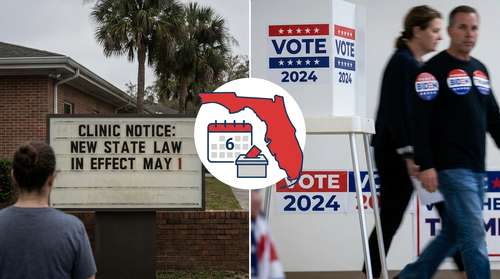
As of today, May 1, a controversial Florida abortion ban has officially taken effect, abruptly cutting off legal access to the procedure at six weeks of pregnancy. The new six-week abortion law replaces the previous 15-week restriction and dramatically reshapes the healthcare landscape across the southern United States. Before many women even know they are pregnant, they will now be turned away from clinics. This dramatic policy change is not just a major medical milestone; it is rapidly transforming into a defining flashpoint for the reproductive rights 2024 election battles occurring across the nation.
The Ground Reality of the Six-Week Abortion Law
For decades, the state served as a critical refuge for women seeking reproductive care across the Southeast. In a typical year, clinics here accounted for roughly 80,000 abortions, representing about 1 in 12 procedures nationwide. With the restrictive heartbeat bill Florida activists and lawmakers championed now enacted, women throughout the region are scrambling for safe alternatives.
Medical Professionals Voice Alarm
Healthcare providers are sounding the alarm over the severe new limitations on abortion access Florida residents now face. Dr. Leah Roberts, a reproductive endocrinologist based in Boca Raton, noted recently that these new legal hurdles are aggressively interfering with established medical science. Under the new restrictions, doctors face potential prison sentences for providing what was once standard reproductive care. This threat leaves medical teams hesitant to act even during emergencies.
While the law contains narrow exceptions to save a patient's life or in specific instances of rape and incest, medical professionals warn that vaguely written rules will delay vital care, particularly for nonviable pregnancies. Patients experiencing severe complications could now be forced to travel out of state to places like North Carolina, which remains the closest viable option for many seeking care.
The Regional Domino Effect
The impact of this legislation extends far beyond the state borders. Neighboring southern states have already implemented near-total bans, meaning that the loss of clinics in this region creates an expansive healthcare desert. Women without the financial means or flexibility to travel hundreds of miles are the most vulnerable. Advocacy groups are currently rushing to secure travel funds and logistical support, but the sheer volume of patients displaced by today's enactment threatens to overwhelm networks across the country.
Biden vs Trump Florida: Political Mobilization Heats Up
The political fallout has been immediate and intense. Both major political parties recognize that the realities of the Florida abortion ban will heavily influence voter turnout this November. In the unfolding Biden vs Trump Florida showdown, President Joe Biden’s campaign has directly linked the state's restrictions to former President Donald Trump. Democrats repeatedly point out that Trump's appointment of three conservative Supreme Court justices paved the way for the historic overturn of Roe v. Wade.
"There is one person responsible for this nightmare," Biden stated emphatically, making sure to keep the national spotlight directly on the issue. In a coordinated display of political force, Vice President Kamala Harris traveled to Jacksonville on May 1 to condemn the enactment of the ban. She stressed to audiences that millions of women woke up today with fewer freedoms than they had the day before. The Biden campaign sees this as a crucial opening to shift momentum in a state that has leaned heavily Republican since 2016.
On the other side of the aisle, Donald Trump has offered mixed messaging, recently suggesting that abortion policies should be left entirely to individual states. However, Democratic strategists hope the undeniable reality of this severe state-level restriction will mobilize suburban and independent voters who typically shy away from hardline conservative social policies, potentially putting the state back in play.
The Florida Ballot Initiative: A Path to Reversal?
While the legislative action championed by Governor Ron DeSantis has culminated in today's harsh restrictions, voters will ultimately have the final say at the polls. A high-stakes Florida ballot initiative has officially secured a spot on the upcoming November ballot. The proposed constitutional amendment aims to explicitly enshrine abortion rights into the state constitution, protecting access before fetal viability or when necessary to protect a patient's health.
Organizers collected roughly 1.5 million signatures to ensure this measure reached the voters, demonstrating robust grassroots mobilization across the state. The state Supreme Court, despite leaning conservative, ruled recently that the language of the ballot measure was clear enough to be presented to the public. If the amendment secures the required 60 percent supermajority to pass, it would effectively override the current six-week restriction.
Securing a 60 percent threshold is notoriously difficult, but advocates are banking on a nonpartisan approach. They are emphasizing that personal medical decisions should remain entirely between patients and their trusted healthcare providers, a message that resonates across party lines. Recent victories for abortion rights in conservative states like Ohio and Kansas give organizers hope that similar bipartisan coalitions can be formed here.
As the months tick down to November, the ongoing fallout from the Florida abortion ban stands as a massive test case for the resilience of reproductive freedom as a dominant voting issue. The convergence of strict state laws, a polarized presidential race, and direct-to-voter referendums guarantees that all eyes will remain on the Sunshine State. The decisions made here will undoubtedly set the blueprint for future state-level battles and potentially alter the landscape of the impending presidential race.