
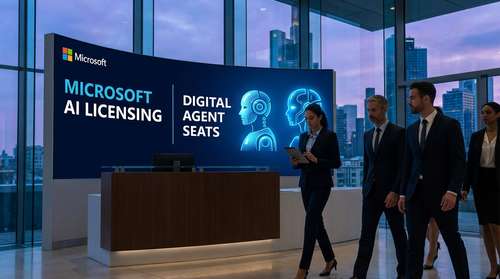
The enterprise software industry has long relied on a simple mathematical equation: more human employees mean more software subscriptions. However, as the realities of the AI workforce layoffs 2026 trend accelerate, Wall Street investors have grown increasingly anxious about a potential collapse in enterprise software revenue. If artificial intelligence allows companies to slash human headcount, the foundational "per-seat" business model of major tech providers risks crumbling. A controversial new Microsoft AI licensing strategy, however, aims to flip that assumption entirely on its head.
During a highly anticipated industry conference in early April 2026, Rajesh Jha, Microsoft executive vice president of the Experiences + Devices Group, outlined a provocative roadmap for the future of work. Rather than allowing artificial intelligence to erode the total number of paid subscriptions, Microsoft is positioning autonomous AI agents as independent, billable entities. The strategy officially introduces the concept of digital agent seats, fundamentally rewiring tech industry monetization for the era of automated labor.
The Math Behind Digital Agent Seats
Jha's proposed framework rests on treating an autonomous agent not as an anonymous background tool, but as a full-fledged software user. "All of those embodied agents are seat opportunities," Jha noted, envisioning a near-future where corporate networks host significantly more digital workers than human ones.
To illustrate the financial impact, Jha provided a stark mathematical example. Consider a company that currently employs 20 people, purchasing 20 standard Microsoft 365 licenses. Through aggressive AI integration, that organization might reduce its human workforce to just 10 employees. In a traditional model, the software vendor loses half its revenue. Under the new licensing paradigm, if each of those 10 remaining employees manages a team of five autonomous AI agents, the enterprise must purchase licenses for 10 humans and 40 digital agents. The vendor secures 50 paid seats, transforming a devastating human layoff into a massive revenue expansion.
This pivot shifts the core metric of enterprise software from ARPU (Average Revenue Per User) to ARPAA (Average Revenue Per Autonomous Agent). Organizations will soon find themselves negotiating enterprise agreements where every worker, human or digital, carries a specific price tag and requires a unique license key.
Navigating the Infrastructure of Autonomous AI Agents
Treating software bots as employees triggers immediate operational shifts for IT and procurement departments. An agent cannot simply piggyback on a human user's credentials without creating massive cybersecurity vulnerabilities and compliance blind spots.
Identity and Access Management
Microsoft is laying the groundwork for this shift by requiring distinct digital identities for agentic workflows. Enterprises will need to assign Entra Agent IDs to authenticate these nonhuman actors. This means digital workers will possess their own logins, secure mailboxes, and isolated workspaces within corporate systems. Security teams must manage credential rotation, configure scoped API access, and establish strict concurrency controls to monitor what these agents are doing and accessing at any given second.
Budgeting for the Hybrid Workforce
For Chief Financial Officers, this transition introduces complex forecasting challenges. While companies might save millions in human payroll and benefits, software expenditures could skyrocket. Microsoft's push ensures that the technological infrastructure originally built for human operators—from identity layers to data fabrics—remains entirely billable when utilized by digital colleagues.
Industry Pushback and Alternative Platforms
Despite Microsoft's confident push, the transition to charging for digital agent seats faces fierce skepticism from enterprise customers and industry analysts. Many corporate leaders argue that paying premium seat prices for a bot is effectively double-billing, especially when the underlying computing power is already being metered and monetized through cloud consumption fees.
Nenad Milicevic, a partner at the consulting firm AlixPartners, offers a counter-narrative to Jha's optimistic revenue projections. Milicevic argues that AI agents will drastically reduce the sheer volume of human interactions required within traditional software interfaces, ultimately slashing the need for licenses. Instead of 20 employees requiring full software suites, a single human supervisor might oversee a localized cluster of agents through a streamlined dashboard, sidestepping the need for individual software seats.
This philosophical clash sets the stage for a bruising battle over software pricing models. Milicevic and other critics suggest that Microsoft's rigid per-agent licensing could alienate cost-conscious enterprises, driving them toward open-source platforms. Competitors who allow businesses to run machine-based access freely—charging only for raw compute rather than individual agent licenses—could aggressively capture market share from traditional SaaS giants attempting to hold the line on seat-based billing.
The Broader Impact on Tech Industry Monetization
Microsoft is hardly the only company grappling with the financial implications of the automated workforce. Across the Silicon Valley ecosystem, major players like Salesforce, Workday, and Oracle are watching Microsoft's pricing experiment with intense interest. If the Seattle-based tech giant successfully normalizes the concept of paying for a digital worker, the entire Software-as-a-Service (SaaS) industry will likely follow suit in rapid succession.
This domino effect would trigger a profound restructuring of tech industry monetization. Historically, venture capitalists and institutional investors valued SaaS companies based on their ability to acquire and retain human users. Metrics like Net Revenue Retention (NRR) were inextricably linked to human hiring trends. By decoupling software revenue from human headcount, tech providers are attempting to build a firewall around their profit margins, ensuring that future waves of corporate downsizing do not translate into financial disaster for the vendors themselves.
However, this strategy places immense pressure on the perceived value of the software itself. If a company is expected to pay full-price subscriptions for a fleet of AI bots, those digital workers must deliver flawless, measurable return on investment. Procurement departments will demand granular analytics proving that an agent's output justifies its recurring monthly cost. The era of paying for idle software licenses is rapidly ending; in the agentic economy, every paid seat must prove its worth continuously.