
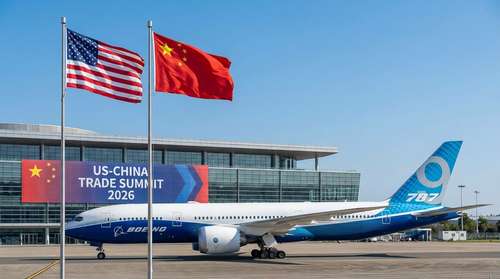
During a critical diplomatic visit to Beijing, President Donald Trump announced that China has committed to purchasing 200 Boeing aircraft. This landmark Boeing China deal, confirmed during meetings on Thursday and Friday, marks the end of a prolonged commercial drought for the American aerospace manufacturer in one of the world's most lucrative aviation markets. The high-profile agreement arrived during the closely watched Trump Xi summit 2026, signaling a renewed cooperative tone between the two economic superpowers. As global markets process the announcement, the multi-billion-dollar order aims to directly bolster American manufacturing jobs while fundamentally addressing the long-standing US trade deficit.
Inside the Trump Xi Summit 2026: Rebuilding Commercial Ties
The two-day diplomatic mission to China's capital featured intense negotiations designed to recalibrate the overarching US China trade agreement. Speaking to the press from the Chinese central leadership compound, President Trump hailed the diplomatic progress, noting that his administration secured "fantastic trade deals" that would mutually benefit both nations.
According to the president, American negotiators secured a larger aviation order than the manufacturer initially anticipated. "Boeing wanted 150, they got 200," Trump remarked during a television interview with Fox News. This order represents the first major commitment from Beijing to the U.S. manufacturer since a 300-jet agreement was signed in 2017.
To ensure the transaction's success, a heavy-hitting contingent of U.S. business leaders accompanied the president, including Boeing CEO Kelly Ortberg and U.S. Treasury Secretary Scott Bessent. Their presence underscored the administration's aggressive approach to expanding aerospace industry growth and securing lucrative export contracts that support domestic supply chains.
Boosting American Manufacturing Jobs and Closing the Trade Gap
The sheer scale of a 200-aircraft order carries massive implications for the U.S. industrial base. Commercial aviation remains one of the United States' most valuable export sectors. By injecting fresh capital into the production lines, this agreement aims to secure thousands of highly skilled American manufacturing jobs across multiple states.
Beyond the aviation sector, the broader framework discussed in Beijing is strategically engineered to narrow the US trade deficit. U.S. Trade Representative Jamieson Greer and other officials outlined that the tentative agreements include substantial commitments from Beijing across several critical sectors:
- Agricultural Exports: An agreement to purchase "double-digit billions" worth of American agricultural products annually over the next three years, heavily featuring soybeans to support U.S. farmers.
- Energy Resources: China has signaled strong interest in purchasing U.S. crude oil and liquefied natural gas to bypass Middle East shipping risks.
- Industrial Goods: The flagship 200-jet aviation package designed to keep factory lines moving and regain market share from European rival Airbus.
Catalyzing Aerospace Industry Growth
For Boeing, the stakes could not have been higher. China remains one of the world's largest aviation markets, requiring thousands of new aircraft over the next two decades to support its domestic travel demand. Securing a firm foothold back in this market is critical for long-term aerospace industry growth. While specific aircraft models were not fully itemized in the initial announcement, industry experts anticipate the order will heavily feature the 737 MAX family.
Boeing Stock News: Why Wall Street Reacted with Caution
Despite the historic nature of the announcement, the immediate Boeing stock news reflected mixed emotions on Wall Street. Following the president's remarks on Thursday, Boeing shares slipped by more than 4 percent in afternoon trading. To casual observers, a stock dip following a massive international order might seem counterintuitive, but financial analysts were pricing in much higher expectations.
Prior to the summit, industry speculation heavily suggested that Ortberg and the U.S. delegation were negotiating a mega-order of up to 500 aircraft, potentially including 100 wide-body jets. Because the finalized 200-jet package fell short of these lofty rumors, institutional investors adjusted their positions. Additionally, the broader market is closely monitoring how quickly Boeing can deliver these jets amidst ongoing regulatory scrutiny and historic production hurdles.
Shaping the Future of Economic Relations
The successful completion of this aerospace deal sets a pragmatic precedent for future bilateral negotiations. U.S. and Chinese officials are reportedly discussing the formation of a formalized "board of trade" to manage commerce in non-strategic sectors, isolating mutually beneficial economic activities from broader geopolitical frictions.
As President Xi prepares for a reciprocal visit to the United States scheduled for September 24, the groundwork laid during this summit will be heavily scrutinized. If Beijing honors its commitments to purchase aircraft, agricultural goods, and energy, it could mark a stabilizing era for international commerce. For now, the administration is celebrating the aerospace agreement as a concrete victory that brings home undeniable capital, fortifies the industrial base, and sets the stage for sustained domestic prosperity.