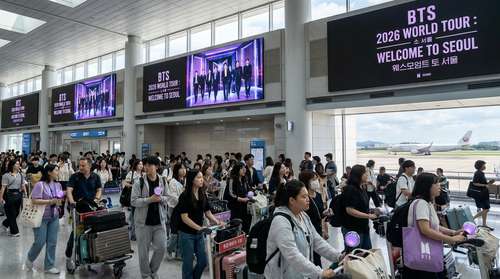
The highly anticipated BTS reunion 2026 has officially transformed from a pop culture milestone into a global economic phenomenon. After completing their mandatory military service, the seven-member powerhouse returned to the stage this spring, triggering an unprecedented South Korea travel surge. As the group launched their monumental BTS 2026 World Tour in April, the resulting influx of international fans radically reshaped the nation's hospitality landscape. Government data released this week reveals the country is currently experiencing a historic boom, breaking all-time tourism records for the first quarter of the year. From sold-out stadium shows in Goyang to a massive free concert in the heart of the capital, the comeback is redefining modern travel and boosting the regional economy.
South Korea Tourism Records Shattered by Global ARMY
In March 2026, South Korea welcomed a staggering 2.06 million foreign visitors, marking the highest single-month arrival figure in the nation's history. According to the Ministry of Culture, Sports and Tourism, this extraordinary wave of tourism contributed to a record-breaking 4.76 million arrivals in the first quarter, representing a 23% increase year-over-year. While geopolitical headwinds have slowed travel in other global regions, the magnetic pull of the group's return has proven entirely immune to economic friction. The release of their comeback album, ARIRANG, paired with a massive live-streamed concert at Gwanghwamun Square, set off a rapid chain reaction across the travel sector. Foreign credit card spending in the first quarter subsequently spiked 23%, reaching 3.21 trillion won (approximately $2.18 billion) as fans flooded local businesses.
The Impact on Seoul Hotel Bookings 2026
Finding a vacancy in the capital region has become a formidable challenge. The announcement of the band's return sent immediate shockwaves through the hospitality industry, heavily impacting Seoul hotel bookings 2026. When BigHit Music confirmed the initial tour dates, global travel searches for accommodations in Seoul jumped by 155% within just 48 hours. The scramble for rooms reached a fever pitch ahead of the group's March 21 comeback show, which was broadcast globally on Netflix. Accommodations surrounding the historic Gwanghwamun Square sold out almost instantly. This trend seamlessly continued into April as the group kicked off the first three nights of their world tour at the Goyang Comprehensive Stadium. For the hospitality sector, this is not a temporary weekend spike; fans are extending their stays, transforming quick concert trips into week-long cultural vacations that drive continuous local revenue.
Evolving K-pop Travel Trends: Moving Beyond the Capital
One of the most fascinating developments arising from this tourism boom is exactly how visitors are navigating the country. Traditional K-pop travel trends usually isolate tourist activity to major Seoul districts. However, early 2026 data indicates a significant geographical shift. Arrivals through regional airports have soared by 49.7% compared to the previous year. Additionally, the proportion of tourists exploring areas outside the Seoul metropolitan region has climbed to 34.5%.
The Rise of the Experiential Economy
Tourists are no longer satisfied with simply snapping a photo outside a concert venue. The modern travel experience demands deep cultural immersion. Concertgoers are actively turning their itineraries into comprehensive national tours. They are utilizing high-speed rail to visit music video filming locations, pop-up stores, and the members' hometowns across regions like Busan and Daegu. This shift toward experiential spending ensures that the tourism revenue benefits a highly diversified range of local merchants outside the immediate capital zone.
Tracking the Spending: International Flights to South Korea
The financial footprint of the reunion is staggering. Fans are not just booking international flights to South Korea; they are injecting heavy capital directly into the local economy. A recent analysis by Hana Card tracked the spending patterns of 30,000 foreign nationals who secured tickets for the first three Goyang tour stops between January 1 and April 12. The data revealed that these fans spent approximately 55.5 billion won ($37.7 million) in the country. The average spending per visitor hovered around 1.85 million won, covering luxury retail, local dining, beauty treatments, and transportation. Chinese tourists led the overall international influx with 1.45 million first-quarter arrivals, followed closely by Japanese and Taiwanese visitors, showcasing a robust regional recovery that outpaces broader global travel metrics. Aviation data reflects this massive shift. With flight capacities expanding to meet the overwhelming demand, international carriers are recording highly elevated load factors on routes bound for Incheon and Gimpo airports.
A Historic Blueprint for Music Tourism
With the world tour expanding to an anticipated 79 shows across 34 cities globally, the group's economic gravity will soon ripple across North America, Europe, and beyond. Yet, the initial kickoff has firmly established a new baseline for what music tourism can achieve. Financial analysts note that the traditional economic multiplier effect for concerts severely underestimates this specific cultural phenomenon. Because fans view these tour dates as major life events rather than casual entertainment, their length of stay and scale of consumption defy standard industry models. South Korea is actively proving that cultural exports can drive tangible, large-scale economic revival. As millions of fans continue to secure their spots for upcoming tour dates through 2027, the comeback stands as a historic blueprint. It demonstrates exactly how a single musical act can rewrite a nation's tourism records while uniting a global audience.