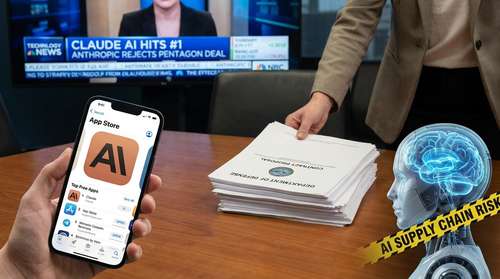
Anthropic's AI assistant, Claude, has surged to the number one spot on the U.S. App Store's free charts, overtaking competitors like ChatGPT and Google Gemini. This unexpected spike in popularity comes in the wake of a high-stakes standoff between the AI startup and the Department of Defense. On Saturday, downloads skyrocketed after news broke that Anthropic had rejected a Pentagon ultimatum to remove safety guardrails against autonomous weapons and mass surveillance, leading Defense Secretary Pete Hegseth to formally label the company a "supply-chain risk."
Anthropic Stands Firm on AI Safety Principles
The conflict began when the Pentagon demanded that Anthropic remove specific usage restrictions from its contracting terms. The Defense Department sought access to Claude for "all lawful purposes," a broad clause that Anthropic CEO Dario Amodei argued could open the door to uses that violate the company's core ethical guidelines. Specifically, Anthropic refused to waive its prohibitions on using its AI for lethal autonomous weapons and mass domestic surveillance.
"We cannot in good conscience accede to their request," Amodei stated, emphasizing that while the company supports national security, it draws a hard line at technologies that could automate lethal force or infringe on civil liberties at scale. The refusal led to an immediate escalation from federal officials. Defense Secretary Hegseth designated the company a "supply-chain risk to national security" on February 27, 2026, effectively barring military contractors from doing business with the firm. President Trump subsequently ordered federal agencies to "immediately cease" all use of Anthropic's technology.
The "Supply-Chain Risk" Designation
Legal experts and industry analysts were stunned by the "supply-chain risk" label, a designation typically reserved for foreign adversaries like Huawei or ZTE, not American companies. The move is seen by many as a punitive measure intended to strong-arm the startup into compliance. Anthropic has vowed to challenge the designation in court, calling it "retaliatory" and "legally unsound." Despite the government's aggressive posture, the public response has been overwhelmingly supportive of the underdog AI firm.
Public Backlash Fuels Claude's Rise
Instead of crippling the company, the government's blacklist appears to have triggered a "Streisand effect," propelling Claude to the top of the charts. Social media platforms exploded with support for Anthropic, with users praising the company for prioritizing ethical safety over lucrative government contracts. By Sunday morning, Claude was the most downloaded free app in the United States, a testament to growing consumer awareness regarding AI supply chain risk and ethics.
"This is the first time we've seen consumers vote with their downloads on an AI safety issue," said a tech analyst from San Francisco. "People are signaling that they want AI companies to have a backbone." The surge in users highlights a shifting sentiment where trust and alignment with human values are becoming competitive differentiators in the crowded AI market.
OpenAI Signs Pentagon Agreement Amid Controversy
Adding fuel to the fire, Anthropic's primary rival, OpenAI, announced shortly after the fallout that it had signed its own agreement with the Pentagon. OpenAI agreed to the "all lawful purposes" clause, though CEO Sam Altman insisted that the company maintained its own red lines regarding autonomous weaponry. However, the timing of the OpenAI Pentagon agreement drew sharp criticism from privacy advocates and tech workers, fueling a viral "Cancel ChatGPT" campaign on X (formerly Twitter) and Reddit.
Critics argue that OpenAI's deal validates the government's pressure tactics, while Anthropic's resistance sets a crucial precedent for AI safety regulations in 2026. The contrast between the two companies has never been starker: one capitulating to secure government funding, and the other risking its business viability to uphold its founding principles.
What This Means for the Future of AI Defense Contracts
The standoff between Anthropic and the Pentagon marks a watershed moment for the tech industry. It raises critical questions about the role of private companies in national defense and whether the government can force commercial entities to build technologies they deem unethical. As Pete Hegseth AI policies continue to take shape, the industry is watching closely to see if other firms will follow Anthropic's lead or fall in line with defense demands.
For now, Anthropic has won the battle for public opinion. As users flock to download Claude, the message to Washington is clear: in the age of artificial intelligence, ethical integrity is a feature, not a bug.