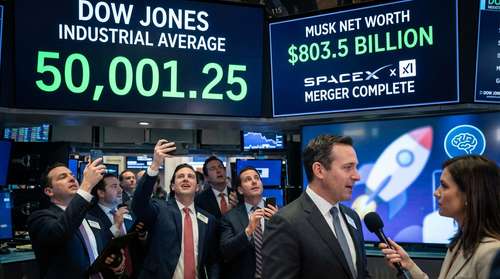
The Dow Jones Industrial Average made history on Monday, shattering the 50,000-point barrier for the first time—a psychological and financial milestone that seemed decades away just a few years ago. This unprecedented surge, closing at 50,115.67, comes on the heels of a massive global market rally ignited by the consolidation of Elon Musk’s corporate empire. As artificial intelligence stocks rebound from last week’s volatility, the merger between SpaceX and xAI has not only reshaped the tech landscape but also catapulted Musk’s personal net worth to a staggering $852 billion.
The 50,000 Milestone: A New Era for Wall Street
Friday’s trading session will be remembered as the moment the “Trump Bump” met the AI supercycle. After a bruising selloff earlier in the week driven by fears of an AI bubble, the blue-chip index roared back, gaining over 1,200 points in a single session. The rally was broad-based but led by familiar titans: Nvidia surged 8%, recovering recent losses, while industrial bellwether Caterpillar jumped 7%, fueled by the fiscal stimulus promises of the administration's "One Big Beautiful Act."
“This isn’t just a number; it’s a validation of the productivity boom we’ve been promising,” said Scott Wren, a senior global market strategist. While the S&P 500 and Nasdaq also posted gains of over 2%, the Dow’s crossing of the 50,000 threshold carries immense symbolic weight. President Donald Trump took to Truth Social to celebrate the achievement, noting he hit the target “three years ahead of schedule” and warning that political opponents would jeopardize this economic momentum.
Tech Titans and Industrial Giants Unite
What makes this rally unique is the dual engine of growth: advanced technology and heavy industry. While chipmakers like Broadcom and AMD rallied on renewed data center spending forecasts from Amazon and Alphabet, traditional sectors are also benefiting from the "re-industrialization" narrative. Goldman Sachs, a key Dow component, rose 4%, reflecting the financial sector's optimism about continued deal-making and deregulation.
Musk’s $800 Billion Empire: The SpaceX-xAI Merger
Central to the market’s euphoria is the blockbuster consolidation of Elon Musk’s private ventures. On Monday, verified reports confirmed that SpaceX has officially acquired xAI, the artificial intelligence startup Musk founded in 2023. The all-stock deal values the combined entity at a colossal $1.25 trillion, instantly making it one of the most valuable companies on the planet alongside public giants like Microsoft and Apple.
This merger has fundamentally re-priced Musk’s fortune. According to updated Forbes estimates, Musk’s 43% stake in the combined "SpaceX-xAI" juggernaut has pushed his net worth past $850 billion—more than the GDP of many mid-sized nations. This marks the first time in history a single individual has controlled nearly $1 trillion in personal wealth.
Orbital Data Centers: The Next Frontier?
The strategic rationale behind the merger is as ambitious as it is controversial. Musk has pitched the concept of “orbital data centers”—placing massive AI compute clusters in low Earth orbit. The theory is that space-based servers can utilize unlimited solar energy and natural vacuum cooling, bypassing the energy grid constraints that have plagued terrestrial data centers in Virginia and Texas.
“It’s the ultimate vertical integration,” noted a tech analyst from Wedbush. “Musk controls the launch (Starship), the connectivity (Starlink), the power (solar), and now the intelligence (Grok). If he can pull off orbital compute, the $1.25 trillion valuation might actually look cheap.”
Market Outlook: Boom or Bubble?
Despite the champagne corks popping on Wall Street, caution remains. The rapid ascent to Dow 50,000 has some analysts warning of an overheated market. The "Buffett Indicator"—the ratio of total market cap to GDP—is at historic highs, and volatility metrics suggest that investors are still jittery about the sustainability of AI capital expenditures.
However, the momentum for now is undeniable. With a potential SpaceX IPO rumored for mid-2026, retail and institutional investors alike are clamoring for exposure to the space economy. As the Dow settles comfortably above 50,000, the message from the market is clear: the AI revolution is moving from software to infrastructure, and the race to the stars is just beginning.