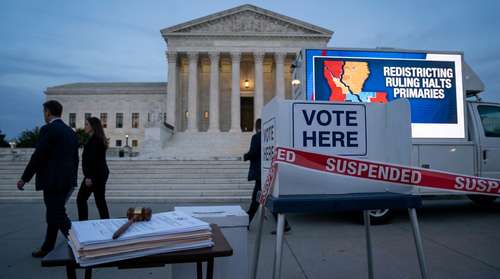
The political landscape for the upcoming midterm cycle was just thrown into uncharted territory. In a historic and highly controversial move, the U.S. Supreme Court’s landmark 6-3 conservative majority ruling in Louisiana v. Callais has triggered nationwide shockwaves, granting states unprecedented leeway to prioritize partisan lines over racial demographic protections. The immediate fallout? A Louisiana primary election suspended just days before voters were supposed to head to the polls.
This seismic Supreme Court redistricting ruling 2026 has effectively ignited a furious mid-decade redistricting battle, sending several state legislatures into an abrupt scramble to redraw congressional maps. With control of Congress hanging by a thread, these last-minute voter map changes 2026 threaten to fundamentally reshape the battle for 2026 Midterm House control.
The Louisiana v. Callais Decision Explained
Handed down on April 29, the Louisiana v. Callais decision dismantled the state’s current congressional map, known as SB8. The map, which had previously been enacted to comply with the Voting Rights Act (VRA) by creating a second majority-Black district, was struck down as an unconstitutional racial gerrymander.
Writing for the majority, Justice Samuel Alito argued that compliance with Section 2 of the VRA did not justify Louisiana's use of race as a primary factor in drawing its district boundaries. Alito's opinion underscored a strict interpretation of the Fourteenth and Fifteenth Amendments, positing that race cannot predominate the map-making process without a compelling state interest. The ruling significantly raises the burden of proof for civil rights groups looking to challenge district lines, severely limiting the VRA's historical application in protecting minority voters' ability to elect candidates of their choice.
Because the decision took effect almost immediately—bypassing the standard 32-day procedural window after a May 4 order—state officials were given the green light to discard their current districts right in the middle of an active election cycle. For election law experts, the decision represents a definitive departure from decades of established precedent, drastically reducing the avenues available to combat systemic voter dilution.
Chaos at the Polls: Louisiana Primary Election Suspended
Following the high court's mandate, Republican Governor Jeff Landry issued a stunning executive order on April 30 to pause the state’s upcoming May 16 congressional primaries, pushing them back to at least July 15. The move came after Secretary of State Nancy Landry certified an "electoral emergency," citing the invalidated maps.
The logistical nightmare for voters is already unfolding. At the time of the suspension, over 100,000 Louisianians had cast early votes, and roughly 42,000 absentee ballots had been submitted. State officials have confirmed that while other local races and the GOP Senate primary will proceed as planned, any votes cast for the U.S. House of Representatives will simply not be counted.
Unsurprisingly, this abrupt halt has triggered immediate legal retaliation. The American Civil Liberties Union, partnering with the NAACP and the League of Women Voters, filed a lawsuit in Baton Rouge state court on May 1 to block the suspension. They argue that a judicial ruling does not meet the state law definition of an emergency—which historically applied only to natural disasters—warning that tossing tens of thousands of active ballots disenfranchises the electorate.
A Nationwide Mid-Decade Redistricting Battle
The implications extend far beyond Baton Rouge. This latest gerrymandering Supreme Court news has emboldened lawmakers across the South and beyond to aggressively rewrite the electoral playbook. Historically, maps are largely settled shortly after the decennial census, but the new legal standard has opened the floodgates for a nationwide mid-cycle scramble.
Other states are already maneuvering to capitalize on the precedent. In Florida, Governor Ron DeSantis recently pushed through a revised congressional map designed to expand Republican advantages, drawing intense local opposition. Tennessee legislators also passed new gerrymandered lines, and officials in South Carolina and Alabama are reportedly racing to adjust their districts before the fall campaigns officially kick off.
Conversely, the partisan battles have sparked action on both sides of the aisle, though not always successfully. A recent 4-3 ruling from the Virginia Supreme Court just struck down a Democrat-backed redistricting measure on procedural grounds. That decision reverted the state to its older maps, wiping out an effort that would have significantly favored Democratic candidates and ensuring Republicans maintain an edge in the state's delegation.
Shifting the Odds for 2026 Midterm House Control
Both parties are painfully aware of the high stakes. Before April, historical trends and polling indicated a highly competitive environment where Democrats held a realistic chance of reclaiming the lower chamber. Now, the sheer volume of aggressive voter map changes 2026 could effectively erase those odds.
Political analysts note that by aggressively capitalizing on the Louisiana v. Callais precedent, Republicans could net up to ten additional House seats nationwide purely through redistricting maneuvers. Such a gain would provide a massive buffer against potential electoral losses, heavily tilting the scales for 2026 Midterm House control.
As civil rights organizations scramble to navigate the narrowed protections of the Voting Rights Act, the coming weeks will determine whether these emergency map revisions hold up to lower court scrutiny. What remains undeniable is that the conventional rules of electoral mapping have been rewritten, leaving voters, candidates, and election officials to navigate the resulting turbulence.