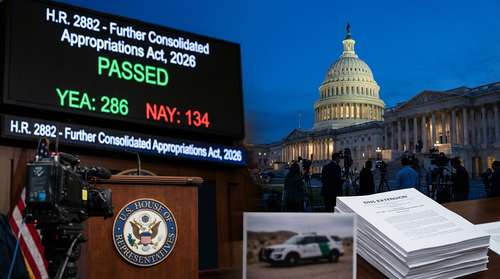
The U.S. House of Representatives narrowly passed a massive $1.2 trillion spending package on Tuesday, ending a partial government shutdown that had paralyzed federal operations since the weekend. The bipartisan vote of 217-214 clears the way for most government agencies to operate through September, but the deal comes with a volatile caveat: a short-term, two-week funding extension for the Department of Homeland Security (DHS), setting the stage for a high-stakes showdown over immigration enforcement in mid-February.
Shutdown Ends, But a "Two-Week Fuse" Remains
In a dramatic Tuesday session, Speaker Mike Johnson secured the passage of the government shutdown 2026 funding bill by relying on a coalition of Republicans and a pivotal group of 21 moderate Democrats. The final tally saw 21 GOP hardliners defect, joining the vast majority of Democrats in opposition, though for vastly different reasons. President Trump signed the legislation late Tuesday night, declaring it a "great victory," though the temporary reprieve for DHS ensures that the political ceasefire will be short-lived.
While the legislation secures full-year budgets for the Pentagon, Labor, Health and Human Services, and other key departments, the DHS two-week extension acts as a legislative fuse. Funding for the department is now set to expire again on February 13, forcing Congress to immediately return to the negotiating table. The stopgap measure was necessary to break a deadlock in the Senate, where negotiations had stalled over demands for sweeping reforms to Immigration and Customs Enforcement (ICE).
Minnesota ICE Shootings Spark Legislative Revolt
The ICE funding debate has become the central fault line in Washington following a series of tragic events in the Midwest. The demand for stricter DHS oversight stems directly from the recent Minnesota ICE shooting incidents that have galvanized Democratic opposition. On January 7, 37-year-old Renee Nicole Good was fatally shot by an ICE officer in her vehicle. Less than three weeks later, on January 24, Alex Pretti, a 37-year-old ICU nurse, was killed by federal agents during a protest in Minneapolis.
These incidents have sparked outrage among progressives and prompted calls for "guardrails" on federal immigration enforcement. Senate Democrats and House progressives are now demanding that any long-term DHS funding bill include requirements for body-worn cameras, stricter warrant protocols, and de-escalation training. "We cannot sign a blank check for an agency operating without accountability," said Rep. Mike Levin (D-CA), who voted against the package.
The Vote by the Numbers
The precarious nature of Speaker Johnson's majority was on full display during the House vote immigration debate. The breakdown of the 217-214 vote revealed deep fractures within both parties:
- Support: 196 Republicans and 21 Democrats voted "Yes."
- Opposition: 21 Republicans and 193 Democrats voted "No."
House Minority Leader Hakeem Jeffries led the Democratic opposition, arguing that the two-week punt failed to address the core concerns regarding the Minneapolis ICE crackdown. Conversely, the conservative Freedom Caucus members who voted "No" argued the spending levels were too high and failed to secure aggressive enough border policies.
What's Next: The February 13 Cliff
With the 1.2 trillion spending package now law, the immediate threat of a broad shutdown has passed, but the clock is already ticking on the next crisis. Lawmakers have less than ten days to craft a DHS appropriations bill that can pass a divided Congress. The upcoming negotiations will focus entirely on the ICE funding debate.
Democrats have signaled they will withhold support for a full-year DHS bill without the inclusion of the requested oversight measures. Meanwhile, President Trump has urged Republicans to "stay united" and resist policy changes that would restrict enforcement operations. As the February 13 deadline approaches, the nation faces the prospect of a targeted DHS shutdown if a compromise on immigration policy cannot be reached.