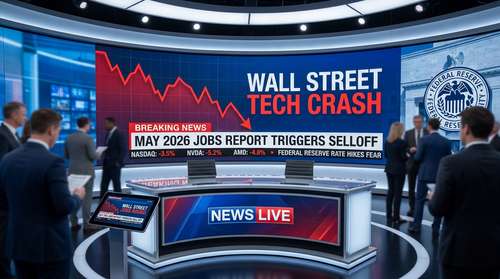
In a classic case of "good news is bad news," Wall Street experienced a brutal awakening on Friday. The much-anticipated May jobs report 2026 delivered an unexpected blockbuster performance, revealing that the U.S. economy added a staggering 172,000 jobs. While Main Street might celebrate this resilient hiring pace, financial markets responded with sheer panic. The data triggered a massive stock market selloff, unwinding months of optimism and sending high-flying technology shares into an aggressive tailspin.
Decoding the US Labor Market May 2026 Data
The latest figures from the Bureau of Labor Statistics absolutely demolished economists' consensus estimates, which had projected a modest gain of around 88,000 positions. Instead, the US labor market May 2026 snapshot showed broad-based economic strength, with the national unemployment rate holding remarkably steady at 4.3%. Hiring was particularly robust across the leisure and hospitality, healthcare, and government sectors.
The robust report didn't just surprise forecasters; it fundamentally challenged the narrative that higher borrowing costs were finally chilling corporate expansion. However, rather than cheering the economic resilience, traders immediately recognized the darker implications for monetary policy. A labor market running this hot threatens to keep consumer demand elevated, which in turn fuels the exact inflationary pressures policymakers have been desperately trying to cool.
Nasdaq Tech Crash and the Trillion-Dollar Wipeout
The immediate casualty of this labor data was the technology sector. The resulting Nasdaq tech crash saw the index plummet by over 4%, marking its worst single-session decline since April 2025. Investors rapidly liquidated their positions in growth-oriented assets, pivoting toward defensive safe havens as borrowing cost fears surged.
Nowhere was the financial pain more acute than in the semiconductor and artificial intelligence space. A severe Nvidia AMD stock drop helped erase more than $1 trillion in market value from chip stocks alone. Leading innovators that had propelled the broader market to record highs suddenly found themselves at the epicenter of the carnage. The S&P 500 snapped an impressive nine-week winning streak, shedding nearly 2% in a violent rotation out of momentum trades. For technology companies, whose lofty valuations rely heavily on the promise of cheap future capital, the prospect of prolonged tight monetary conditions is a worst-case scenario.
The Looming Threat of Kevin Warsh Fed Rate Hikes
To understand the severity of the stock market selloff, you have to look at the shifting power dynamics in Washington. Newly sworn-in Federal Reserve Chair Kevin Warsh is now caught in a high-stakes economic crossfire. Early this year, the market had confidently priced in multiple rate cuts. Now, surging oil prices tied to geopolitical conflicts and the implementation of new trade tariffs have sharply altered the global inflation trajectory.
The blowout employment numbers essentially tie the central bank's hands. Wall Street is rapidly pricing in the likelihood of Kevin Warsh Fed rate hikes. Futures markets, which had previously bet on a dovish pivot, abruptly shifted on Friday. According to CME data, traders now see a nearly 70% probability that the central bank will actually raise interest rates by the end of 2026—a stark reversal from expectations just weeks ago.
A Credibility Test for the Central Bank
The timing couldn't be more critical. Warsh faces an immediate institutional credibility test. While political pressures mount for a more accommodative stance to spur growth, the underlying economic data is screaming for restraint. If the labor market is consistently generating 172,000 jobs a month with unemployment sitting comfortably at 4.3%, the traditional justification for easing vanishes entirely.
What This Means for Federal Reserve Interest Rates
The immediate repricing of Federal Reserve interest rates sent severe shockwaves through the bond market. The benchmark 10-year Treasury yield surged past 4.5% immediately following the jobs report, while the 2-year yield spiked to roughly 4.13%. When risk-free government bonds offer these kinds of guaranteed returns, the mathematical appeal of investing in volatile, high-growth tech stocks evaporates rapidly.
This structural shift in the bond market explains why the current tech rout feels fundamentally different from routine profit-taking. Investors aren't just selling because shares were overbought; they are aggressively recalibrating their portfolios for an environment where capital remains expensive.
If the May jobs report 2026 is any indication, the U.S. economy remains incredibly resilient, but that strength comes with a heavy price tag for equities. Until there are definitive signs that the labor market is cooling enough to bring inflation back down to the 2% target, the specter of higher borrowing costs will continue to cast a long, chilling shadow over Wall Street.