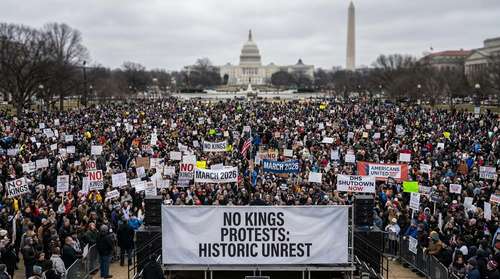
An estimated nine million Americans flooded the streets this weekend for the No Kings protests March 2026, cementing the mobilization as the largest protest in American history. Driven by mounting fury over the sudden military escalation in the Middle East and lethal immigration enforcement actions, the massive crowds paralyzed major cities from coast to coast. Simultaneously, the political landscape in Washington has fractured. The Department of Homeland Security remains gutted by the longest partial government shutdown on record, leaving critical security and emergency agencies operating without pay as a fierce legislative standoff continues.
Millions Mobilize in the Largest Protest in American History
Organizers from the 50501 Movement and the Indivisible coalition reported staggering turnout for the third iteration of the No Kings demonstrations. With over 3,300 coordinated events globally and in all fifty states, the sheer scale of the mobilization dwarfed previous civic actions. While local law enforcement in cities like New York reported relatively peaceful marches with appearances by high-profile civil rights leaders, the broader national picture was dominated by No Kings movement arrests.
In major metropolitan hubs and border states, clashes erupted near federal buildings and immigration detention centers. Specialized riot units were deployed in several cities to clear thoroughfares, resulting in the mass detentions of activists attempting to block federal vehicles and disrupt ICE staging areas. Law enforcement agencies executed thousands of arrests over a 48-hour period, a development that organizers argue validates their concerns regarding excessive state power.
The flagship demonstration took place in St. Paul, Minnesota, where more than 50,000 people converged on the State Capitol. The location served as a solemn focal point following the January killings of American citizens Renée Good, Keith Porter, and Alex Pretti by federal immigration agents. Protestors carried makeshift memorials, demanding immediate accountability for the agencies involved and an end to what organizers describe as unchecked executive branch overreach.
2026 Iran War Protests Fuel Nationwide Defiance
While previous mobilizations focused heavily on domestic immigration policy, the demographic makeup of this weekend's crowds shifted significantly. The newly sparked conflict in the Middle East transformed the rallies into massive 2026 Iran war protests. Veterans groups, student organizations, and anti-war advocates marched alongside labor unions to condemn the unilateral military action.
The convergence of these distinct grievances has created an unprecedented pressure campaign. Demonstrators from Seattle to Philadelphia carried signs reading 'No War, No Kings,' bridging the gap between foreign policy outrage and domestic civil rights demands. Protest leaders have emphasized that launching a major overseas offensive without explicit congressional approval violates foundational constitutional boundaries, a sentiment that resonated loudly across the thousands of individual rallies.
DHS Shutdown Updates: The Government Shutdown Longest Duration
As millions marched across the country, lawmakers in Washington failed to resolve the crippling funding lapse paralyzing the Department of Homeland Security. Now entering its seventh week after beginning on February 14, this crisis officially marks the government shutdown longest duration for a specific federal agency in modern history.
The legislative deadlock deepened late Friday evening. The Senate managed to broker a 2 a.m. off-ramp deal that would have reopened most DHS operations while strategically excluding specific funding for Immigration and Customs Enforcement (ICE) and select Border Patrol divisions. However, House conservative leadership swiftly rejected the Senate-brokered compromise. Representatives demanded that any funding measure must fully restore ICE appropriations and include a controversial voter ID provision, effectively killing the bill on arrival and leaving the agencies in operational limbo.
TSA Walkouts and Security Crises
The on-the-ground reality of the funding freeze is becoming increasingly dire for everyday Americans and federal workers alike. Over 100,000 DHS employees are currently working without pay. The Transportation Security Administration (TSA) is experiencing a severe internal crisis, with daily call-out rates spiking to 55% at major aviation hubs like Houston.
Union representatives indicate that over 400 TSA agents have resigned entirely, citing their inability to pay for basic necessities like rent, gas, and groceries. Consequently, travelers are facing record-breaking, multi-hour security lines that stretch outside terminal doors. Concurrently, the Federal Emergency Management Agency (FEMA) watches its disaster relief funds rapidly deplete just ahead of peak storm seasons.
A Defining Moment for Trump Administration 2026 News
These converging, simultaneous crises represent a historic stress test for the current White House. Managing the largest public outcry in the nation's history while presiding over a shattered homeland security apparatus leaves the administration with few easy legislative or political maneuvers. Searching for top Trump administration 2026 news yields a landscape dominated almost entirely by the fallout from these dual domestic and international flashpoints.
The White House has publicly dismissed the protests as the product of 'leftist funding networks,' with spokespeople claiming the demonstrations lack genuine public support. Yet the vast geographic spread of the demonstrations—including massive registration surges in deep-red, conservative-leaning states—suggests a much deeper and more systemic frustration taking root among the electorate.
As the new week begins, all eyes remain fixed on the House of Representatives. With federal workers missing their second consecutive paychecks and domestic unrest showing zero signs of cooling, lawmakers face immense pressure to break the stalemate. Until a workable compromise materializes, the nation remains caught between paralyzed federal security operations and city streets filled with millions of citizens demanding fundamental change.